

I was diagnosed Autistic at 39, given a brochure, and told to start Cognitive Behavioral Therapy, which I would need to do for the rest of my life.
My diagnosis explained some things, but did not come with an Autistic life. That didn’t come until I started to get to know other Autistic people.
It took me a decade to figure out what being Autistic meant when nobody was assessing me: how I worked, what exhausted me, why certain interests consumed me, what I needed from other people, and which parts of myself I had spent decades treating as problems because other people did.
New research on adults diagnosed after 50 suggests that process is what determins whether you are thriving or surviving as an Autistic person. In a study published this month in the journal Autism, Jennifer A. Kirton, Angela Tod, and Tony Ryan interviewed 14 people between the ages of 50 and 73 about their lives after diagnosis. While all of these people considered their diagnoses beneficial, their subsequent experiences differed considerably depending on whether or not they connected with an Autistic community.
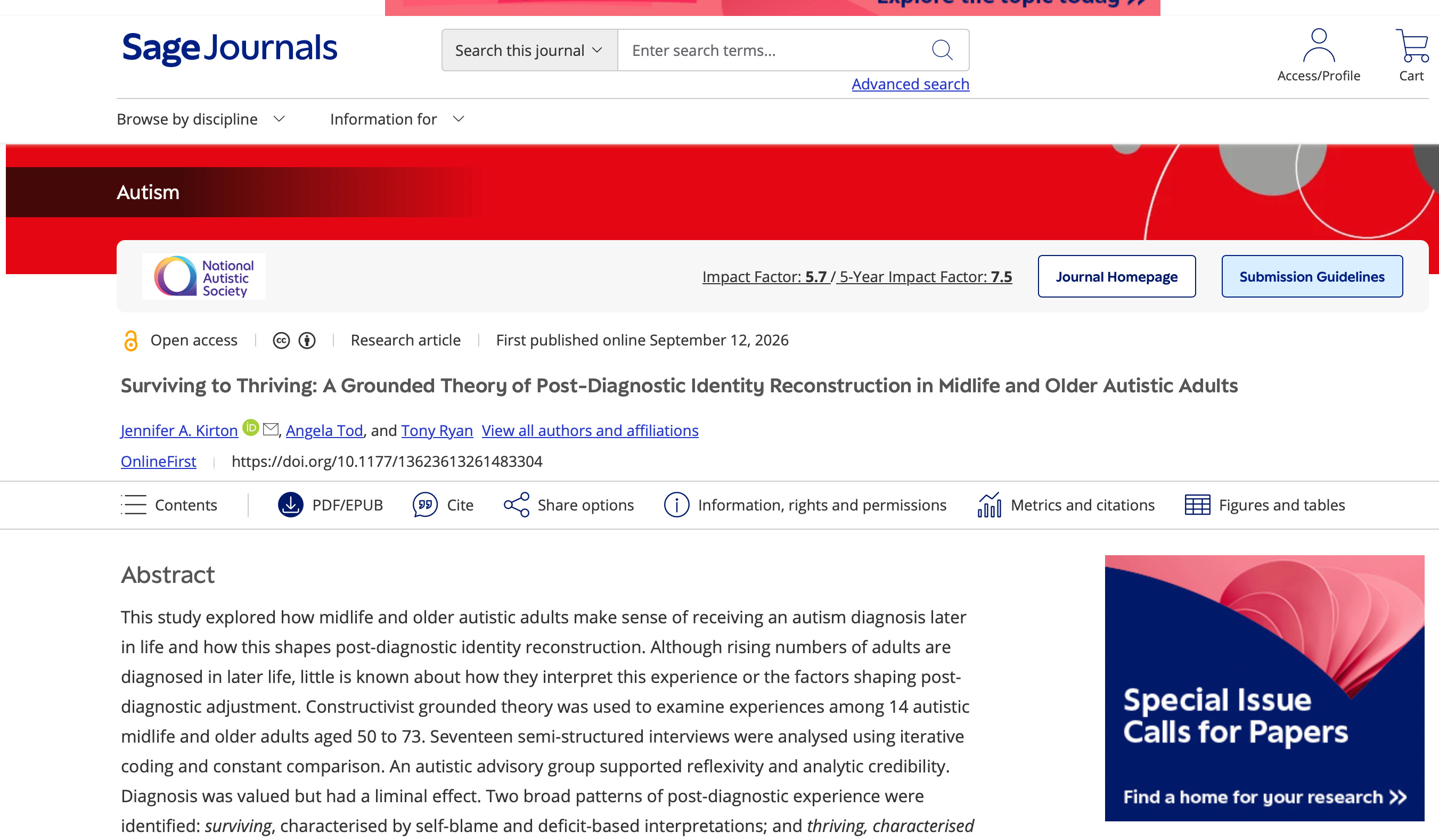
The researchers identified two broad patterns, which they called “surviving” and “thriving.” People in the surviving group continued to describe themselves through self-blame and deficit-based understandings of autism. People in the thriving group described a deeper sense of self-compassion and, most importantly, they had reorganized their lives around an understanding of themselves as Autistic.
The people who were thriving had positive connections with people who had a strong Autistic identity, they had connected with Autistic communities, and they continued making sense of themselves through that knowledge.
For some, like for me, that process took years.
Community Without Having to Enter a Room
The age of the participants in Kirton’s study makes the question of access particularly interesting. All were over 50.
Finding an Autistic peer community at 55 or 65 can present practical problems that are different from finding one at 20. Someone may have spent decades building a life around non-Autistic expectations. They may live somewhere without an Autistic social group. They may have mobility, sensory, communication, work, or caring constraints. Walking into a room full of strangers may itself be inaccessible.
There is also no requirement that somebody who has just discovered they are Autistic immediately become a joiner.
That is part of the reason Simon Scott and I created the Autistic Culture Podcast Network (ACPN). Podcasts offer another kind of commuity. One we think is more accessible to some people.
On ACPN, you can listen to Autistic people talk about music. Writing. Theatre. Creativity. Spirituality. Hobbies. Identity. Health. Relationships. Sports. Film. You name it!
You can listen alone.
You can listen while driving, walking the dog, lying in bed, cooking dinner, or recovering from a day in which you have already spoken to enough people.
Nobody asks you to introduce yourself.
Nobody asks for eye contact.
Nobody notices if you pause halfway through an episode and return three days later.
You can simply have Autistic people in your ears.
Why We Built a Podcast Network
The network does not teach a newly diagnosed person the correct way to be Autistic. There isn’t one, obvi.
What we can do is supply examples.
Currently, we have more than 25 Autistic hosts who offer dozens of different ways of being an Autistic person. With co-hosts, guests, and network growth, those examples multiply. Different countries, genders, ages, interests, communication styles, professions, politics, senses of humor, support needs, and obsessions begin accumulating into something much harder to mistake for a diagnostic stereotype.
Our listeners get to notice where recognition happens for them.
The subject changes completely from one show to another, but they are all created with Autistic people at the center. Creating shows by and for Autistic people is an antidote to a lifetime of content that is created about Autistic people by people speaking for us.
Only 30% of our shows are directly about autism, and that distinction is fundamental to our work at the Autistic Culture Institute. If the only time you encounter another Autistic person is when somebody is discussing the symptoms, difficulties, treatments, or politics of Autism, you might be learning about a diagnostic category. We are MORE than our diagnosis, more than our neurotype even.
Being Autistic is part of our culture, but it’s not all of it. Being Italian-American and wearing clothes with the Italian flag on it is a PART of my Italian-American culture, but it’s not all of it. Cannoli, Mt. Vesuvius, and Italian Horn necklaces and dancing the tarentella are all parts of our culture that I love that extend beyond my Italian DNA.
Culture also happens when people talk about the things they love.
I can learn something about another Autistic person from hearing how intensely they know a musician’s catalogue, how they construct a fictional world, how they approach writing, what they notice in a piece of theatre, or the particular rabbit hole that has occupied them for six months.
Nobody has to stop the conversation and explain, “This is an example of Autistic pattern matching.”
They are simply doing it.
This is part of what it means to encounter positive constructions of Autistic identity. Autistic people appear as hosts, critics, artists, writers, experts, fans, interviewers, storytellers, and extremely enthusiastic people with microphones.
Autism does not disappear, it just stops being the only interesting thing about us.
Put Autistic people in your ears
Someone who discovers at 55 that they are Autistic may have no idea where to find another Autistic adult. There may be no local group. An available group may not feel right. Work, caring responsibilities, disability, geography, or sensory needs may make attending one difficult.
A person may simply have no desire to walk into a room full of strangers and discuss their autism. A lot of that is because of internalised ableism, but undoing that doesn’t come with a diagnosis. It’s a process.
A podcast asks considerably less of you. You can listen while driving or cooking. You can listen in bed. You can stop halfway through an episode if it gets uncomfortable or just boring. You do not have to introduce yourself or explain why you are there.
You can have Autistic people in your ears before you are ready to have Autistic people in your living room.
For someone who has spent five or six decades assuming that almost everyone around them experiences the world more or less as they do, repeated exposure to other Autistic people can provide a different reference point.
Our Community Changes the Stories Available to Us
We need information about ourselves before we can shift our perceptions of who we are. We need opportunities to reconsider the explanations we’ve carried for decades. We need to encounter Autistic lives that are recognizable without being identical to their own.
This matters because many people diagnosed after 50 have spent half a century receiving other explanations.
Too sensitive.
Too intense.
Too difficult.
Too obsessive.
Too antisocial.
Too much.
A diagnostic assessment can replace some of those explanations with a word.
Autistic.
Then you have to discover what that word can contain.
The point of a cultural network is not to produce a model Autistic person. It is to make the variety harder to miss.
This new study describes positive Autistic narratives as part of the process associated with thriving. I think the word positive can be misunderstood here. A healthy Autistic narrative does not require every Autistic person to be happy, successful, or inspirational. It leaves room for disability, difficulty, dependence, burnout, loneliness, and frustration. It also leaves room for an Autistic person to spend an hour talking about theatre.
The researchers argue that adults need more support after diagnosis. They recommend identity-affirming information, opportunities to connect with the Autistic community, and continuing opportunities to make meaning from a newly understood identity.
They specifically point toward Autistic-led programs combining peer support and psychoeducation.
For a newly identified Autistic person, ordinary Autistic lives can be surprisingly difficult to find.
I know what it is like to spend decades without an explanation and finally receive one. I also know that the life I have now did not arrive with my diagnostic report.
I had to meet Autistic people.
With ACPN there is another way to hear those voices and meet those people while you are still in the chyralis phase.
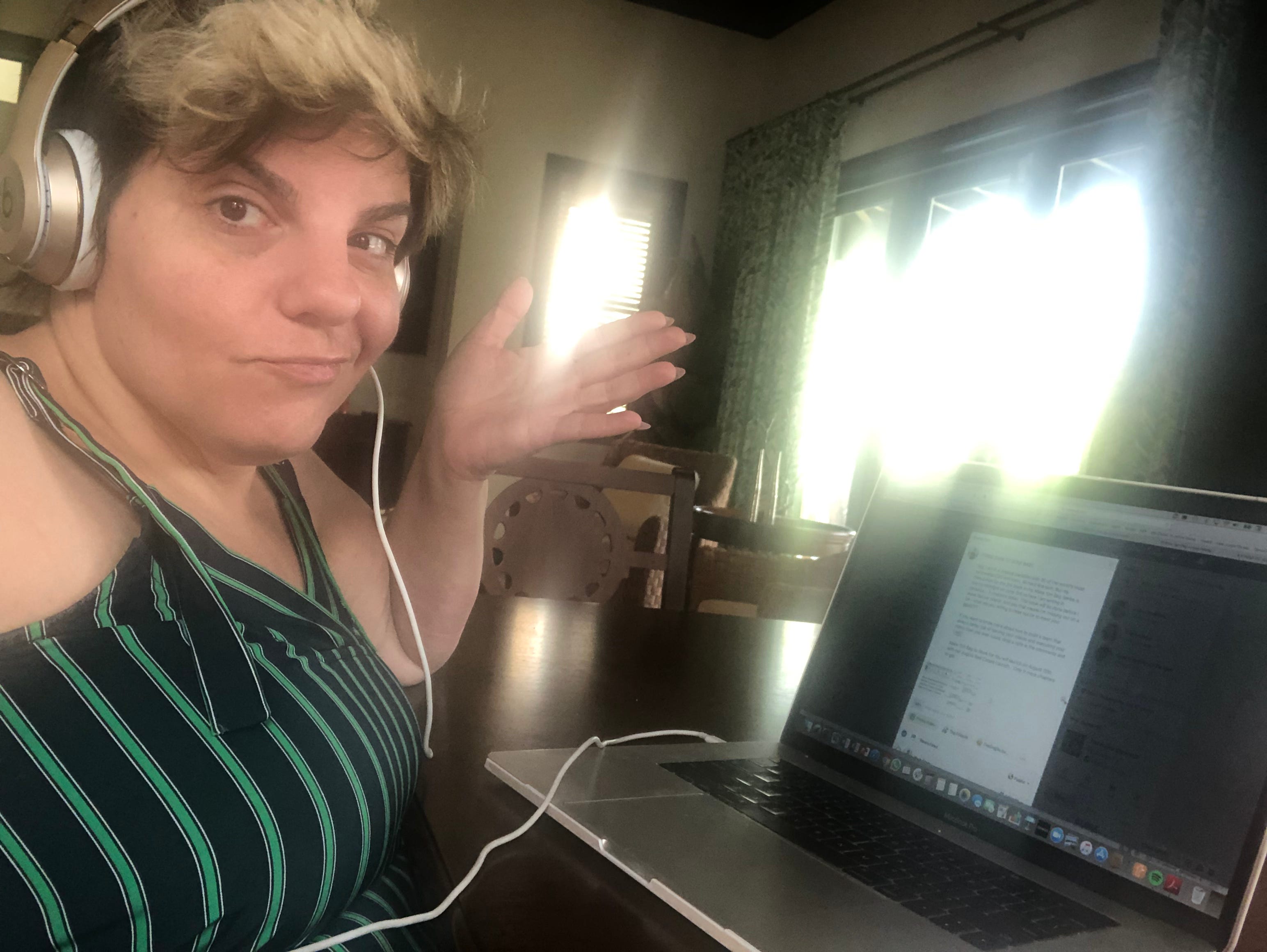
Just put on your headphones and listen to Autistic people talk about something they love.