


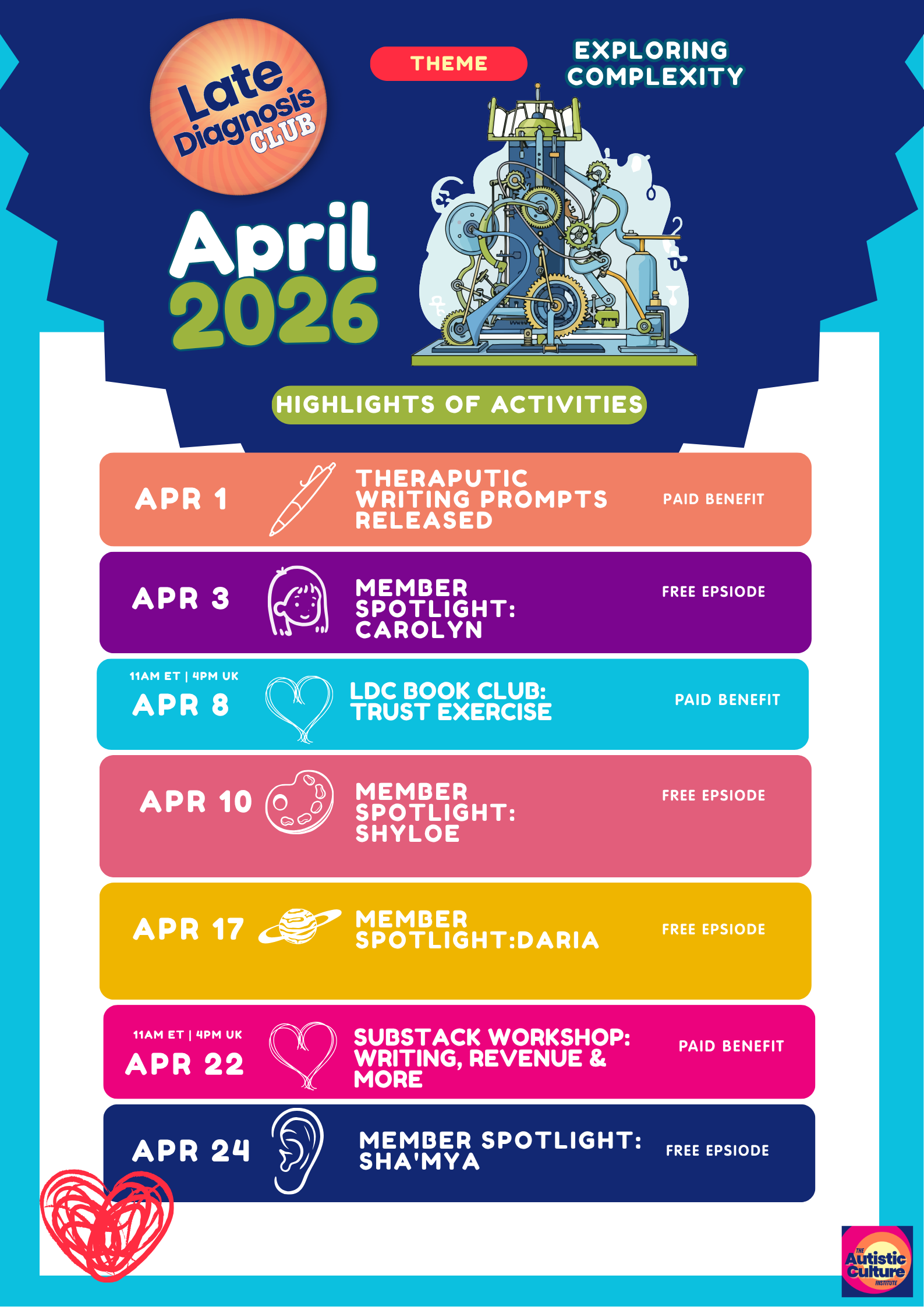
This month in the Late Diagnosis Club, we are exploring complexity and internal contradictions, the parts of ourselves that do not add up neatly, the experiences that resist simple telling, and what happens when we stop trying to make them make sense.
The Complexity We Were Told to Hide
There is a particular kind of exhaustion that comes not from doing too much but from explaining yourself too many times to people who were never going to understand anyway. Most neurodivergent adults who discover their identity later in life know this exhaustion intimately. It lived in the gap between who they actually were and the version of themselves they had learned to present. It accumulated in every diagnostic report that missed the point, every performance review that rewarded the mask, every relationship where love was conditional on staying legible.
What late diagnosis tends to surface, among many things, is the realization that the complexity was never the problem. The problem was the pressure to resolve it.
Neurotypical culture has a strong preference for coherence. It wants people to be one thing at a time, consistent across contexts, readable at a glance. It rewards simplicity of presentation even when the inner life is anything but simple. For neurodivergent people, whose experience is often characterized by intense and sometimes contradictory inner states, this creates a particular kind of double bind. The more honestly you present yourself, the more difficult you become to categorize. The more you simplify yourself for legibility, the further you drift from anything that feels true.
This is not a personal failing. It is a structural mismatch between a culture organized around surfaces and a neurotype organized around depth.
Research into autistic experience consistently points to the richness and intensity of inner life as a core feature rather than a peripheral one. Autistic people tend to process experience from the bottom up, accumulating detail, sensation, and meaning before arriving at a conclusion, which is the opposite of the top-down shortcutting that neurotypical social environments tend to reward. This means that the autistic interior is, by design, more complex and slower to resolve than the world generally has patience for. The result, for many people, is a lifetime of being told in various ways that their inner experience is too much, too specific, too contradictory, or simply unverifiable.
What is less often discussed is what happens when that pressure is removed.
When neurodivergent people find communities, frameworks, and creative practices that make room for the full complexity of their experience, something significant tends to happen. Not resolution. Not simplification. Something closer to integration. The contradictions do not disappear. The grief and the humor coexist. The anger and the tenderness coexist. The exhaustion and the capacity for deep joy coexist. What changes is the relationship to the complexity itself. It stops being evidence of dysfunction and starts being evidence of depth.
Therapeutic writing is one of the most reliable routes to that shift. There is substantial research supporting expressive writing as a tool for processing difficult experience, reducing psychological distress, and building coherent self-narrative. But for neurodivergent writers in particular, the value goes beyond processing. Writing that does not demand resolution, writing that allows contradiction to remain on the page without forcing it into a lesson, offers something that most official systems never provided: a form that is large enough to hold the actual experience.
This is what the hermit crab essay does, and what spoken word poetry does, and what the best autistic memoir does. It borrows or builds a container that is honest enough to hold a life that did not fit the available categories. It says: the complexity was always real. It was always worth documenting. It just needed a form that was not afraid of it.
That is what we are practicing this month. Not tidying up our contradictions. Not resolving our complexity into something more palatable. Writing from inside it, with honesty and without apology, and seeing what we find when we stop trying to make ourselves smaller than we actually are.
This is what we’ll explore together in the Late Diagnosis Club in April. We meet live 5 times on Zoom, with cameras always optional, for a member infodump session, a workshop, a book club discussion of Trust Exercise, a surprise guest speaker, and it all starts with a therapeutic writing session with Neurodivergent Narratives editor Libby Banks.
If you are not already a supporting member, just click "upgrade" in the top right-hand corner on the AutisticCulture.substack.com page. No one is ever turned away who wants to join and can’t afford it. Paid members also get to participate in our Virtual Writing Circle, Book Club, monthly workshops, and our Member Infodump. We’d love to have you check it out. Come for a week and stay for the fun and friendships.
If you are already a member, keep reading for the members’ only schedule for the month.
