


FIELD REPORT [002]
ARTIFACT: DUNE
ARCHIVE NO: ACA-002-DUNE
PERIOD: 1965 / Present
CLASSIFICATION: AUTISTIC CULTURE
PRIMARY PILLARS: World Building · Pattern Matching · Passionate Superfanning
ADDITIONAL TRACES: Bottom-Up Processing · Boldly Creating · Predictably Comforting · Rhythmic Communicating · Justice Seeking · Game Changing
LEAD EXCAVATOR: Simon Scott
ACCOMPANYING EXCAVATOR: Dr Angela Kingdon
LISTEN TO THE EXCAVATION
This Field Report accompanies our excavation of DUNE on This Week in Autistic Culture.
The Archive segment presents the case.
The Field Report contains the evidence locker.
Listen to the full excavation on the Autistic Culture Podcast Network.
Watch the full excavation on our YouTube channel: https://www.youtube.com/@AutisticCulturePodcast
THE DISCOVERY
What The Lord of the Rings is to fantasy, Dune is to science fiction, but what happens when we examine Dune through the Rosetta Stone of Autistic Culture?
It becomes really interesting. Special interest-interesting.
Frank Herbert’s Dune is an enormous world. But what fascinates me isn’t simply the size of the world Frank Herbert created. It’s how that world works.
There’s World Building everywhere. There’s Pattern Matching and Bottom-Up Processing built into the way the book actually asks you to read it. There’s Predictably Comforting, Justice Seeking, Game Changing, Passionate Superfanning — and even Rhythmic Communicating, when we get into things like Fremen ritual and the Litany Against Fear.
Everything is connected.
Ecology connects to politics.
Politics connects to economics.
Economics connects to religion.
Religion connects to psychology, language and history.
And Herbert expects you, as the reader, to gather these individual pieces, hold onto them, recognise the patterns and gradually understand the enormous system underneath it all.
THE ARTEFACT
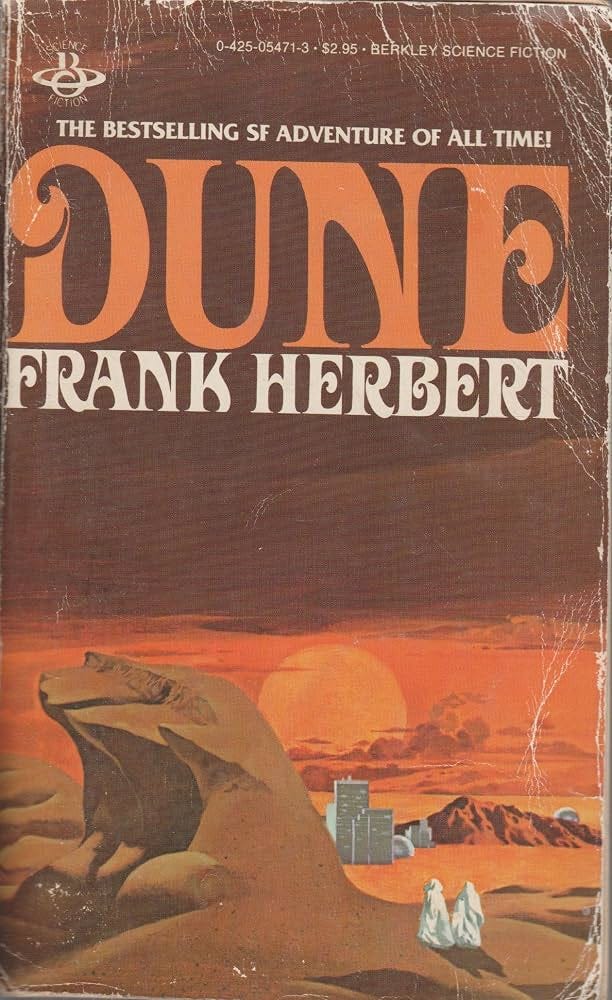
Frank Herbert’s Dune was published in 1965, after first appearing in serial form as Dune World and Prophet of Dune. It went on to win the inaugural Nebula Award for Best Novel, share the Hugo Award and become one of the most successful science-fiction novels ever published.
And it started with sand.
In 1957, Herbert travelled to Florence, Oregon, where the US Department of Agriculture was experimenting with ways of stabilising moving dunes using grasses.
Herbert planned to write a magazine article about what he found.
The working title was “They Stopped the Moving Sands.”

He never finished it. Instead, the research became something much bigger.
Sand led Herbert towards ecology. Ecology led towards questions of resources and scarcity. Those questions opened into politics, religion, power, psychology and the relationship between human beings and their environment.
Eventually, the unfinished article became part of the foundations of Dune.
And I think that’s an appropriate place for our excavation to begin, because Dune is a story in which almost nothing can be understood on its own.
You can’t really understand the spice without understanding the desert.
You can’t understand the desert without understanding the great sand worms.
You can’t understand the worms without understanding the ecology of Arrakis.
And once you understand why the spice matters, you’re suddenly dealing with economics, politics, religion, colonialism and the balance of power across an entire civilisation.
Pull one thread, and you discover another.
Which is also a fairly accurate description of what happened when I started researching this episode.
I’ve always loved worlds with depth. I want to know what’s behind the door the story doesn’t open. I want to understand why something works, where it came from and what connects it to everything else.
Dune doesn’t punish that instinct.
It rewards it.
The further down you go, the more there is to find.
So when Angela and I decided to begin this new expedition into Autistic Culture, there was something wonderfully appropriate about making our first artefact a book that began because one man went to look at some sand...
and kept digging.
ARTEFACT RECOVERED: DUNE
THE EXCAVATION
PATTERN MATCHING + PREDICTABLY COMFORTING
“There is in all things a pattern that is part of our
universe. It has symmetry, elegance, and grace - these qualities you
find always in that the true artist captures. You can find it in the
turning of the seasons, the way sand trails along a ridge, in the
branch clusters of the creosote bush of the pattern of its leaves. We
try to copy these patterns in our lives and in our society, seeking
the rhythms, the dances, the forms that comfort. Yet, it is possible
to see peril in the finding of ultimate perfection. It is clear that
the ultimate pattern contains its own fixity. In such perfection, all
things move towards death.”
Herbert’s passage finds patterns in seasons, sand and plants and describes humans reproducing patterns in our lives and societies, seeking rhythms and forms that provide comfort. But then Herbert warns about what happens when a pattern becomes completely fixed.
This gives you two pillars almost explicitly:
Pattern Matching
Finding structures and relationships within apparently disconnected
information.
Predictably Comforting
Creating repetition, rhythm and familiar structures because they provide security. But Herbert immediately complicates it:
What happens when the pattern becomes too fixed?
Keep that question open. Because it becomes Paul’s entire story!
DUNE TELLS YOU WHAT’S GOING TO HAPPEN
Every chapter opens with an epigraph from fictional historical writings
--- frequently Princess Irulan.
Biography. History. Philosophy. Religious commentary. Quotations. But these texts are written after the events we’re currently reading.
So the reader frequently knows where Paul’s story is going - again, the pattern is fixed. The epigraphs deliberately foreshadow events and create a gap between knowing an outcome and understanding how that outcome occurs.
MY OBSERVATION
Paul experiences the present while seeing possible futures. We experience Paul’s present while reading information written in his future. We’re almost being trained to read like Paul.
The question isn’t always: WHAT happens?
It’s: HOW do all these pieces create what we already know is going to happen?
That’s Pattern Matching!
THE BOOK EXPECTS YOU TO LEARN IT
At the beginning of Dune, Herbert throws terminology at you. You don’t
necessarily understand it. He doesn’t always stop the story to explain it. But eventually:
You’ve heard Bene Gesserit enough times.
You’ve encountered Kwisatz Haderach enough times.
You understand Mentats.
You understand the Landsraad - the assembly of noble Great Houses in the Dune universe.
You understand the cultural and ecological significance of Shai-Hulud to Arrakis and the Fremen.
THE EXPERIENCE OF READING
First: What the hell does that mean?
Then: I think I understand this.
Then: OH --- THAT’S WHAT THAT EARLIER THING MEANT.
And suddenly I wanted to go backwards. And I did!
Brian Herbert said his father believed readers could follow one layer of the novel, then reread it concentrating on an entirely different layer. Herbert intentionally left pieces that would keep readers thinking after finishing.
PASSIONATE SUPERFANNING
The book is effectively designed to reward: rereading; research;
memorisation; pattern recognition; lore; obsessive attention.
THE APPENDICES --- THE STORY ENDS, THE RESEARCH BEGINS
You finish Dune... and Herbert gives you appendices.
Ecology. Religion. History. The Great Houses. Terminology.
IMPORTANT EFFECT:
The world suddenly feels bigger than the story we’ve just read.
Scholars are studying this universe.
Historians are recording it.
Ecologists are analysing it.
Religious texts.
Books referenced by other books.
The novel feels like one surviving document from a civilisation that
actually existed.
You’re no longer simply consuming a narrative.
You’re researching a fictional culture.
And this produced one of my favourite reactions from Angela during the excavation.
When I explained that some of these appendices effectively contain scholarship written from inside Herbert’s fictional universe, she stopped me:
“He wrote books inside the world?”
Yes!
And when I explained that we’re getting ecology, history, religion and even material on sandworm biology, her response was essentially:
That might be the most Autistic thing we’ve found.
Which rather beautifully demonstrates the point.
The story has finished.
The world hasn’t.
Instead, Herbert effectively says:
If you’d like to know considerably more about all of this, I’ve prepared some additional reading.
For a reader inclined towards deep interests, that isn’t merely an appendix.
It’s an invitation.
You’re no longer simply consuming a narrative.
You’re researching a fictional culture.
That’s World Building becoming Passionate Superfanning.
APPENDIX I --- KYNES AND SYSTEMS
Ecology is not background decoration. It’s arguably Herbert’s model for how everything in Dune works.
The father of Kynes says:
“The thing the ecologically illiterate don’t realise about an
ecosystem is that it’s a system.”
The passage describes ecosystems as possessing a fluid stability and explains that disrupting one niche can cause consequences throughout the wider system. It concludes that ecology’s highest function is understanding consequences.
THIS COULD BE THE THESIS OF DUNE
Arrakis is a system.
Spice is a system.
The Imperium is a system.
CHOAM is a system.
The Space Guild is a system.
The Bene Gesserit are a system.
Religion is a system.
The Missionaria Protectiva is a system.
Paul is inserted into all of them.
And then Herbert asks: What are the consequences?
”A process cannot be understood by stopping it. Understanding must
move with the flow of the process, must join it and flow with it.”
AUTISTIC CULTURE FINDINGS
Bottom-Up Processing + Pattern Matching + World Building
Individual details matter because every detail belongs to something larger.
THE PILLARS DON’T EXIST IN ISOLATION
Something Angela noticed during our excavation was that we weren’t really finding the Pillars one at a time.
We started with World Building.
That was obvious.
It’s Dune.
But the deeper we excavated the World Building, the more we kept finding Bottom-Up Processing and Pattern Matching underneath it.
Individual details accumulate.
Relationships between those details emerge.
Patterns become visible.
Patterns become systems.
Systems become worlds.
Bottom-Up Processing → Pattern Matching → World Building.
Angela also pointed out that World Building isn’t always connected to Boldly Creating — which made its presence here more interesting rather than less.
And I think there’s something important for the Archive in that.
The Ten Pillars aren’t ten boxes we’re trying to tick.
They interact.
One can reinforce another.
Sometimes one may even appear to produce another.
Perhaps the Rosetta Stone becomes most useful not when we ask:
Which Pillars are here?
But:
How are the Pillars interacting with each other?
That’s something we’ll be watching for in future excavations!
BOTTOM-UP PROCESSING --- EVERYONE IS COLLECTING DATA
Look at how many groups understand their world through details.
MENTATS
Data → analysis → conclusion. Thufir Hawat effectively performs the role a computer might perform in another science-fiction universe. However, the book proves that incorrect conclusions can be drawn from false information and a predetermined assumption — Jessica as the traitor of the Atreides.
FREMEN
The desert looks empty to outsiders. The south is widely believed to be uninhabitable, and the estimated population is in the tens of thousands across the whole planet.
The Fremen see information.
Sand. Spice Beds. Drum Sand. Movement. Water. Wormsign. Weather. Rhythm. Environmental change. They can interpret details outsiders don’t even recognise as information.
BENE GESSERIT
Breathing. Voice. Muscle tension. Facial movement. Language. Physiology.
Genetics. Behaviour. There’s a Bene Gesserit axiom:
“If you rely only on your eyes, your other senses weaken.”
They’re trained to notice things most people filter out.
PAUL MUAD’DIB ATREIDES
Paul gets multiple systems of training. Bene Gesserit perception.
Mentat-style analysis. Political education. Combat. Then spice. The way of the Fremen. He is raised in a culture that has harnessed Sea Power and Air Power. Now he masters desert power. Then prescience. And there’s a brilliant Irulan description:
“Muad’Dib learned rapidly because his first training was in how to
learn. And the first lesson of all was the basic trust that he could
learn. It’s shocking to find how many people do not believe they can
learn, and how many more believe learning to be difficult. Muad’Dib
knew that every experience carries its lesson.”
Paul isn’t simply taught what to know. He’s taught how to learn.
Observe.
Collect information.
Recognise patterns.
Update understanding.
Adapt.
THE MISSIONARIA PROTECTIVA --- PLANTING THE SEEDS OF PROPHECY
Possibly the single strongest example of Pattern Matching in the book.
The Bene Gesserit deliberately plant myths and prophecies within cultures. Not because those prophecies are necessarily true. Because a future Bene Gesserit might need them.
Generations later: Jessica arrives on Arrakis.
Jessica recognises the religious pattern.
The Fremen recognise Jessica and Paul through the pattern.
Jessica knows what responses the pattern expects.
Paul eventually occupies the role of Lisan Al-Gaib.
The prophecy surrounding him was planted generations earlier by the Missionaria Protectiva.
THE CHAIN
Create pattern ↓
Repeat pattern culturally ↓
Pattern becomes familiar ↓
People derive meaning from pattern ↓
Jessica recognises pattern ↓
Jessica exploits pattern ↓
= Paul becomes the pattern.
This is Pattern Matching being WEAPONISED.
PREDICTABLY COMFORTING --- PROPHECY
And there’s another layer. Why does prophecy work?
Because it provides a structure for interpreting uncertainty. Something strange happens.
Instead of: We don’t know what this means.
You have: We’ve been told this would happen.
That’s Predictably Comforting.
The Bene Gesserit understand that. They manufacture familiar narratives into
which future events can be placed.
Paul doesn’t just call any sandworm worm; he calls a grandfather worm - the Fremen then recall it as the largest ever seen in the retelling of the events - as it was written.
PAUL’S PRESCIENCE --- WHEN PREDICTABILITY BECOMES HORRIFYING
Herbert writes:
“Deep in the human unconscious is a pervasive need for a logical
universe that makes sense.”
That’s almost the philosophical version of Predictably Comforting.
We want: cause → effect. Pattern. Logic. Certainty.
Paul gets closer to that than almost anybody. And discovers that it’s a curse.
Paul doesn’t simply see THE future.
He perceives possible futures - in certain key moments in the book, he states he has never seen this before, which will alter what happens next - and this terrifies him. Choices create different paths. But the more he acts upon what he sees, the more possibilities can narrow.
The thing that should provide ultimate comfort --- knowing what’s coming --- becomes a trap.
Herbert writes:
“Any road followed precisely to its end leads precisely nowhere.”
And Paul resists choosing the completely clear and safe course because he associates it with stagnation and what could result in the jihad against the universe he fears creating.
Big question that needs further investigation…
What happens when predictability stops being comforting?
An inversion of a Pillar.
Paul is trapped within Predictably Uncomfortable.
Can a Pillar become disabling when the environment or circumstances invert it?
This became one of the more unexpected discoveries during our excavation.
I asked Angela whether one of the Pillars could effectively become disabling when the environment or circumstances push it far enough in the opposite direction.
Because Paul has reached something approaching Predictably Uncomfortable.
He doesn’t suffer because he can’t identify the pattern.
He suffers because he can see too much of it.
Angela pointed out that Autistic experiences frequently seem to exist at extremes. Sensory input, for example, can be desperately avoided or intensely sought.
So perhaps Predictably Comforting has an extreme at the other end.
Predictability can regulate.
Knowing the pattern can create safety.
But what happens when you can’t escape the pattern?
What happens when knowing what’s going to happen doesn’t give you control over it?
What happens when certainty itself becomes overwhelming?
Paul gives us an extraordinary fictional version of that problem.
Predictably Comforting → Predictably Uncomfortable.
And that raises a much bigger question for future excavations:
Can a Pillar become disabling when the environment or circumstances invert it?
THE LITANY AGAINST FEAR --- SCRIPTING AS REGULATION
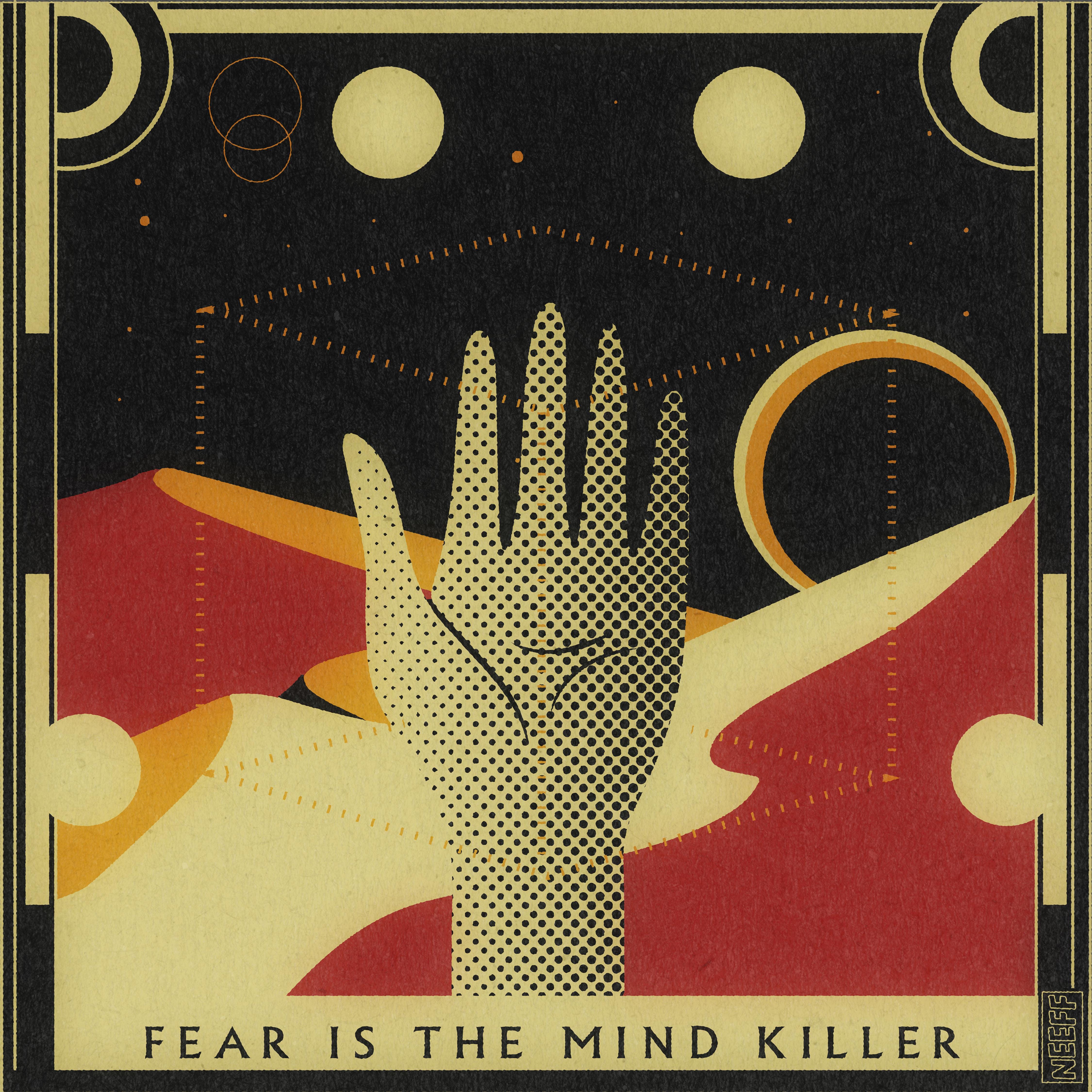
Now take the most famous quote in Dune and look at it differently.
“I must not fear. Fear is the mind-killer. Fear is the little death that brings total obliteration. I will face my fear. I will permit it to pass over me and through me. And when it has gone past, I will turn the inner eye to see its path. Where the fear has gone there will be nothing. Only I will remain.”
There is another Dune passage that fits the Gom Jabbar and the Litany
particularly well:
“The mind can go either direction under stress---toward positive or toward negative: on or off. Think of it as a spectrum whose extremes are unconsciousness at the negative end and hyperconsciousness at the positive end. The way the mind will lean under stress is strongly influenced by training.”
That makes the role of the Litany Against Fear more interesting.
Paul’s response to overwhelming stress is not presented simply as an
innate superpower.
Training, preparation, and practice matter.
The Bene Gesserit have given him a rehearsed cognitive structure to use
when the body and mind are under pressure.
Everyone knows the Litany Against Fear. But what actually is it?
A memorised sequence.
Repeated in moments of distress.
Predictable words.
Predictable rhythm.
Something to focus upon while experiencing overwhelming emotion.
AUTISTIC CULTURE FINDINGS
Rhythmic Communicating + Predictably Comforting.
This is an interesting way of reading this as scripting used for regulation.
Fear arrives. ↓
Recite familiar words. ↓
Follow familiar rhythm. ↓
Move through the experience. ↓
= Return to yourself.
The content matters. But so does the repetition.
JUSTICE SEEKING — THE FREMEN
One of the strongest connections to Justice Seeking in Dune is the Fremen themselves.
And something important to remember — particularly when we start talking about Paul as the apparent hero of this story — is that the Fremen struggle doesn’t begin when Paul arrives.
They already have a history.
A culture.
A religion.
Extraordinary ecological knowledge.
Political ambitions.
Generations of trauma and oppression.
And resistance to the people exploiting their planet.
Paul doesn’t create any of that.
He enters their story.
Arrakis is enormously valuable to the Imperium because it is the only source of spice. Yet those who actually live there exist under a succession of outside powers primarily interested in extracting that resource.
The planet is valuable.
The spice is priceless.
As Baron Vladimir Harkonnen famously puts it in the 1984 Dune Film
”He who controls the spice, controls the universe”
The Fremen themselves are largely treated as something to be controlled, underestimated or ignored.
And Herbert gradually reveals just how badly the Imperium has underestimated them.
There’s a powerful line:
“They’ve discovered they’re a people. They’re awakening.”
In this part of the story, that awakening is collective.
The Fremen aren’t simply the population that Paul arrives to rescue. They already possess the knowledge, organisation, culture and capability to become an extraordinary political force.
And I think that’s important when we’re looking at Justice Seeking, because Dune doesn’t give us a particularly simple version of justice.
There is genuine oppression.
There is exploitation.
There is colonial power.
A population with legitimate reasons to resist all of those things.
But resistance also becomes entangled with religion, prophecy, revenge, charismatic leadership and eventually enormous violence.
So Dune gives us something much more complicated than:
Oppressed people + heroic leader = Justice.
And that’s really important for what happens next.
Because Paul increasingly appears to fit the pattern of the person who’s going to deliver that justice.
The betrayed son ↓
The exiled Duke ↓
The outsider accepted by the Fremen ↓
The leader who can overthrow the Harkonnens and the Emperor ↓
The hero ↓
= The Lisan Al-Gaib.
And that’s exactly where Frank Herbert wants us to start becoming suspicious.
NOW WE HAVE TO TALK ABOUT PAUL

Up to this point, Paul looks remarkably like the classic hero. It’s almost the archetypal hero’s journey.
Except Herbert gives us this:
“No more terrible disaster could befall your people than for them to
fall into the hands of a Hero.”
And suddenly the entire story looks different.
RULERSHIP --- THE PERSON AND THE SYSTEM
Another passage worth holding beside Herbert’s warning about heroes is:
“Grave this on your memory, lad: A world is supported by four things... the learning of the wise, the justice of the great, the prayers of the righteous and the valour of the brave. But all of these things are as nothing... without a ruler who knows the art of ruling. Make that the science of your tradition!”
This creates an interesting tension inside Dune.
The novel repeatedly warns about surrendering judgement to heroic
leaders, while also taking the mechanics of leadership and rule
extremely seriously.
Learning.
Justice.
Religion.
Courage.
None exists politically in isolation; all become part of the system of
rule.
Paul is trained not merely to be extraordinary, but to understand how power operates.
That makes Herbert’s later warning about heroes complicated, not unimportant: a ruler can understand the system brilliantly and still become the centre of something catastrophic.
PAUL ISN’T NECESSARILY THE ANSWER
Herbert was explicit outside the novel that he was suspicious of heroic leaders. He described Dune in terms of the “superhero syndrome”, and later said the underlying lesson was to beware of heroes and rely upon one’s own judgement. He was deeply concerned with the mistakes of leaders becoming amplified through the number of people following them.
HERBERT ON WHAT HE WANTED READERS TO NOTICE
Herbert later stated the warning in unusually direct terms:
“Don’t give over all of your critical faculties to people in power, no matter how admirable those people may appear to be.”
That sits very naturally beside the novel’s warning about falling into
the hands of a Hero.
The important distinction is that Herbert is not simply saying, leaders
are bad.
The warning is about what happens when followers stop exercising their own judgement because the person leading them appears exceptional, admirable, destined or necessary.
MY THOUGHTS:
Maybe Dune isn’t: Look at this extraordinary hero.
Maybe it’s: Look how badly human beings want an extraordinary hero.
And look what happens when they find one.
PAUL BECOMES A PATTERN
Herbert writes that greatness depends partly upon humanity’s “myth-making
imagination”
“Greatness is a transitory experience. It is never consistent. It depends in part upon the myth-making imagination of humankind. The person who experiences greatness must have a feeling for the myth he is in. He must reflect what is projected upon him. And he must have a strong sense of the sardonic. This is what uncouples him from belief in his own pretensions. The sardonic is all that permits him to move within himself. Without this quality, even occasional greatness will destroy a man.”
And the supposedly great individual has to reflect what other people project onto them. That’s Paul.
The Bene Gesserit creates the pattern.
The Fremen inherit the pattern.
Jessica recognises the pattern.
Paul fits the pattern.
The Fremen recognise Paul through the pattern.
Then something happens: Paul stops simply being Paul Atreides.
He’s Muad’Dib. He’s Lisan al-Gaib. He’s the Mahdi; he’s a Messiah.
At what point does Muad’Dib stop belonging to Paul? Paul even acknowledges that Stilgar, the leader of the Fremen, his mentor in the ways of the Fremen and his father figure within the culture, goes from being a friend to a follower, and this saddens him.
Once thousands/millions of people believe in the symbol, does the person
inside it still control what it means?
RELIGION + POLITICS — THE MACHINE OF THE JIHAD STARTS MOVING
“When religion and politics travel in the same cart, the riders
believe nothing can stand in their way.”
Herbert’s passage then describes the movement becoming faster until
those involved cannot see the precipice. Look at Paul’s journey:
Missionaria Protectiva plants pattern ↓
Fremen recognise Paul ↓
Paul uses prophecy ↓
Religious authority grows ↓
Political revolution grows ↓
Muad’Dib becomes larger than Paul.
= Paul can no longer control what happens - and through Princess Irulan’s quotes, we see the result.
At the end, Paul understands that Fremen belief in him has become so powerful that he cannot prevent the jihad. That’s the tragedy.
The person apparently controlling the system has become trapped inside the
system.
GAME CHANGING --- PAUL UNDERSTANDS THE SYSTEM
Paul does ultimately break the existing political order. But not simply because he has the best army. He understands the dependency beneath everything.
“The people who can destroy a thing, they control it.”
The Imperium believes: Spice = wealth.
Paul sees: Spice = civilisation’s dependency.
Control of Arrakis isn’t ultimately enough.
The ability to destroy spice production creates leverage over the entire Imperium.
Pattern Matching → Game Changing
Paul sees the system. Identifies its weakest point. Changes the rules.
But in doing so, he complicates the Pillar itself.
Game Changing in this context isn’t inherently good.
Someone can recognise that a system is broken. Someone can understand exactly how to dismantle it. Neither guarantees that what replaces it will be better.
That’s an interesting complication of Game Changing itself.
PASSIONATE SUPERFANNING
Dune didn’t remain a single novel.
Herbert wrote five sequels, and after his death the universe continued expanding through further novels, films, television, games and other adaptations.
But the more interesting Autistic Culture connection is what readers do with Dune.
They learn genealogies.
They learn the Houses and political factions.
They learn terminology, religions and histories.
They debate the ecology of Arrakis and the biology of the sandworms.
They compare adaptations.
They trace Herbert’s influences.
They argue over interpretations of events that happened thousands of years before the first novel even begins.
And eventually they start building their own reference works.
Willis E. McNelly’s Dune Encyclopedia became a 500-plus-page attempt to catalogue the universe.
Before continuing his father’s universe, Brian Herbert compiled a roughly 600-page, single-spaced “Dune Concordance” organising the material Frank Herbert had created.
Herbert’s readership became so intensely engaged that he reportedly found himself being asked whether he was actually trying to start a cult — something he firmly rejected.
This is where Dune feels almost purpose-built for Passionate Superfanning.
The deeper you go, the more there is to know.
And there’s something wonderfully circular about all of this:
Frank Herbert couldn’t stop researching.
That research created Dune.
Dune created readers who couldn’t stop researching.
Those readers created encyclopaedias and concordances about Dune.
And now we’re making a podcast episode about all of it.
THE ADAPTATION PROBLEM
And then there’s another enormous part of Dune fandom: trying to film the f****** thing.
The history of adapting Dune stretches across more than fifty years.
Producer Arthur P. Jacobs, who had produced Planet of the Apes, acquired the film rights in the early 1970s but died before production began.
Then came one of the most famous films never made: JODOROWSKY’S DUNE
In the mid-1970s, Alejandro Jodorowsky developed an extraordinarily ambitious adaptation.
The planned film was reportedly going to run somewhere around 10–14 hours.
I’d watch it!
His proposed collaborators and cast included:
Salvador Dalí as Emperor Shaddam IV — reportedly demanding $100,000 an hour.
Orson Welles as Baron Harkonnen (Ooooft, what a choice)
Pink Floyd contributing music (Dark Side of the Moon’s of Arrakis, anyone?)
Moebius working on visual design.
H. R. Giger, years before Alien, creating designs for the Harkonnen world
Herbert reportedly described the enormous collection of script and storyboard material as being “the size of a phonebook.”
Around $2 million was reportedly spent on pre-production, but the financing ultimately collapsed.
And yet even an adaptation of Dune that was never made had a cultural afterlife.
Jodorowsky and Moebius later collaborated on The Incal, while the entire failed production eventually became the subject of the 2013 documentary Jodorowsky’s Dune.
Which feels very Dune….
Even the failed adaptation has lore.
WHY IS DUNE SO DIFFICULT TO ADAPT?
The problem becomes obvious when you think about everything the novel has asked us to pay attention to.
Internal monologue.
Politics.
Religion.
Ecology.
History.
Terminology.
Prescience.
Genetic memory.
Thousands of years of backstory.
Appendices.
And, perhaps most importantly, information whose significance you aren’t necessarily supposed to understand when you first receive it.
A novel can simply tell you what Paul is thinking.
It can stop for a paragraph of history.
It can give you an epigraph written decades after the events you’re currently reading.
It can introduce the phrase Kwisatz Haderach and allow you to spend another hundred pages figuring out what that actually means.
Film doesn’t have those same tools.
So the adaptation problem isn’t simply:
How do you film Dune?
How do you put all of that information on screen without stopping the film every five minutes to explain it?
Or perhaps:
Can you adapt Dune without infodumping?
DAVID LYNCH’S DUNE — 1984
Which brings us to David Lynch.
And I don’t think the interesting conversation is:
Lynch’s Dune = bad. Villeneuve’s Dune = good.
Because Lynch is attempting to solve exactly the problem we’ve just identified.
How do you communicate Paul’s internal thoughts?
How do you explain terminology?
How much does an audience need to know about the Bene Gesserit, Mentats, Guild, Spice, Houses and Emperor?
What information can you remove before the systems connecting everything stop making sense?
And what happens when you try to fit Dune into a single feature film?
Lynch’s film was released in 1984, with Kyle MacLachlan as Paul.
Its original US reception was largely negative, and it disappointed commercially. Angela’s research notes that reception was strong in parts of Europe and Japan. It subsequently developed a cult following.
Lynch ultimately disowned the film, and some later television versions credited it to the traditional pseudonym Alan Smithee rather than Lynch.
But it’s so interesting to revisit it now.
Some of the elements that don’t work are attempts to solve genuinely difficult problems.
The internal voiceovers are trying to preserve Herbert’s interiority.
The exposition is trying to communicate an enormous amount of information.
The strangeness is, at least sometimes, an attempt to represent a book that is itself deeply strange.
And despite everything that happened to it, the film now has its own passionate cult audience.
Which is perhaps another example of Passionate Superfanning.
Even the adaptation widely regarded as a failure becomes something people preserve, reassess, defend, analyse and love.
WHY THE VILLENEUVE FILMS STICK THE LANDING BETTER FOR ME
This is where the Villeneuve films ultimately work better for me personally.
Because if you describe the ending of Dune: Part Two purely in terms of plot, it sounds like the ending of an incredibly conventional hero story.
Paul defeats the Harkonnens.
He kills Feyd-Rautha.
The Emperor is defeated.
Paul takes control.
The oppressed Fremen have defeated the imperial forces occupying their world.
The exiled son has avenged his father.
The hero wins.
Emotionally, that’s not how Villeneuve allows the ending to feel.
Because Chani walks away.
The film doesn’t give us uncomplicated catharsis. Someone we’ve come to trust sees this supposed victory and knows that something has gone badly wrong. And meanwhile, the Fremen are preparing to take Paul’s holy war beyond Arrakis, to take the Universe to Paradise.
So the imagery of heroic victory is there. But the emotional language of the film tells us to be suspicious of it.
Which brings us back to one of the most important warnings in Dune:
“No more terrible disaster could befall your people than for them to fall into the hands of a Hero.”
Villeneuve makes that warning emotionally visible. Paul has completed the hero’s journey.
And that’s the problem.
CLOSING
Why was reading Dune such a powerful experience for me after discovering my own neurodivergence?
Maybe part of the answer is that Dune never tells you:
You’re too interested in this.
Instead:
Here’s a word you don’t understand. Learn it.
Here’s a political system. Figure it out.
Here’s an ecology. Understand it.
Here’s a religion. Research where it came from.
Here’s a prophecy. Work out who planted it.
Here’s something that happened thousands of years ago. Remember it, because it might matter.
Here’s the future. Now spend hundreds of pages understanding how we arrive there.
And when you’ve finally finished the story...
Here are the appendices.
HERBERT CALLBACK
And there’s a lovely circle back to Herbert himself here.
Brian Herbert described his father as someone who couldn’t open a reference book, find the information he needed on one page, and stop there.
He had to keep reading.
And that’s remarkably similar to the experience Dune creates for its most enthusiastic readers.
Herbert follows one question about sand until it becomes a universe.
The reader follows one unfamiliar word until it becomes an understanding of that universe.
Then fans build encyclopaedias and concordances to catalogue it.
And eventually we spend an entire podcast episode doing the same thing.
AWAKENING — AUTISTIC SELF-DISCOVERY
Dune keeps returning to this idea of awakening.
And since discovering that I’m Autistic, that word has acquired a very different meaning for me.
Because I didn’t become Autistic when I discovered my neurodivergence.
I discovered something that had always been there.
And suddenly experiences from completely different parts of my life started connecting.
Things I’d previously understood as individual quirks, difficulties or failures became part of a much bigger pattern.
Which makes that famous idea in Dune hit me very differently now:
“The sleeper must awaken.”
Because that’s much closer to how my own self-discovery felt.
Not becoming someone else.
Understanding the person who had always been there.
But there’s another line in Dune that takes that idea somewhere even more meaningful for me:
“They’ve discovered they’re a people. They’re awakening.”
Because discovering I was Autistic wasn’t only a process of discovering myself.
It was discovering other people.
My people.
Discovering that experiences I’d thought were uniquely mine were being described by other Autistic people.
Discovering shared language.
Shared experiences.
Shared ways of understanding the world.
And eventually discovering the very idea we’re exploring with this archive:
Autistic Culture.
So there are two kinds of awakening there for me.
I understand myself differently.
And:
I understand that I’m part of something larger than myself.
“HERE I AM, HERE I REMAIN”
And there’s one more line — this time from Villeneuve’s film — that triggered a surprisingly emotional response in me.
Duke Leto says, as he uses his last dying breath against the Baron:
“Here I am, here I remain.”
And I can’t separate that line from my own experiences of unmasking.
Discovering I was Autistic was partly about finally understanding who I had always been. Unmasking has been about accepting myself as the person I truly am.
When I’m not constantly changing myself to meet somebody else’s expectations.
When I’m not automatically hiding the things I’ve learned I’m supposed to hide.
When I can say:
Here I am.
And:
Here I remain.
So perhaps that’s another reason Dune has meant so much to me at this particular point in my life.
I encountered a story obsessed with patterns at the exact moment when I was beginning to recognise the patterns in myself.
A story about awakening as I have passed through an awakening of my own.
And a story containing this incredibly simple statement of remaining who you are, while I was beginning to understand what unmasking might actually mean for me.
And maybe that’s why the most Autistic thing about Dune isn’t any particular character.
Maybe it’s what Dune invites its audience to do.
Pay attention.
Collect information.
Notice patterns.
Learn the terminology.
Understand the systems.
Research the history.
Reread.
Analyse.
Argue about interpretations.
Become intensely interested.
And eventually...infodump about Dune to somebody else.
Which means that after spending an entire episode doing exactly that on This Week in Autistic Culture...
This episode itself has become an example of Passionate Superfanning.
ACCOMPANYING EXCAVATOR’S NOTES
Dr Angela Kingdon
What surprised me during this excavation wasn’t the World Building. What I wasn’t expecting was how quickly World Building started connecting to the other Pillars.
Bottom-Up Processing.
Pattern Matching.
Boldly Creating.
Justice Seeking.
Game Changing.
And then we got into Predictably Comforting becoming Predictably Uncomfortable — the idea that recognising the pattern can provide comfort, but being unable to escape the pattern might become disabling.
That felt like a genuinely different way of thinking about that Pillar.
But the thing that sealed the deal for me was Passionate Superfanning.
Because you finish Dune...
and there are appendices.
Not just a glossary.
Ecology.
Religion.
History.
Political structures.
Books written inside the world.
And apparently that’s just the beginning.
The deeper you go, the more there is to know.
And Dune seems completely happy for you to keep going.
Which means Simon can spend an entire podcast explaining sandworm ecology to me and claim it’s research.
Which is convenient!!!
CLASSIFICATION
After examining the evidence, we’re filing Dune in the Autistic Culture Archive.
What began with Frank Herbert researching sand became an extraordinarily interconnected fictional world.
And that world invited generations of readers to do exactly what Herbert had done.
The strongest evidence isn’t simply the enormous amount of information Dune contains.
It’s what Dune invites people to do.
Pay attention.
Collect information.
Learn the terminology.
Notice the pattern.
Understand the system.
Research the history.
Reread.
Follow the rabbit hole.
Become intensely interested.
Tell somebody else absolutely everything you’ve discovered.
And when you think you’ve finally finished? Here are the appendices.
ARTIFACT: DUNE
ARCHIVE NO: ACA-002-DUNE
PERIOD: 1965 / Present
CLASSIFICATION: AUTISTIC CULTURE
PRIMARY PILLARS: World Building · Pattern Matching · Passionate Superfanning
ADDITIONAL TRACES: Bottom-Up Processing · Boldly Creating · Predictably Comforting · Rhythmic Communicating · Justice Seeking · Game Changing
LEAD EXCAVATOR: Simon Scott
ACCOMPANYING EXCAVATOR: Dr Angela Kingdon
STATUS: Excavation Complete
Dune Is Autistic Culture.
SUBMIT YOUR EVIDENCE
An archive is never finished.
So now we’re handing the brushes to you.
What did we miss?
If Dune has become one of your deep interests, what pulled you into the universe?
How is the world built?
The ecology?
The politics?
The religions?
The sandworms?
Did you finish the book and immediately start reading the appendices?
Did one unfamiliar word send you into a research rabbit hole that ended three hours later with you knowing considerably more about the Bene Gesserit than you intended?
And if you’re Autistic or otherwise neurodivergent, is there something about the way Dune asks you to learn its world that particularly works for your brain?
What do you make of Predictably Uncomfortable?
And which Pillar do you think appears most strongly here?
Leave your field notes in the comments.
The Archive is never finished.