


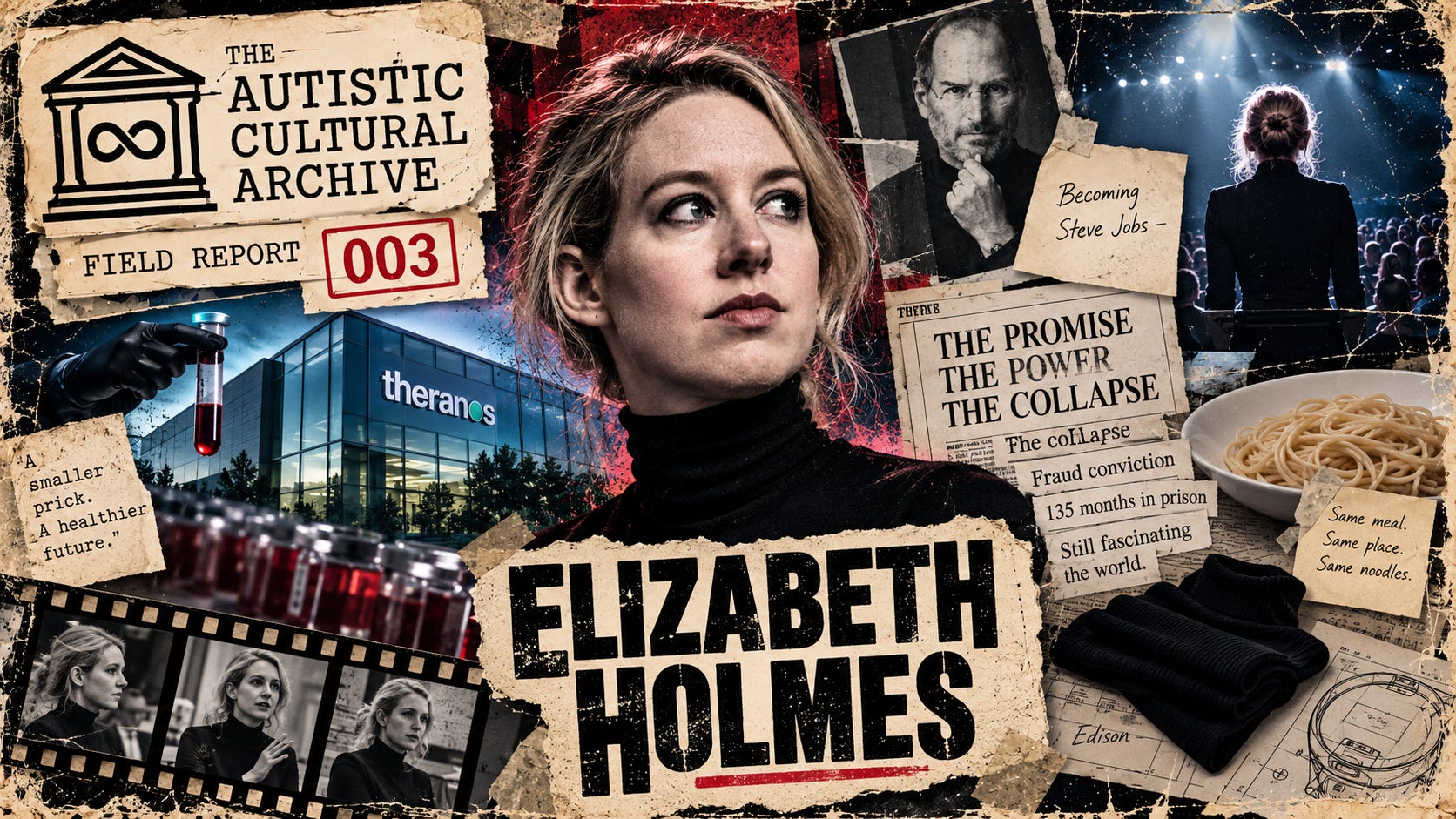
FIELD REPORT [003]
THE AUTISTIC CULTURAL ARCHIVE
ARTIFACT: ELIZABETH HOLMES
ARCHIVE NO.: ACA-003-ELIZABETH-HOLMES
PERIOD: 2004 / Present
CLASSIFICATION: AUTISTIC CULTURE
PRIMARY PILLARS: Rhythmic Communicating · Predictably Comforting · Passionate Superfanning
ADDITIONAL TRACES: World Building · Norm Challenging · Game Changing · Boldly Creating · Bottom-Up Processing · Pattern Matching · Justice Seeking
LEAD EXCAVATOR: Dr Angela Kingdon
ACCOMPANYING EXCAVATOR: Simon Scott
LISTEN TO THE EXCAVATION
This Field Report accompanies our excavation of Elizabeth Holmes and Theranos on This Week in Autistic Culture.
The Archive segment presents the case.
The Field Report contains the evidence locker.
Listen to the full excavation on the Autistic Culture Podcast Network.
Watch the excavation on our YouTube channel.
THE DISCOVERY
What happens when someone becomes one of the most recognisable figures in modern business, and almost everything about the way they behave becomes evidence against them?
Their clothes.
Their voice.
Their eye contact.
Their food.
Their routines.
The way they speak.
The people they admire.
And the way they respond when somebody challenges their understanding of the world.
That’s the question at the heart of this week’s excavation.
Elizabeth Holmes is best known as the founder of Theranos, the blood-testing company that promised to revolutionise healthcare, attracted enormous investment and ultimately collapsed amid revelations that its technology did not work as advertised.
Holmes was convicted of defrauding investors and sentenced to 11 years and three months in prison.
That’s the story most people know.
But when Angela brought the new documentary You Can See Everything into the Autistic Culture Archive, she wanted to examine something else.
What happens when we look at this story through the Ten Pillars of Autistic Culture?
There’s an important distinction between identifying someone’s behaviour and understanding what that behaviour might mean.
An unusually deep voice becomes evidence of deception.
Repeated phrases become evidence of manipulation.
An unusual relationship with eye contact becomes something sinister.
An obsession with a particular person becomes proof of an elaborate performance.
And an extraordinarily repetitive lifestyle becomes another strange detail in an already strange story.
But some of those behaviours may also be familiar to Autistic people for entirely different reasons.
That doesn’t tell us why Holmes behaved as she did.
And it certainly doesn’t overturn the evidence presented at her trial.
But it does raise questions about the assumptions we make when interpreting other people’s behaviour.
And that’s where this excavation becomes particularly interesting.
We’re not attempting to diagnose Elizabeth Holmes. We have no evidence that she identifies as Autistic.
We’re examining the public record, the culture around her, and the ways that familiar patterns can be interpreted differently depending on who’s looking.
Because sometimes the most interesting archaeological discoveries aren’t the things we expected to find.
They’re the things that make us reconsider what we thought we already understood.
THE ARTEFACT
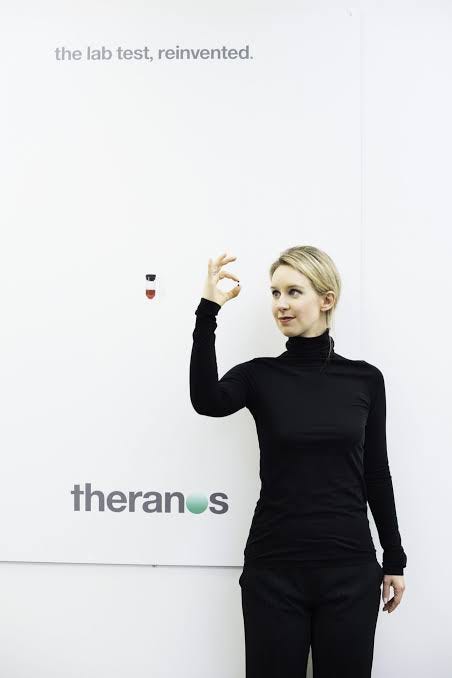
Elizabeth Anne Holmes was born in Washington, D.C., in 1984.
From an early age, she expressed an interest in invention and changing the world.
According to accounts of her childhood, at seven she designed a time machine and kept the notebook.
At nine, she wrote to her father about wanting to discover something that humanity didn’t already know was possible.
She later attended Stanford University to study chemical engineering, leaving in 2004 to establish the company that became Theranos.
Her ambition was enormous.
She wanted to replace conventional blood testing with technology capable of performing extensive medical tests using only a tiny sample collected from a finger prick.
No conventional blood draw.
No large collection of vials.
Potentially faster, more accessible testing.
And, in theory, a fundamental change in the relationship between patients and their healthcare information.
Theranos attracted hundreds of millions of dollars in investment. By 2014, the company had been valued at approximately $9 billion.
Holmes became one of the most recognisable young entrepreneurs in Silicon Valley.
Magazine covers.
Interviews.
Conference appearances.
A distinctive black turtleneck.
A remarkably deep speaking voice.
And comparisons with another famous technology founder.
Steve Jobs.
But behind the extraordinary promises, serious problems were emerging.
In October 2015, The Wall Street Journal published an investigation questioning Theranos’s technology and testing practices.
The company eventually collapsed.
In January 2022, Holmes was convicted of three counts of wire fraud and one count of conspiracy to commit wire fraud relating to investors.
She was acquitted on four patient-related counts. The jury could not reach verdicts on three other counts, which were subsequently dismissed.
In November 2022, she was sentenced to 135 months in federal prison.
And now, years after the collapse of Theranos, her story continues to attract extraordinary interest.
Books.
Podcasts.
Dramatisations.
Documentaries.
And the latest artefact to bring her back into the cultural conversation:
You Can See Everything, the documentary involving Nathan Fielder and Lance Oppenheim.
Angela’s proposition during our excavation was that we could examine the same public record through a different cultural lens.
Not to rewrite what happened.
But to see what else might be visible.
ARTIFACT RECOVERED: ELIZABETH HOLMES
THE EXCAVATION
THE VOICE
RHYTHMIC COMMUNICATING
One of the most recognisable things about Elizabeth Holmes is her voice.
Deep.
Measured.
Deliberate.
Sometimes described as robotic.
Sometimes described as unnatural.
And frequently presented as evidence that she was performing a character rather than being herself.
But why?
In 2014, journalist Ken Auletta described a distinction between Holmes’s quiet conversational voice and the deeper, more formal cadence she adopted onstage.
That distinction is interesting.
Because many people communicate differently depending on their environment.
Politicians adopt public-speaking voices.
Broadcasters change their delivery.
Actors learn to project.
People rehearse difficult conversations.
And Autistic people may use scripts, practised rhythms, familiar phrases and particular vocal patterns to navigate demanding social situations.
During our excavation, I suggested an alternative interpretation of Holmes’ distinctive delivery.
What if some of what audiences interpreted as performance could also be understood through Rhythmic Communicating?
She raised the possibility of vocal regulation.
The sensation of producing a low voice.
The physical vibration.
The predictable cadence.
The familiar words.
The ability to repeat something that has already been practised.
None of this establishes Holmes’s motivation.
But it gives us another way to think about the behaviour itself.
A FIND FROM THE EXCAVATION
This was one of the moments when Simon recognised something from his own experience.
I’m somebody who hums and uses my voice as a form of stimming.
I can find the physical sensation of vibration in my larynx regulating.
And after years of working in broadcasting, I also recognise the desire to adopt a voice that sounds authoritative.
There are times when I’ve deliberately lowered my voice because I’ve wanted to sound more official.
A broadcasting voice.
A presenting voice.
A voice that communicates authority before I’ve even said anything.
That doesn’t mean I was trying to deceive anybody.
It means that the way I communicate changes according to what I’m doing.
And that leaves us with an interesting question here…
Why do we accept a practised voice as professionalism in one person, but interpret it as evidence of dishonesty in another?
There are other questions, too.
Could repetition help somebody regulate themselves?
Could a familiar cadence make a demanding public appearance easier?
Could somebody rehearse their words so thoroughly that their delivery begins to sound artificial?
Absolutely.
Does that mean this is what Elizabeth Holmes was doing?
We don’t know.
And that’s an important distinction.
THE SCRIPT
Holmes was also known for returning to familiar phrases.
During the controversy surrounding Theranos, she repeatedly presented the company through the language of innovation, disruption and changing the world.
One particularly memorable statement followed a familiar three-part structure:
First, people think you’re crazy.
Then they fight you.
Then you change the world.
It’s a compelling narrative.
It has rhythm.
It has progression.
And it’s easy to repeat.
Angela connected this to the way scripts can become part of communication.
But there’s another side to the discovery.
A familiar script can make communication easier for the person using it.
It can also make communication more difficult for the person trying to get an answer.
Journalists questioning Theranos’s technology encountered repeated explanations that did not adequately address their questions.
So the presence of scripting doesn’t resolve the issue.
The content matters.
The context matters.
And whether somebody is answering the question matters.
FIELD NOTE: A communication pattern and the truthfulness of the information being communicated are two different things.
That’s a distinction worth keeping in the Archive.
BECOMING STEVE JOBS
PASSIONATE SUPERFANNING · PREDICTABLY COMFORTING
When I think about Elizabeth Holmes, the first image that comes into my head isn’t a blood-testing machine.
It’s the black turtleneck.
And I suspect I’m not alone.

During our excavation, I mentioned that I might struggle to identify Holmes from her name alone.
But describe the blonde woman wearing the black turtleneck?
Immediately recognisable.
And Angela knew exactly where she wanted to take that observation.
Steve Jobs.

Holmes was an admirer of the Apple co-founder.
The comparisons between the two became part of her public image.
The black turtleneck.
The carefully constructed product announcements.
The language of technological revolution.
The secrecy.
The idea that an extraordinary individual could fundamentally change an established industry.
But the connection went beyond superficial resemblance.
Holmes recruited people who had worked at Apple.
Former Apple designer Ana Arriola joined Theranos.
Former Apple executive Avie Tevanian joined its board.
Accounts of Holmes’s working life describe an intense interest in Jobs and his approach to business.
And then there’s a particularly unusual piece of evidence.
THREE WORDS AND A DASH
During Holmes’s trial, a note she had written to herself in 2015 entered the public record.
“Becoming Steve Jobs -”
Three words.
And a dash.
During our excavation, I was particularly interested in the reaction to this note.
Because the existence of an unfinished note is hardly unusual.
I have an enormous collection of notes.
Some are fully developed ideas.
Some are half a sentence.
Some are a title that seemed important when I wrote it down.
And some make absolutely no sense when I return to them.
We don’t know what Holmes intended to write.
It might have been a personal ambition.
A research note.
A potential article.
A reminder.
Or something else entirely.
But in the context of the public story surrounding Theranos, the note became another piece of the puzzle.
And I see an interesting connection with Passionate Superfanning.
WHEN A HERO BECOMES PART OF YOUR IDENTITY
One of the things we’ve explored repeatedly on the Autistic Culture Podcast is that a passionate interest isn’t necessarily something separate from a person’s identity.
Sometimes it becomes part of who they are.
The music you listen to.
The films you watch.
The books you study.
The people whose work you admire.
The ideas you return to over decades.
They become part of the way you understand yourself.
I have often and continue to talk about my longstanding connection with Neil Finn’s music.
Simon shared his relationship with his tattoos.
Lyrics.
Album artwork.
Pieces of culture that have become so personally significant that he literally had them incorporated into his body.
And I think that illustrates something important.
Sometimes we don’t simply admire an artefact. We carry it with us.
Holmes’s admiration for Steve Jobs is well documented.
But what makes it interesting through the Pillars is the relationship between that admiration and the methods she adopted.
The clothes.
The public presentation.
The company culture.
The language of innovation.
The ambition to replace an established system.
Passionate Superfanning may provide a template.
And that template can influence the way somebody constructs their own identity.
THE COMPLICATION
There’s an important question here.
What happens when somebody studies a hero so closely that they begin to copy their methods?
Which methods do they copy?
The creative ambition?
The discipline?
The attention to detail?
The willingness to challenge convention?
Or the appearance of genius?
The secrecy?
The presentation?
The belief that an extraordinary vision justifies extraordinary demands?
Can you reproduce the visible characteristics of a successful person without reproducing the systems that made their success possible?
And this is where Passionate Superfanning becomes a particularly interesting lens.
It can help explain how people learn from the cultural figures they admire.
But it doesn’t guarantee that the lessons they take away are the right ones.
The hero becomes the template. The question is what gets copied.
A BAG OF NOODLES, SUPPLIED IN ADVANCE
PREDICTABLY COMFORTING
Now we come to one particularly detailed item I wanted to bring into the evidence locker.
Dinner.
Specifically, spaghetti.
In a 2014 profile of Holmes, Roger Parloff described her visiting an Italian restaurant where the staff already knew what she wanted.
Oil-free spaghetti.
Whole-wheat noodles.
And not simply noodles the restaurant served.
Holmes reportedly provided the noodles herself in advance.
Same restaurant.
Same meal.
Same preparation.
Same expectations.
And I immediately recognised a possible connection with Predictably Comforting.
Because for many Autistic people, familiarity isn’t simply about liking something.
It can be about reducing uncertainty.
Reducing the number of decisions.
Avoiding unexpected sensory experiences.
And preserving attention for something else.
THE COST OF DECISIONS
During the recording, I wanted to explore something we often overlook: the cost of everyday decisions.
If you’re intensely focused on a project, even ordinary daily decisions can become interruptions.
What should I wear?
What should I eat?
When should I eat?
Where should I go?
Will the food agree with me?
Will I be able to return to work afterwards?
Sometimes the easiest answer is to make one decision, and then repeat it indefinitely.
That doesn’t necessarily mean the food is your favourite meal in the world.
It might simply be something that works.
Something familiar.
Something reliable.
Something you don’t need to think about.
Before we broadcast, I often have a cup of Dole peaches.

I know what to expect from them.
They’re familiar, and I don’t have to spend energy worrying about whether they’re going to upset my stomach
Simon described something related but different.
When he’s concentrating on work, even deciding what to eat or managing a meal during a conversation can become difficult.
He talked about how much easier life would be if somebody could simply bring him a familiar sandwich without interrupting his focus.
Neither experience tells us why Holmes supplied her own noodles to a restaurant.
But it changes the questions I ask about that detail.
From the outside, supplying a restaurant with your own noodles might appear eccentric.
But from the perspective of Predictably Comforting?
It could also be a way of removing one uncertainty from the day.
THE UNIFORM
The same principle may help explain the appeal of wearing similar clothes every day.
Holmes’s black turtleneck became her signature.
But her clothing habits were also discussed as a way of simplifying daily decisions.
There’s a familiar idea associated with Steve Jobs and other technology founders.
Reduce the number of unimportant choices.
Save your attention for the work that matters.
I connected that approach with the Autistic experience of Predictably Comforting.
And this is where two Pillars begin interacting.
Passionate Superfanning → Predictably Comforting.
The admired person supplies a model.
The model becomes a routine.
The routine reduces decisions.
The decisions no longer interrupt the work.
It’s a compelling connection.
Although, once again, we can’t establish from the outside precisely what motivated Holmes’s clothing choices.
THE PRISON ROUTINE
My research also explored Holmes’s daily life in prison.
In a 2025 interview, Holmes described an established routine.
Waking early.
Exercise.
Breakfast.
Work in the education building.
Regular calls with family.
A structured day.
Now, prison is an environment in which routines are imposed as well as personally chosen.
So we shouldn’t treat that routine as straightforward evidence of an individual preference.
But it adds another dimension to the public record.
Across very different environments, accounts of Holmes’s life contain repeated references to structure and routine.
The businesswoman with a carefully managed schedule.
The founder with a recognisable uniform.
The restaurant that knew her order.
And the prisoner describing the organisation of her day.
FIELD NOTE: Predictability can be a practical tool for managing daily life. Its presence does not tell us why a particular person relies on it.
THE DREAM OF CHANGING EVERYTHING
NORM CHALLENGING · GAME CHANGING · BOLDLY CREATING
One of the most striking things about Elizabeth Holmes’s story is the scale of her ambition.
She didn’t want to make conventional blood testing slightly more convenient.
She wanted to replace it.
That distinction matters.
During our excavation, I returned to Holmes’s childhood ambition to discover something humanity hadn’t previously thought possible.
And then to her decision to leave Stanford and pursue the company that became Theranos.
According to her professor, Prof. Channing Robertson, when he encouraged her to complete her degree, Holmes questioned why she should wait when she already knew what she wanted to do.
That is a recognisable expression of Norm Challenging.
Why follow the established path?
Why accept the existing system?
Why spend years doing something because of societal expectation?
And there’s a Game Changing connection too.
WHY ARE WE STILL DOING IT THIS WAY?
Holmes publicly questioned the experience of conventional blood testing.
Why should somebody have to sit and watch blood being drawn through a needle?
Why couldn’t the experience be less invasive?
Why couldn’t patients access more information about their health?
Why couldn’t the system be redesigned?
These are legitimate questions.
And the ambition to improve medical testing is not inherently problematic.
But an ambition and a functioning technology are not the same thing.
Theranos claimed capabilities that its technology did not reliably deliver.
And that distinction became central to the fraud case.
THE DIFFERENCE BETWEEN AN IDEA AND A CLAIM
This is where the excavation becomes uncomfortable.
Because there are two very different statements.
“I believe I can create technology that will transform blood testing”.
And:
“I have created technology that can perform the tests I’m promising”.
The first is an ambition.
The second is a factual claim.
And investors, medical professionals and patients need to know the difference.
Holmes argued that Theranos had failed rather than committed fraud.
But the jury convicted her of knowingly misleading investors.
We cannot use the Ten Pillars to determine somebody’s private intentions.
Nor can we use them to replace the findings of a court.
What we can do is examine how a commitment to a particular vision may interact with the other patterns in the story.
Game Changing can begin with a refusal to accept the existing system.
Boldly Creating can involve enormous commitment to an idea.
Norm Challenging can mean questioning established authority.
But none of those things establishes that the proposed alternative works.
The desire to change the world is not evidence that the world has been changed.
THE WORLD INSIDE THERANOS
WORLD BUILDING · PASSIONATE SUPERFANNING
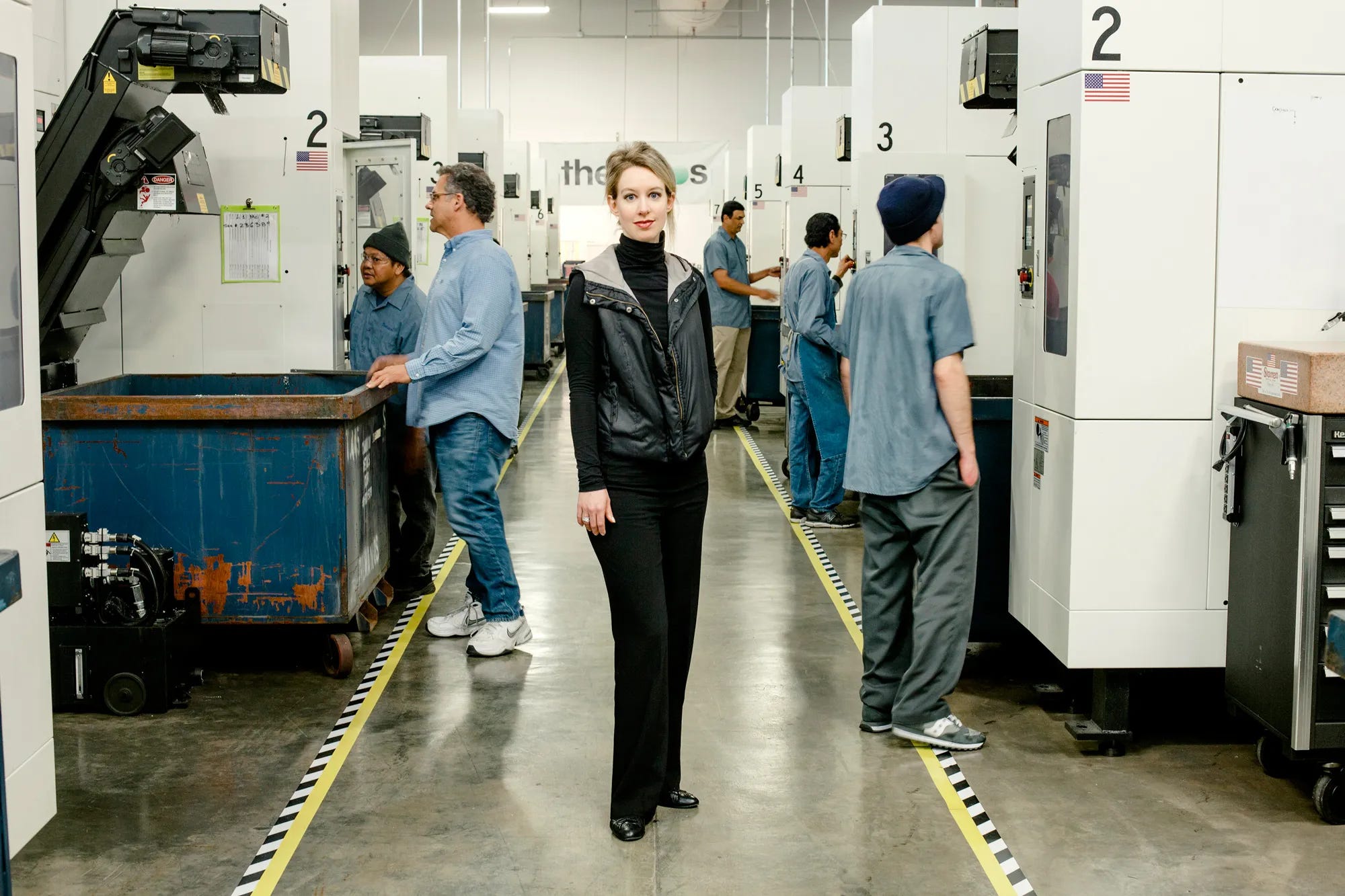
Theranos wasn’t simply a company with an ambitious product.
It developed an entire identity.
A name.
A mission.
A visual language.
A distinctive founder.
Specialist terminology.
Devices with names such as Edison.
The nanotainer.
The miniLab.
Secrecy.
Prestigious board members.
Carefully presented demonstrations.
And an extraordinary promise about the future of healthcare.
What struck me in the research was how much of this resembled the construction of a self-contained world.
One with its own language.
Its own expectations.
Its own rituals.
And a central narrative that explained why everything mattered.
In the Archive, we’ve already seen how World Building can emerge from a deeply interconnected fictional universe.
We explored that with Dune.
But Theranos presents a different kind of world.
Not an imaginary universe designed to entertain readers.
A real organisation that made claims about real technology.
And that’s where the stakes change.
WHEN THE STORY AND THE SYSTEM DON’T MATCH
Theranos’s public narrative described a technological revolution.
But inside the company, employees and laboratory professionals were raising serious concerns about the equipment and testing practices.
The external story and the internal reality were not consistent.
And this creates an important distinction for our Archive.
A coherent story is not necessarily an accurate account of the world.
A fictional universe can invent its own rules.
A medical laboratory cannot.
Its technology must produce reliable results.
Its claims must correspond with evidence.
And the people relying on those claims must be able to trust them.
World Building can help people imagine a different future.
But when a constructed narrative becomes more important than the evidence contradicting it, the consequences can be serious.
THE WORLD PEOPLE WANTED TO BELIEVE IN
One of the things I find fascinating about Theranos is how many influential people became invested in its story.
The idea was extraordinary.
The founder was compelling.
The promise was enormous.
And the company appeared to represent the future.
People wanted to believe.
That doesn’t make the technology work.
But it helps explain why the narrative was so powerful.
And perhaps this is where World Building and Passionate Superfanning begin interacting again.
A founder models herself on a celebrated technology pioneer.
A company adopts the language of revolutionary innovation.
Investors and supporters become attached to the possibility of what that company might achieve.
The story reinforces itself.
Until somebody begins asking questions that the story cannot answer.
THE PEOPLE WHO NOTICED
BOTTOM-UP PROCESSING · PATTERN MATCHING · JUSTICE SEEKING
This is one of the most important parts of the excavation.
Because the Ten Pillars don’t appear only in the story of Elizabeth Holmes.
They also offer a way to examine the people who challenged Theranos.
Erika Cheung.
Tyler Shultz.
Laboratory staff.
Former employees.
Journalists.
People who noticed that the claims being made about the technology didn’t match what was happening.
And who refused to ignore the difference.
THE DETAILS THAT DIDN’T FIT
Erika Cheung testified about problems with quality control and testing practices.
Tyler Shultz questioned the capabilities of the Edison machine.
Other employees raised concerns about the organisation’s priorities and its handling of laboratory results.
These concerns eventually became part of the wider investigation into Theranos.
And I connected them with three Pillars.
Bottom-Up Processing.
Look at the individual details.
What does the machine actually do?
What do the results show?
What happens when the same test is repeated?
Pattern Matching.
Compare the evidence.
Identify inconsistencies.
Recognise that individual problems may form part of something larger.
Justice Seeking.
When something is wrong, challenge it.
Even when the people you’re challenging are powerful.
Even when you’re being told to stop asking questions.
Even when the consequences of speaking up are considerable.
We’re not claiming that the whistleblowers were Autistic.
We’re recognising that their methods can be examined through the cultural framework.
And this produces a particularly interesting finding.
THE SAME PILLARS, DIFFERENT DIRECTIONS
Throughout this excavation, we’ve been identifying possible cultural connections in Holmes’s behaviour.
Her routines.
Her scripts.
Her intense interests.
Her desire to change an established system.
But when we examine the people who challenged Theranos, we find other Pillars.
Attention to detail.
Pattern recognition.
A commitment to confronting something that appears wrong.
And suddenly the Archive is asking a different question.
What happens when the same cultural framework helps us understand people on opposing sides of a conflict?
That doesn’t make their actions morally equivalent.
It means that the Pillars are not a substitute for examining what people actually do.
They don’t automatically make somebody right.
They don’t guarantee that somebody is trustworthy.
And they don’t excuse behaviour that harms others.
The Pillars help us recognise patterns.
We still have to evaluate the evidence.
JUSTICE SEEKING — AND WHO DEFINES JUSTICE?
There’s another complication in this story.
Elizabeth Holmes has continued to maintain that she did not commit fraud.
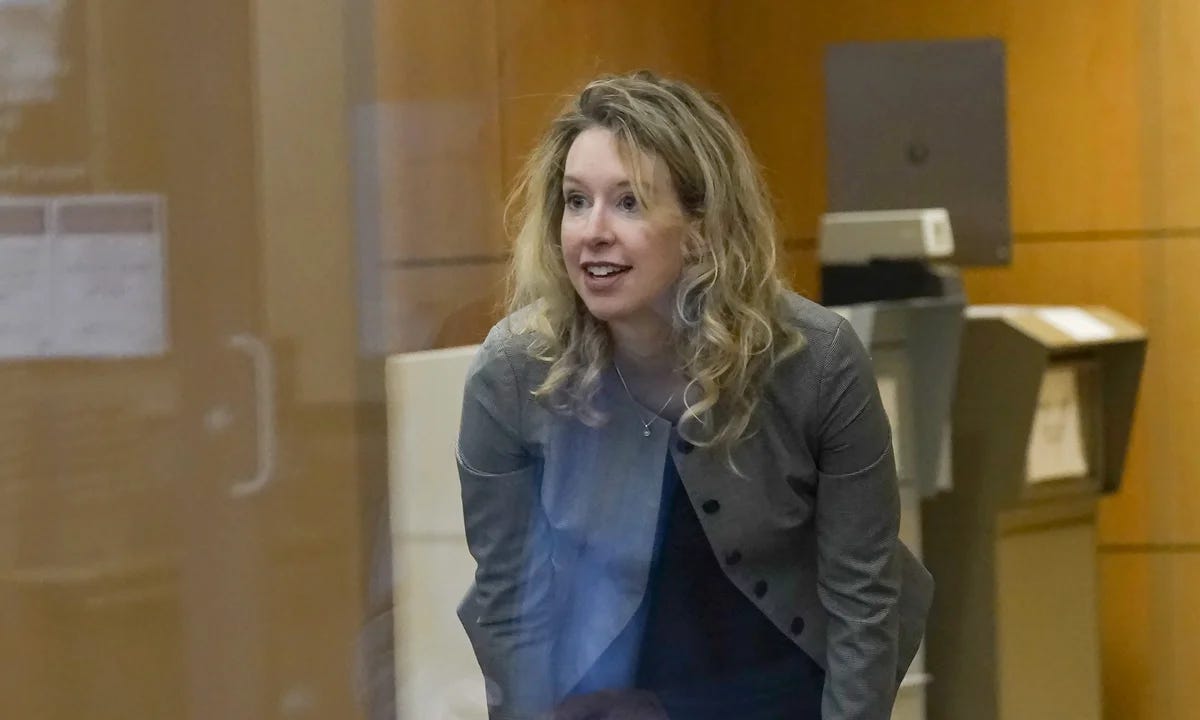
And my research explored her reported involvement in work supporting other prisoners, including women who have experienced sexual violence.
During our recording, I discussed Holmes’s involvement in prison education, legal assistance and criminal justice reform.
I also discussed Holmes’s continuing interest in invention and her efforts to challenge her conviction.
This introduces another dimension to Justice Seeking.
People can hold a sincere belief that they’re pursuing justice while others strongly disagree with their interpretation.
Holmes has described her mission at Theranos in terms of making healthcare information more accessible.
She has also presented her own conviction as an injustice.
Those are her positions. They do not negate the evidence that led to her conviction.
And her reported work supporting others does not erase the consequences of Theranos’s actions.
But it would be incomplete to examine Justice Seeking only in the people who opposed her, without also examining the values and causes she has publicly described as important.
JUSTICE SEEKING ISN’T INFALLIBILITY
One of the questions this raises is whether a strong sense of justice necessarily means having an accurate understanding of a situation.
Of course it doesn’t.
People can be mistaken.
They can misunderstand evidence.
They can become so committed to a particular interpretation that they struggle to recognise competing explanations.
And sometimes people can pursue what they believe is a good outcome through actions that cause harm.
The strength of a conviction doesn’t establish its accuracy.
That’s an important distinction.
Justice Seeking describes a relationship with perceived fairness. It doesn’t automatically establish that somebody’s understanding of fairness is correct.
And this is something we’ll need to remember in future excavations.
WHEN A PILLAR BECOMES A COMPLICATION
FIELD NOTE — THE ROSETTA STONE
During our excavation of Dune, we encountered an unexpected idea.
Predictably Comforting might have an extreme expression that becomes Predictably Uncomfortable.
Paul Atreides could see so many possible futures that his relationship with predictability became a source of distress rather than reassurance.
That led us to ask whether the Pillars could interact in ways that weren’t always straightforward.
This excavation takes that question somewhere else.
What happens when a cultural pattern is recognisable, but the outcome is harmful?
Passionate Superfanning can inspire somebody to learn from a hero.
But what if they copy the wrong lessons?
Predictably Comforting can help somebody create a stable environment.
But what if the environment becomes resistant to new information?
Rhythmic Communicating can provide familiar language and structure.
But what if a repeated script prevents meaningful questions from being answered?
World Building can help people imagine something extraordinary.
But what if the world being presented doesn’t correspond with reality?
Game Changing can challenge a broken system.
But what if the proposed replacement doesn’t work?
And Justice Seeking can inspire people to challenge wrongdoing.
But what happens when people fundamentally disagree about what justice requires?
A Pillar is not a moral verdict.
That’s perhaps the most important distinction in this excavation.
The Ten Pillars help us understand patterns in Autistic Culture.
They don’t replace ethics.
They don’t replace evidence.
And they don’t establish whether an individual is Autistic.
We can recognise a pattern without endorsing an action.
We can understand a behaviour without knowing its motivation.
And we can acknowledge a cultural connection while recognising serious harm.
The Rosetta Stone helps us interpret what we’ve found. It doesn’t tell us that everything we find is good.
THE AUDIENCE BECOMES THE INVESTIGATOR
PATTERN MATCHING · PASSIONATE SUPERFANNING
There’s one final part of this story that I think deserves attention.
The audience.
Because Elizabeth Holmes and Theranos have become subjects of extraordinary cultural fascination.
John Carreyrou’s Bad Blood.
The Dropout.
Alex Gibney’s The Inventor.
Television dramatisations.
Countless articles.
Podcasts (yoohoo)
And now You Can See Everything.
The story has been examined and re-examined.
People have studied the timeline.
Analysed the technology.
Compared interviews.
Examined Holmes’s voice.
Investigated the company’s relationships.
And debated what she knew, when she knew it and why she continued.
There’s something very familiar about that kind of cultural engagement.
The detail hunting.
The desire to understand the entire system.
The fascination with contradictions.
The urge to go back to the beginning and see what was missed.
But there’s an important distinction between researching a subject and becoming an admirer of that subject.
Not every intense interest is a celebration.
Sometimes people become fascinated precisely because something doesn’t make sense.
And the more they investigate, the more questions emerge.
The story itself becomes an artefact that people keep excavating.
Which is a rather appropriate discovery for the Autistic Culture Archive.
Because here we are.
Doing exactly that.
WHAT THE EVIDENCE DOESN’T TELL US
There are some important gaps in the evidence locker.
We don’t have evidence that Elizabeth Holmes has been diagnosed as Autistic or publicly identified herself as such.
We don’t know why she adopted her distinctive speaking voice.
We don’t know whether her food routines were motivated by sensory preferences, health concerns, convenience, personal philosophy or something else.
We don’t know precisely what she intended when she wrote her unfinished Steve Jobs note.
We can’t infer her private intentions from the presence of recognisable behavioural patterns.
And we shouldn’t interpret the existence of those patterns as evidence that Autistic people are more likely to behave dishonestly.
The fraud conviction rests on evidence about her statements and conduct, not on whether she spoke unusually, wore the same clothes or preferred a particular meal.
These distinctions matter.
Because the point of the Archive isn’t to collect people who behave differently and declare them Autistic.
It’s to investigate cultural patterns, examine the evidence and understand what those patterns might tell us.
Sometimes that produces a celebration.
Sometimes it produces a complication.
And sometimes it raises questions that we aren’t able to answer.
An archive that only keeps the comfortable evidence isn’t much of an archive.
CLOSING THE EXCAVATION
When I brought Elizabeth Holmes into the Archive, I knew this would be an uncomfortable excavation.
I knew the history of Theranos and the fraud conviction.
I also knew how much public attention had settled on Holmes’s voice, her clothes, her eye contact and her routines.
What I wanted to investigate was whether the Ten Pillars might reveal something about the way we interpret those details, without pretending they establish her neurotype or excuse her actions.
And what interested me during the conversation with Simon was how many different questions those details opened up.
The voice.
The scripts.
The admiration for Steve Jobs.
The routines.
The food.
The ambition.
The world built around Theranos.
And the people who eventually challenged it.
But the thing I’ll take away from this excavation is that recognising something familiar doesn’t necessarily mean understanding why it’s happening.
A behaviour might look familiar to me because I’ve experienced something similar.
But that doesn’t mean the other person is experiencing it for the same reason.
And it doesn’t tell me whether the consequences of their behaviour are acceptable.
Recognition isn’t explanation.
I think that’s an important discovery for the Archive.
Because we’re trying to understand Autistic Culture through the patterns that appear in the world around us.
And the more artefacts we examine, the more complicated those patterns are going to become.
Rocky Horror gave us a community that created belonging through shared scripts and rituals.
Dune gave us an interconnected world that rewarded pattern recognition and intense curiosity.
Elizabeth Holmes gives us something rather different.
A story in which the same cultural framework can help us ask questions about ambition, identity, performance, power, truth and accountability.
And perhaps the most important thing we’ve found is that the Pillars don’t remove those complications.
They give us another way to examine them.
ACCOMPANYING EXCAVATOR’S NOTES
Simon Scott
The thing that surprised me during this excavation was how much of the discussion I recognised from my own life.
Not the billion-dollar company.
Not the blood-testing machines.
And certainly not a criminal conviction.
But the everyday things.
The desire to wear something familiar.
The appeal of knowing exactly what you’re going to eat.
The way a deep interest can become part of your identity.
And particularly the way somebody might change their voice depending on what they’re doing.
I’ve worked in broadcasting for years.
And I’ve absolutely used different versions of my voice depending on the situation.
I’ve also found myself humming or using vocal vibrations because I find the sensation regulating.
So when Angela started talking about the possibility of Holmes using her voice in that way, I immediately recognised the behaviour she was describing.
That doesn’t mean I know why Holmes spoke as she did.
I don’t.
But it did make me think about how quickly we assign meaning to somebody else’s behaviour.
We see something unusual.
We decide what it means.
And then everything else gets interpreted through that assumption.
I think the other thing I’ll remember is the noodles.
Because if I had the money to make every meal predictable, have somebody bring it to me and never have to think about what I was eating while I was working?
I can see the deliciously beige appeal.
Although I probably wouldn’t choose oil-free spaghetti.
And I definitely wouldn’t be bringing my own noodles to a restaurant.
Well. Probably not.
CLASSIFICATION
After examining the evidence, we’re filing Elizabeth Holmes in the Autistic Culture Archive.
Not because we’ve established that Elizabeth Holmes is Autistic.
We haven’t.
And not because the cultural patterns we’ve identified excuse or explain away the fraud for which she was convicted.
They don’t.
We’re filing the artefact because the public record provides an opportunity to examine the Ten Pillars in a particularly complicated cultural context.
What began as an ambition to transform blood testing became a company, a carefully constructed public identity, a technological promise and eventually a criminal case.
And around that story, we found familiar patterns.
Routines.
Scripts.
Intense interests.
Admiration.
World Building.
Norm Challenging.
Ambition.
And people determined to examine the details when something didn’t add up.
The strongest evidence isn’t simply what the record contains.
It’s what examining that record through the Pillars invites us to do.
Notice the detail.
Question the assumption.
Listen to the voice.
Recognise the script.
Examine the routine.
Follow the interest.
Understand the system.
Compare the claim with the evidence.
Listen to the people who noticed something was wrong.
Keep the uncomfortable findings in the Archive.
And when something looks familiar?
Don’t assume you know what it means. Keep digging.
ARTEFACT: ELIZABETH HOLMES
CLASSIFICATION: AUTISTIC CULTURE
PRIMARY PILLARS: Rhythmic Communicating · Predictably Comforting · Passionate Superfanning
ADDITIONAL TRACES: World Building · Norm Challenging · Game Changing · Boldly Creating · Bottom-Up Processing · Pattern Matching · Justice Seeking
ARCHIVE NO.: ACA-003-ELIZABETH-HOLMES
LEAD EXCAVATOR: Dr Angela Kingdon
ACCOMPANYING EXCAVATOR: Simon Scott
STATUS: Excavation Complete
Elizabeth Holmes: An Autistic Culture Artefact.
SUBMIT YOUR EVIDENCE
An archive is never finished.
So now we’re handing the brushes to you.
What did we miss?
Have you watched You Can See Everything?
Did the documentary change your opinion about Elizabeth Holmes?
Or did our excavation change the way you might approach the documentary?
Have you ever had somebody interpret your voice, eye contact or mannerisms as evidence of something you weren’t actually feeling?
Do you have a particular meal, outfit or routine that helps you preserve your attention for other things?
Has a passionate interest ever influenced the way you dress, work or communicate?
And what do you make of the more uncomfortable discovery in this excavation?
Can we recognise the Pillars in a person’s behaviour without knowing their motivations or endorsing their actions?
Which Pillar do you think appears most strongly here?
And should the Archive be examining cultural patterns in complicated figures as well as the people and artefacts we celebrate?
Leave your field notes in the comments.
The Archive is never finished.