


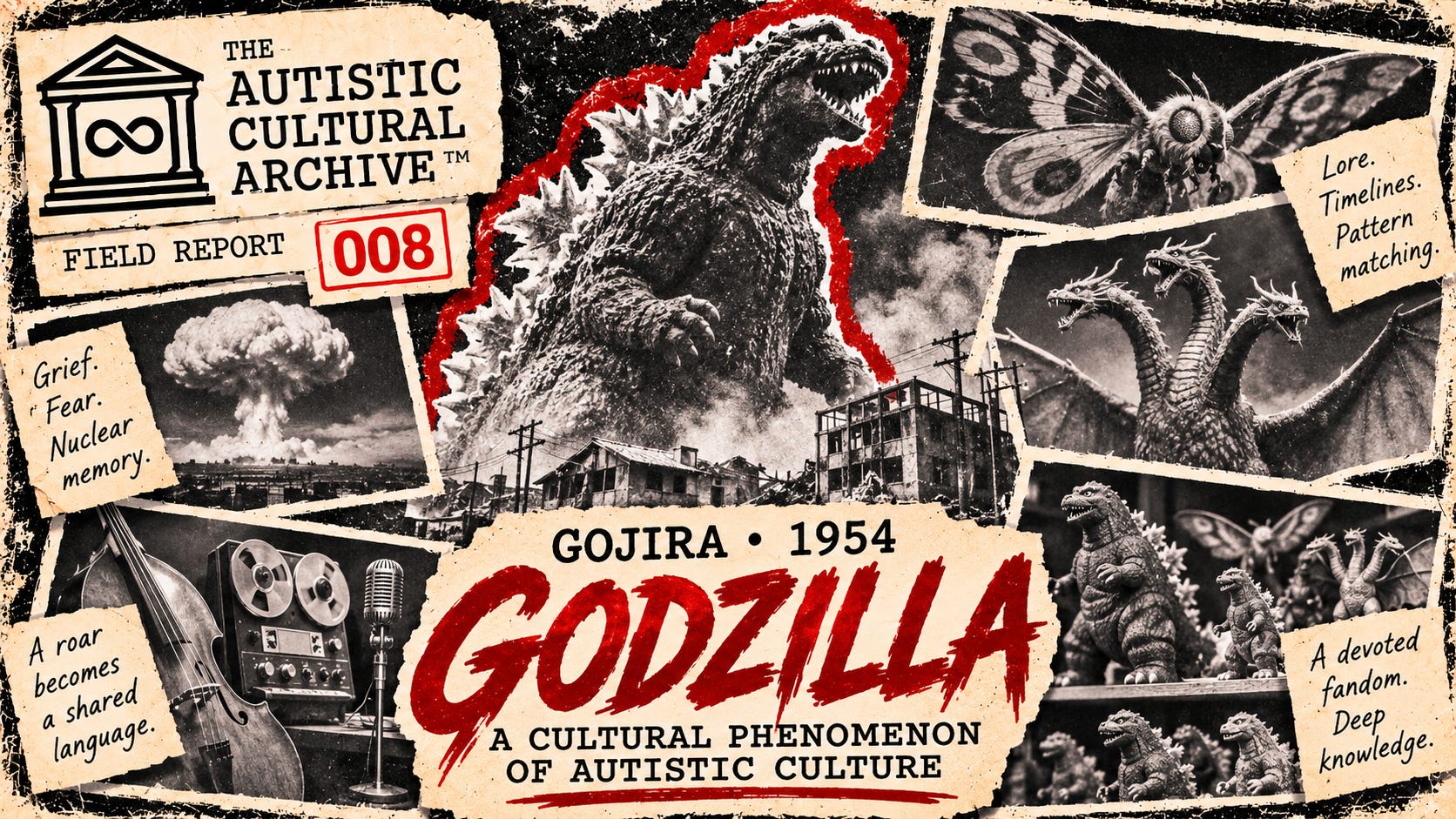
FIELD REPORT [008]
THE AUTISTIC CULTURAL ARCHIVE
ARTIFACT: Godzilla (1954–present)
ARCHIVE NO.: ACA-008-GODZILLA
PERIOD: 1954 / Continuing Cultural Legacy
CLASSIFICATION: AUTISTIC CULTURE
PRIMARY PILLARS: Justice Seeking · Game Changing Innovation · Rhythmic Communicating · World Building · Passionate Superfanning
ADDITIONAL TRACES: Boldly Creating · Bottom-Up Processing · Pattern Matching · Norm Challenging · Predictably Comforting
LEAD EXCAVATOR: Simon Scott
ACCOMPANYING EXCAVATOR: Dr Angela Kingdon
LISTEN TO THE EXCAVATION
This Field Report accompanies our excavation of Godzilla on This Week in Autistic Culture.
The Archive segment presents the case.
The Field Report contains the evidence locker.
Listen to the full excavation on the Autistic Culture Podcast Network.
Watch the excavation on our YouTube channel.
THE DISCOVERY
What is it about an enormous, radioactive monster destroying buildings that has captured the imagination of generations of people worldwide?
I’ve always loved monster movies, and there’s something about Godzilla that I find particularly fascinating. Whether it’s the extraordinary filmmaking techniques used to bring the creature to life, the iconic music and sound effects or the enormous fictional mythology that has developed around him, there’s always something new for me to discover.
And whilst I wouldn’t necessarily describe myself as a Godzilla ‘superfan’, I’ve encountered some extraordinary examples of Passionate Superfanning within the Godzilla community.
People who can tell you which film a particular Godzilla belongs to just by looking at the shape of his head. Others can identify the different versions of Godzilla simply by listening to his roar.
I LOVE that level of specialist knowledge.
When I began researching Godzilla for the Autistic Cultural Archive, I was particularly interested in exploring the relationship between Passionate Superfanning, World Building and the innovative filmmaking techniques associated with the franchise.
But as part of my research, I returned to the original 1954 film, and something rather unexpected happened.
I found myself becoming considerably more interested in the people who created Godzilla and the circumstances in which they were living.
The original Godzilla is a devastating piece of cinema.
It was made by people who had experienced the horrors of the Second World War, for an audience still living with its consequences. Through their extraordinary creativity, they found a way to communicate something that would have been incredibly difficult to express.
And that creation has subsequently become an international cultural phenomenon.
What began as an excavation into the filmmaking and fandom of Godzilla gradually became an exploration of Justice Seeking, creative expression and how something born out of the collective trauma of a nation could become a source of joy, fascination and connection for generations of people.
So, how did Godzilla become Godzilla?
And what can the history of this extraordinary creature tell us about Autistic Culture?
THE ARTEFACT
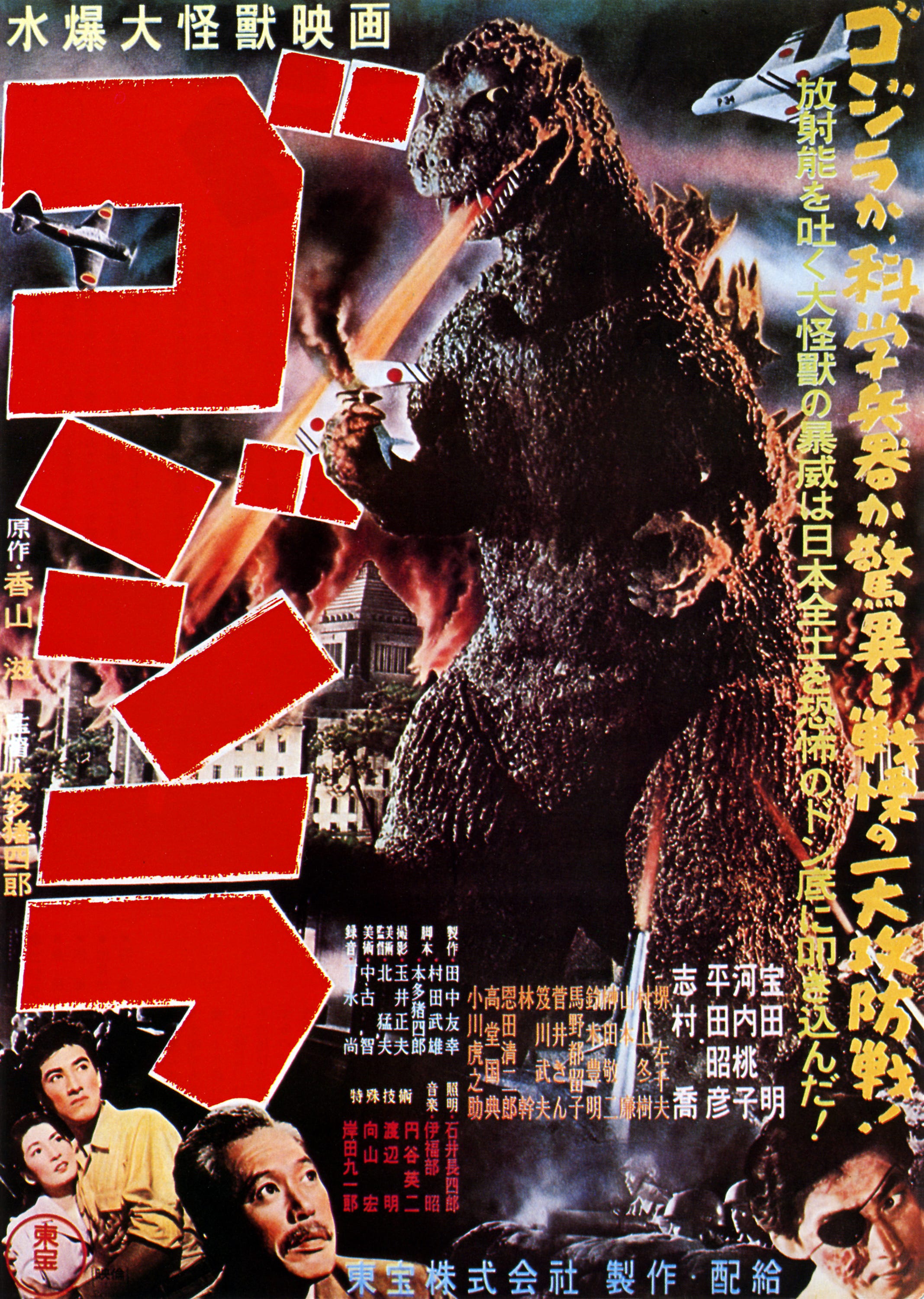
Godzilla, originally titled Gojira, was released in Japan on 3 November 1954.
The film was directed by Ishirō Honda, produced by Tomoyuki Tanaka, with special effects directed by Eiji Tsuburaya and music composed by Akira Ifukube.
These four men would make extraordinary contributions to the development of Japanese cinema, and their work on Godzilla would influence generations of filmmakers around the world.
The story begins with the mysterious destruction of ships at sea before introducing an enormous prehistoric creature whose emergence is connected to nuclear weapons testing. The creature eventually makes its way to Tokyo, where its destructive capabilities overwhelm the country’s military defences.
But if your experience of Godzilla is watching giant monsters fight one another on a Saturday afternoon, the original film might come as something of a surprise.
It is a sombre, black-and-white film that spends a considerable amount of time exploring the human consequences of the monster’s destruction. The images of devastated cities, overwhelmed hospitals and grieving families have much more in common with the imagery of war than the colourful monster battles that would eventually become associated with the franchise.
The original film also helped popularise a particular form of Japanese cinema associated with kaiju, a term meaning strange beast, which has become commonly associated with giant monsters.
Over the decades, the wider Toho monster universe would introduce characters including Mothra, Rodan, King Ghidorah and Mechagodzilla, developing an extraordinary collection of fictional creatures, histories and mythologies.
Godzilla himself would undergo some rather interesting transformations, appearing as a terrifying destroyer in some films and a heroic defender in others.
There are now multiple fictional continuities, Japanese and American interpretations, animated productions, video games, comic books and an enormous international fandom.
But to understand how all of this began, we need to return to Japan in 1954.
THE EXCAVATION
THE MONSTER BORN FROM NUCLEAR FEAR
JUSTICE SEEKING · BOLDLY CREATING
When Godzilla arrived in Japanese cinemas, less than a decade had passed since the atomic bombings of Hiroshima and Nagasaki.
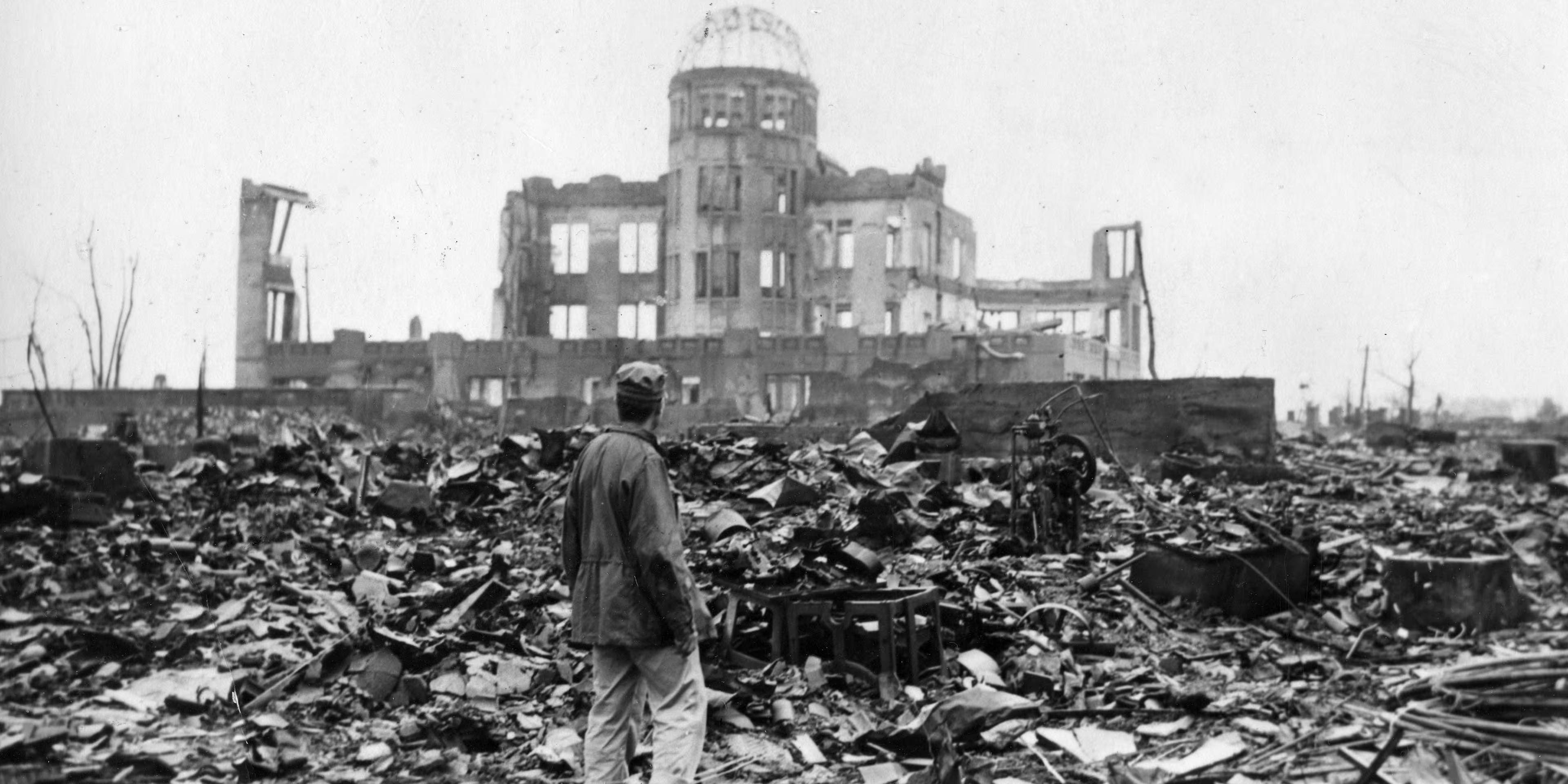
Japan was still rebuilding following the Second World War, and its population was living with the physical, social and psychological consequences of what had happened. Meanwhile, the development of nuclear weapons was continuing around the world.
And in March 1954, something happened that brought the fear of nuclear destruction back into Japanese public life.
THE LUCKY DRAGON NO. 5
On 1 March 1954, the United States carried out a hydrogen bomb test at Bikini Atoll in the Pacific Ocean.
The test, known as Castle Bravo, produced an explosion considerably more powerful than anticipated. Radioactive fallout spread across a large area, exposing the crew of a Japanese fishing vessel called the Daigo Fukuryū Maru, also known as the Lucky Dragon No. 5.
The crew developed radiation sickness, and one of its members, Aikichi Kuboyama, died later that year.
The incident caused considerable concern throughout Japan. There were fears about the contamination of fish, the safety of the fishing industry and the continuing consequences of nuclear weapons testing.
For a population that had experienced the destruction of Hiroshima and Nagasaki, it was a terrifying reminder that the nuclear threat had not disappeared with the end of the war.
In the opening scene of the original Godzilla from 1954, we see a group of people going about their lives aboard a boat. Suddenly, there’s an extraordinary flash of light, followed by the destruction of the vessel.
Watching that scene today, we might recognise it as a relatively familiar device used in monster movies. The filmmakers are introducing the threat before revealing the monster.
But imagine watching that scene in a Japanese cinema in November 1954.
The incident involving the Lucky Dragon No. 5 had happened just eight months earlier.
The audience didn’t need to see Godzilla to understand what the film was communicating.
Producer Tomoyuki Tanaka described the origins of the film:
“The theme of the film, from the beginning, was the terror of the bomb.”
The filmmakers had taken something that was already frightening their audience and given it a physical form.
And when we examine the life of the man who directed the film, this becomes an even more interesting cultural discovery.
THE DIRECTOR WHO HAD WITNESSED THE HORROR
JUSTICE SEEKING · BOLDLY CREATING
Film historian Steve Ryfle described Godzilla as “Honda’s lament for the nuclear age”.
I find the use of the word lament particularly interesting, because it suggests something more than a film warning us about the possibility of a future catastrophe. It is also an expression of grief for something that has already happened.
Before becoming one of Japan’s most influential science-fiction filmmakers, Ishirō Honda had experienced the realities of war himself.
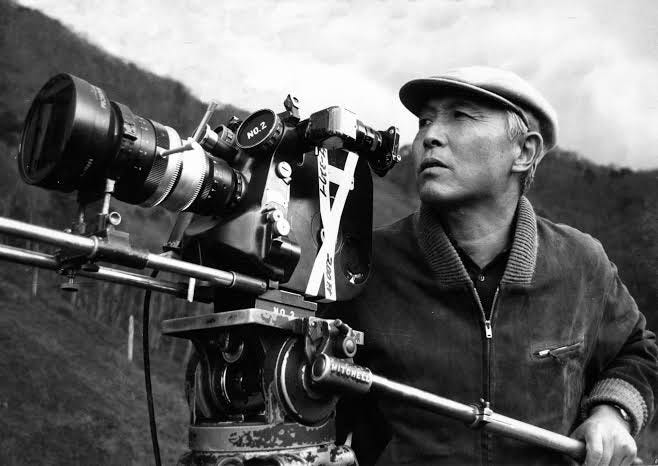
His early filmmaking career was repeatedly interrupted by military service. He experienced combat and captivity, and when he eventually returned to Japan in 1946, he passed through Hiroshima, where he witnessed the devastation left by the atomic bomb.
Honda would later describe the relationship between his filmmaking and those experiences:
“Most of the visual images I got were from my war experience.”
Knowing that changes the experience of watching Godzilla considerably.
When Honda was directing scenes of buildings collapsing, fires spreading through streets and people desperately trying to escape the destruction of a city, he wasn’t simply imagining what those things might look like.
He had witnessed the consequences of war.
And the people watching his film had their own experiences of it.
In March 1945, American aircraft had carried out a devastating firebombing raid on Tokyo, known as Operation Meetinghouse. Fires spread through densely populated neighbourhoods, and an estimated 100,000 people were killed in a single night.
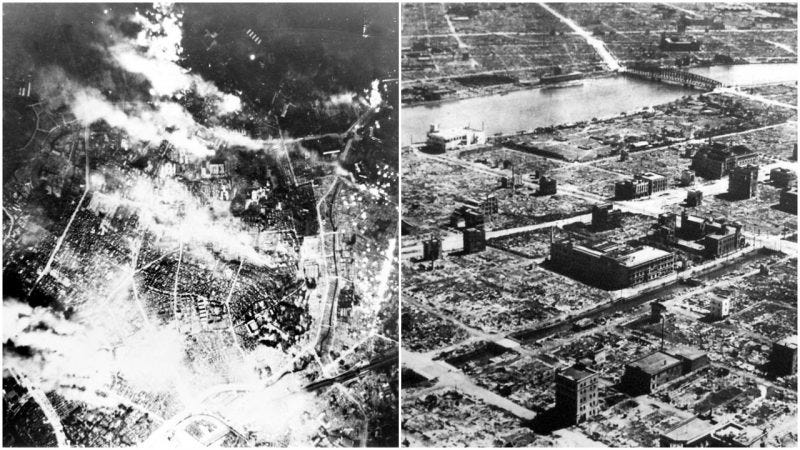
When we see Godzilla walking through Tokyo, setting fire to buildings and leaving large areas of the city in ruins, those images have a significance that can easily be overlooked by those of us watching the film seventy years later.
Honda explained his approach to the design of the monster:
“I took the characteristics of an atomic bomb and applied them to Godzilla.”
And I think that is an extraordinary example of Boldly Creating.
The filmmakers had found a way to take something that was difficult to comprehend, communicate its destructive power and explore its consequences through a fictional creature.
WHAT DID I SURVIVE NAGASAKI FOR?
One of the scenes I found particularly devastating when watching the original film again takes place during a conversation among passengers on a train.
As the passengers discuss the threat posed by Godzilla, one of them refers to having survived Nagasaki.
In one English translation, she asks:
“What did I survive Nagasaki for?”
I found that incredibly moving and it stuck with me for days after watching the film.
During our excavation, Angela recalled a recent visit to Gdańsk in Poland. She had been thinking about the experiences of people who survived the German occupation during the Second World War, only to experience further violence at the hands of Soviet forces.
As Angela observed, there is something particularly devastating about surviving one terrible experience only to discover that the circumstances threatening your survival haven’t disappeared.
And that’s something Honda explores throughout Godzilla.
The film doesn’t simply show us the monster destroying buildings. It shows us what happens to the people afterwards. We see overwhelmed hospitals, injured civilians, grieving families and children being examined for radiation exposure.
There is an extraordinary amount of humanity in this monster movie.
The Criterion Collection describes the original film as a “remarkably humane and melancholy drama”, and I think that is a particularly accurate description.
Godzilla isn’t presented simply as an evil creature acting out of malice. He is also a consequence of something humanity has done.
The film isn’t just asking us to fear the destruction of Japan. It’s asking what happens to humanity when we develop weapons capable of destroying ourselves.
HOW DO WE STOP ONE CATASTROPHE WITHOUT CREATING ANOTHER?
The ethical dilemma at the centre of the original film emerges through the character of Dr Daisuke Serizawa.

Serizawa is a scientist who has developed a technology known as the Oxygen Destroyer, a device with the potential to defeat Godzilla. But he is deeply concerned about revealing the existence of his invention.
He understands that the very thing that might save humanity from Godzilla could subsequently become another weapon capable of causing enormous destruction.
During the film, he describes the cycle:
“A-bombs against A-bombs. H-bombs against H-bombs.”
What I find fascinating about this is that the existence of the Oxygen Destroyer doesn’t provide a straightforward resolution to the story.
Serizawa is faced with a moral dilemma. How does he stop the immediate destruction without creating the possibility of another catastrophe?
He eventually destroys his research and sacrifices his own life to ensure the knowledge behind the Oxygen Destroyer cannot be exploited.
And even after Godzilla has been defeated, the film ends with a warning from Professor Yamane. If humanity continues testing nuclear weapons, another Godzilla might one day appear.
The monster has been defeated, but the conditions that created him haven’t disappeared.
For me, this is a particularly interesting example of Justice Seeking.
We often discuss Justice Seeking in relation to the Autistic experience of identifying something unfair and wanting it to be corrected. But it can also involve wanting to understand why an injustice has occurred and challenging the circumstances that allowed it to happen.
Honda isn’t satisfied with simply giving his audience the defeat of a monster. He wants them to consider the decisions that made the monster possible.
And whilst the filmmakers couldn’t undo what had happened to their country during the war, they could create something that communicated the grief, fear and suffering associated with those experiences.
I think that’s a powerful example of Justice Seeking through creativity.
HOW DO YOU BUILD A MONSTER?
GAME CHANGING INNOVATION · BOTTOM-UP PROCESSING · BOLDLY CREATING
Now, this is where we get into one of my favourite aspects of Godzilla: the filmmaking.
It’s extraordinary enough that the original filmmakers developed the concept of Godzilla. But consider the practical challenges involved in making that concept a reality in 1954.
They needed to create an enormous prehistoric creature and make it appear as though it was physically interacting with a recognisable Japanese city.
They didn’t have access to computer-generated imagery or any of the digital filmmaking technologies we associate with contemporary monster movies.
So, how do you do it?
There were already examples of giant monster cinema. King Kong, released in 1933, had demonstrated the possibilities of stop-motion animation, whilst The Beast from 20,000 Fathoms, released in 1953, featured the extraordinary special-effects work of Ray Harryhausen.
But the Japanese filmmakers were working under different production constraints, and Eiji Tsuburaya and his team developed another approach.
They constructed miniature environments and placed a human performer inside a specially designed monster suit.
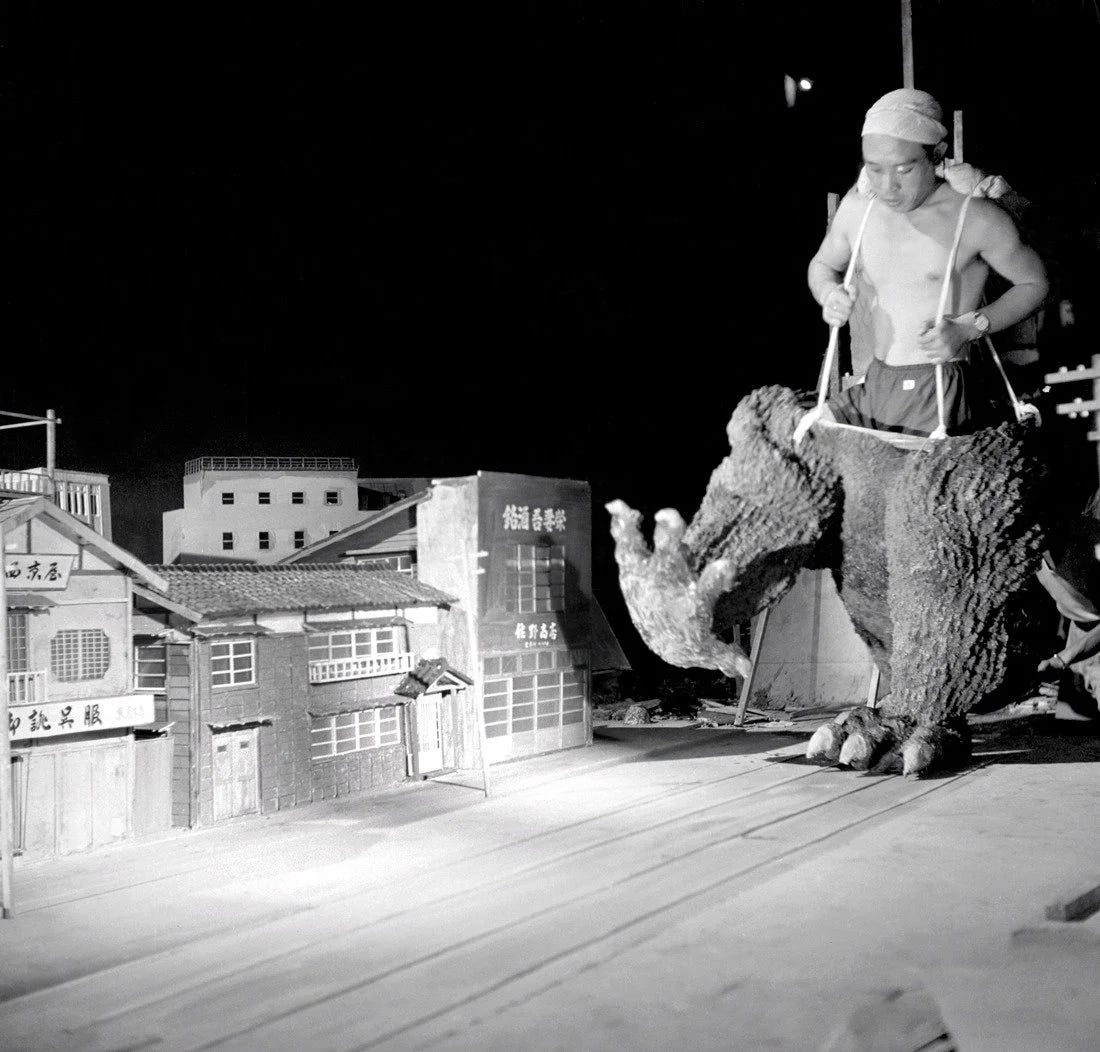
What I find particularly interesting is the extraordinary amount of detail involved in making that work.
BUILDING A TOKYO THAT COULD BE DESTROYED
The filmmakers needed to create miniature buildings, bridges, vehicles and other recognisable features of Tokyo. But those miniatures also had to behave in a particular way when Godzilla interacted with them.
A building didn’t simply need to look like a building. It needed to collapse like one.
The movement of falling debris, the behaviour of smoke and fire, the camera angles and the speed at which the footage was recorded all contributed to the illusion of scale.
Even the movement of the person inside the Godzilla suit had to be considered. If Godzilla moved at the speed of an ordinary human being, the illusion of an enormous creature would become much less convincing.
The filmmakers were faced with an extraordinary creative problem that could only be solved by examining a considerable number of much smaller problems.
How do you make a miniature building appear full-sized? How do you make the creature look heavy? How do you create the impression of an entire city being destroyed?
I think that’s a fascinating example of Bottom-Up Processing and Game Changing Innovation working together.
The filmmakers were constructing something extraordinary through the accumulation of individual details. And the relationship between those details created something much bigger than any of the individual components.
THE MAN INSIDE GODZILLA
One of the people whose contribution to the original film I particularly wanted to recognise is Haruo Nakajima.
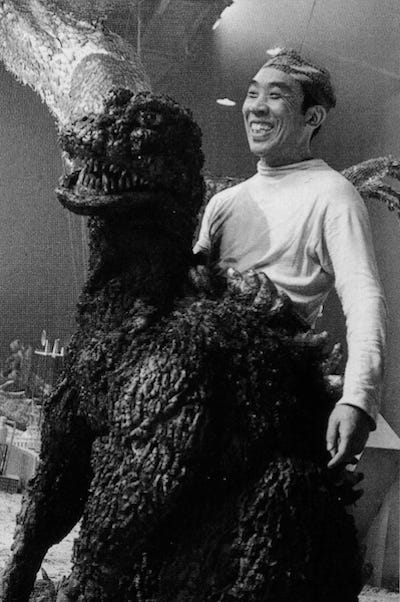
Nakajima was one of the performers who brought Godzilla to life in 1954 and would continue performing as the creature across numerous films.
The original Godzilla costumes were incredibly demanding to wear. They were heavy, restrictive and extremely hot, and Nakajima had to navigate these elaborate miniature environments whilst creating a convincing physical performance.
That performance became an important part of the identity of Godzilla.
Think about the way the creature walks, the positioning of his arms, the movement of his head and the way he interacts with the world around him. These things are as much a part of Godzilla’s identity as the design of the costume.
And amongst Godzilla fans, there is an enormous appreciation of the people who performed inside those suits.
Fans document the different performers, examine the construction of the costumes and identify differences in the physical characteristics of Godzilla across different films.
Even the production history of the character has developed its own mythology.
FROM GODZILLA TO POWER RANGERS
During our excavation, I asked Angela whether she had watched Power Rangers.
It might seem like a rather unusual connection to make when discussing a film about nuclear destruction, but the filmmaking traditions associated with Godzilla have had an enormous influence on Japanese popular culture.
Tokusatsu is a Japanese term associated with special-effects filmmaking.
Think about the elaborate costumes, miniature environments, explosions, giant robots and distinctive fighting styles associated with productions such as Ultraman, Super Sentai and, subsequently, Power Rangers.
They developed within a creative tradition to which Tsuburaya made enormous contributions.
Godzilla didn’t invent giant monster cinema, but it helped define a particular cinematic language that filmmakers could use to communicate scale, movement and destruction.
And I think there’s something extraordinary about the fact that a group of filmmakers solving a very specific creative problem in 1954 contributed to an entire tradition of filmmaking that continues to entertain people today.
It’s a fabulous example of Game Changing Innovation.
THE SOUND OF GODZILLA
RHYTHMIC COMMUNICATING · GAME CHANGING INNOVATION
Now, if there’s one aspect of Godzilla that I could quite happily spend an entire episode discussing, it’s the sound.
Godzilla has one of the most recognisable roars in cinematic history, and the music associated with the character has become an enormous part of his cultural identity.
What interests me about this is that Godzilla is a character who doesn’t speak, and yet the filmmakers have developed an extraordinary way of communicating information about him to the audience.
We can recognise his presence, anticipate his arrival and develop an emotional response to him before he even appears on screen.
And for that, we need to recognise the contribution of Akira Ifukube.
THE GODZILLA MUSIC YOU MIGHT ALREADY KNOW
During our excavation, I asked Angela whether she was familiar with the music from Godzilla.
She wasn’t sure.
But knowing Angela’s appreciation of 1990s hip-hop, I asked her whether she knew Simon Says by Pharoahe Monch.
And, of course, she did.
The song samples music composed by Akira Ifukube for the 1992 film Godzilla vs. Mothra.
So, without necessarily knowing where the music originated, Angela was already familiar with part of the musical language of Godzilla.
Akira Ifukube — Godzilla vs. Mothra (1992)
Pharoahe Monch — Simon Says (1999)
I love this connection because it demonstrates how the creative decisions made by the filmmakers have developed a cultural significance far beyond the films themselves.
The music has become particularly recognisable within Japanese popular culture, and it has been reinterpreted and reused in entirely different musical contexts.
But what fascinates me most is how the filmmakers use that music to communicate with the audience.
Think about the music in Jaws.
Durdum….Durrrrrrdum.
Once we recognise the familiar musical pattern and understand its significance, the filmmakers no longer need to show us the shark to communicate that it’s approaching.
We have learned the language of the film.
Godzilla similarly uses its music in this way. The recurring musical themes, often accompanied by the enormous sound of the creature’s footsteps, create an immediate sense of anticipation.
The audience knows what’s coming.
And that, to me, is a particularly interesting example of Rhythmic Communicating.
THE ROAR THAT WAS MADE FROM A DOUBLE BASS
When the filmmakers were developing the original Godzilla, they needed to establish what the creature sounded like.
And how do you create a sound for an animal that doesn’t exist?
The solution involved something I absolutely love from a sound design perspective.
A double bass.
The strings of the instrument were loosened, and a glove coated in resin was dragged along them to produce a distinctive vibrating sound. The recording was then manipulated to create the roar associated with the original Godzilla.
Have a listen to Godzilla’s original roar — 1954
During our excavation, after playing Angela the original roar, I explained how it had been created and asked her to listen again.
Once you know that the sound originates from a double bass, you can actually hear the characteristics of the instrument within it.
But Angela’s response to hearing the original roar was something I found particularly lovely.
She said it immediately transported her back to her grandparents’ house when she was about six years old, watching Godzilla on television.
We often discuss the emotional associations that we develop with music and familiar sounds. And here was a sound effect created in a Japanese film studio in 1954 that had developed a very personal significance for Angela.
That extraordinary piece of sound design had become connected to her own history.
WHICH GODZILLA ARE YOU LISTENING TO?
What’s particularly interesting about Godzilla’s roar is that it hasn’t remained the same.
As the filmmaking technologies available to different productions developed, so did the sound of the creature.
And there are Godzilla fans who can identify different versions of the character by listening to those sounds.
I’ve encountered footage of people at fan conventions imitating Godzilla’s roar, fans ranking their favourite versions of it, and people creating their own sound effects to accompany footage from the films.
There is also something rather stimmy about the movements and sounds of Godzilla. I’ve seen people imitate the positioning of his arms, the way he walks and, of course, that famous roar.
During our conversation, Angela was particularly interested in these examples of Rhythmic Communicating.
Because the sound has become more than a piece of information communicated by the filmmakers. It has become something that fans reproduce, reinterpret and share.
It’s part of their cultural vocabulary.
GODZILLA DOESN’T HAVE JUST ONE WORLD
WORLD BUILDING · PATTERN MATCHING
One of the things I find particularly fascinating about Godzilla is the mythology.
When you begin looking beyond the original film, you discover this enormous fictional world containing recurring creatures, locations, relationships, histories and stories.
Or, more accurately, several different fictional worlds.
Godzilla has allies and enemies, different origins, different abilities and different relationships with humanity, depending on which films you’re watching.
And yet fans are able to navigate all of it.
THE TOHO MONSTER UNIVERSE
Over the decades, the wider Toho monster universe has introduced an extraordinary collection of creatures, each of whom brings something different into the mythology of Godzilla.
MOTHRA
Mothra first appeared in her own film in 1961.
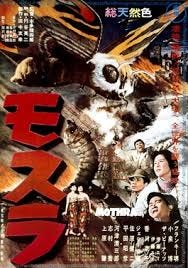
An enormous moth-like creature associated with Infant Island, Mothra is frequently portrayed as a protector and is often accompanied by twin priestesses known as the Shobijin.
Her mythology explores humanity’s relationship with the natural world, and the different stages of her life cycle allow filmmakers to explore recurring themes of death and renewal.
RODAN
Rodan first appeared in 1956 and is an enormous prehistoric flying creature.
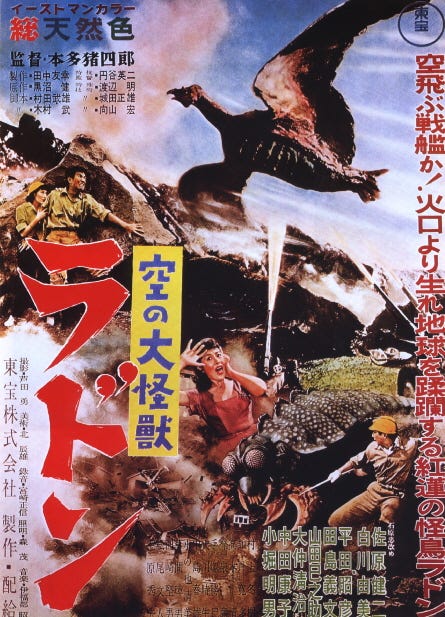
Across different films, Rodan has been portrayed as a threat to humanity, an adversary and an ally to Godzilla.
KING GHIDORAH
Introduced in Ghidorah, the Three-Headed Monster in 1964, King Ghidorah is an enormous three-headed dragon.
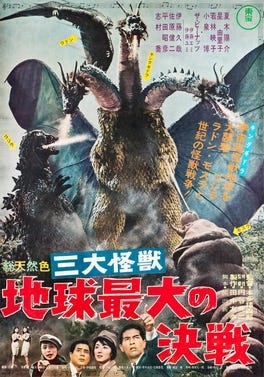
He has become one of Godzilla’s most recognisable adversaries, appearing across multiple interpretations of the franchise, with different origins and abilities.
MECHAGODZILLA
First appearing in 1974, Mechagodzilla is a mechanical interpretation of Godzilla.
Depending on the film, Mechagodzilla might be a weapon created by alien forces or the result of humanity’s attempts to develop a technological defence against Godzilla.
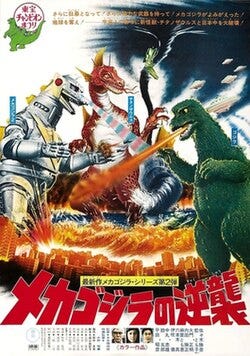
The character provides filmmakers with another way of exploring the relationship between humanity, technology and the destructive power represented by the original monster.
What I find interesting about these creatures is that they aren’t simply opponents for Godzilla to fight. They bring their own mythology into the fictional world.
And that gives the filmmakers an extraordinary amount of material to work with.
FOUR ERAS OF GODZILLA
The Japanese Godzilla films are generally divided into four production eras.
Shōwa 1954–1975
Heisei 1984–1995
Millennium 1999–2004
Reiwa 2016–present
There is also the American MonsterVerse, which has developed its own fictional continuity involving Godzilla, Kong, the Titans and an organisation called Monarch.
But these different eras don’t necessarily constitute one continuous story.
The Heisei films establish a relatively connected continuity, whilst the Millennium era explores several alternative interpretations of Godzilla.
The filmmakers have repeatedly changed the appearance, origins and narrative role of the creature, and there are some enormous differences between different interpretations of the character.
In the original film, Godzilla is terrifying. In some of the later Shōwa films, he becomes a heroic figure who defends humanity against other monsters. And then films such as Shin Godzilla and Godzilla Minus One return him to the role of a destructive threat.
For somebody approaching the franchise for the first time, all of this might seem rather overwhelming.
But for somebody whose passionate interest is Godzilla, there is an extraordinary world of information to explore.
FINDING THE PATTERNS BETWEEN THE WORLDS
This is where I think the relationship between World Building and Pattern Matching becomes particularly interesting.
The different versions of Godzilla retain enough recognisable characteristics for us to understand that they are interpretations of the same creature. But if you examine the details, there are enough differences to make each interpretation distinctive.
The appearance of the monsters, their relationships, the music, the fictional histories and even the way the films are constructed can become things that fans compare and categorise.
And the contradictions between different fictional continuities don’t necessarily detract from the experience.
They become another thing to investigate.
There are also elements of Predictably Comforting within the franchise. Whilst the subject matter of some of the films is anything but comforting, fans can return to these recognisable characters, familiar sounds and favourite fictional worlds repeatedly.
They can enjoy that familiarity whilst also discovering something new about the thing they love.
And it’s the people who have developed these extraordinary relationships with Godzilla that I wanted to examine next.
THE FANDOM THAT BUILT ITS OWN ARCHIVE
PASSIONATE SUPERFANNING · PATTERN MATCHING · BOTTOM-UP PROCESSING
If you spend any amount of time exploring the Godzilla fandom, you’ll discover that watching the films is only one part of the experience.
There are people who have developed an extraordinary amount of specialist knowledge about the history of Godzilla, not just as a fictional character but as a cinematic creation.
They can identify the different costumes, tell you who performed inside them, recognise the individual roars and explain how the designs of the creatures have changed over time.
Even individual Godzilla suit designs have names used by fans to distinguish them.
The original 1954 design is commonly known as ShodaiGoji. The version appearing in King Kong vs. Godzilla in 1962 is known as KingGoji, whilst the distinctive design introduced in Mothra vs. Godzilla in 1964 is known as MosuGoji.
There’s an entire vocabulary associated with the history of Godzilla’s appearance.
And I think that’s fabulous.
Because somebody who has very little knowledge of Godzilla might look at two of these designs and simply see the same creature. But somebody who has developed that specialist knowledge will recognise the differences in the shape of the head, the proportions of the body or the arrangement of the dorsal plates.
Those individual details become incredibly meaningful.
COLLECTING THE HISTORY OF GODZILLA
I’ve seen collections of Godzilla figures displayed in cabinets, organised chronologically according to the films in which those versions of the creature appeared.
What I find particularly interesting about that is that the collection becomes a physical representation of the history of Godzilla.
You can look at the different figures and see how the design of the creature has developed across decades of filmmaking.
For the person who has curated that collection, each figure represents a particular piece of information. And the way those pieces of information have been organised reflects their understanding of the wider history.
It’s an extraordinary combination of Passionate Superfanning, Pattern Matching and Bottom-Up Processing.
They’re effectively creating their own little cultural archives.
A WORLD BUILT BY THE FANS
The Godzilla fandom has also developed its own communities, conventions and resources.
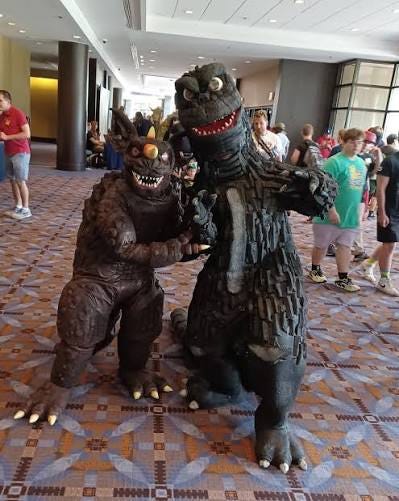
G-FEST, for example, brings together people with a passionate interest in Godzilla and wider Japanese monster culture. Fans can meet people associated with the films, attend discussions, share their collections and celebrate the creative work that has been inspired by them.
And I think there’s something particularly important about having access to spaces where other people understand the significance of the things you know.
Imagine having spent years developing an extraordinary amount of knowledge about the different Godzilla costumes and then finding yourself in a room full of people who are just as interested in those details as you are.
That knowledge becomes a way of connecting with other people.
There are also fans creating their own artwork, animations, fictional monsters, costumes and stories. They’ve developed an understanding of the mythology and the filmmaking traditions associated with Godzilla, and they’re using that knowledge to create something of their own.
This is a relationship between Passionate Superfanning and Boldly Creating that we’ve encountered before in the Autistic Cultural Archive.
During our excavation of Scream, we explored how Kevin Williamson’s love of horror cinema informed his own creative work.
And within the history of Godzilla, there is another extraordinary example of a filmmaker whose childhood fascination with something became the foundation of his own creative achievements.
WHEN THE SUPERFAN BECOMES THE FILMMAKER
PASSIONATE SUPERFANNING · BOLDLY CREATING · GAME CHANGING INNOVATION
Takashi Yamazaki is the writer, director and visual-effects supervisor behind Godzilla Minus One.
He’s also a huge Godzilla fan.
Yamazaki grew up watching Godzilla films and has spoken about the impact the creature had on his imagination during childhood. Interestingly, he’s discussed how frightening he found Godzilla when he was young.
Decades later, he was allowed to make his own Godzilla film.
And one of the things I find particularly interesting about the film he chose to make is that, after decades of different interpretations of the character, he returned to the historical and emotional foundations of the original.
GODZILLA MINUS ONE
JUSTICE SEEKING · BOLDLY CREATING
Released in 2023, Godzilla Minus One takes us back to Japan in the aftermath of the Second World War.
The country is devastated, and people are attempting to rebuild their lives with very little available to them.
It’s within this environment that we’re introduced to Kōichi Shikishima, a former kamikaze pilot struggling with survivor’s guilt and the psychological consequences of his experiences during the war.
One of the things that makes Godzilla Minus One such a moving film is the amount of attention it pays to the lives of its human characters.
Shikishima is trying to establish a life for himself, forming relationships with other people who have also experienced enormous loss. And just as those people are beginning to rebuild their lives, Godzilla emerges.
The film explores grief, guilt, responsibility, family and what it means to survive something terrible.
And I think there’s a particularly interesting element of justice-seeking within the way Yamazaki explores the expectations placed upon Japanese people during the Second World War.
Shikishima has been conditioned to believe that his survival is a failure. His value as a person was supposed to be demonstrated through his willingness to sacrifice his life.
But throughout the film, those ideas are challenged.
There’s a determination amongst the people attempting to defeat Godzilla that they should do so without unnecessarily sacrificing their lives.
These are people who have experienced the consequences of being treated as expendable, and they’re trying to establish a different relationship with the value of human life.
I find that incredibly moving.
And it was one of the things that made me want to return to the original film during this excavation.
Because, although they’re different films made by filmmakers from different generations, Honda and Yamazaki are exploring some remarkably connected ideas through the same fictional creature.
FROM A MINIATURE TOKYO TO AN ACADEMY AWARD
GAME CHANGING INNOVATION · BOTTOM-UP PROCESSING
There is another extraordinary connection between the original Godzilla and Godzilla Minus One.
The filmmakers behind the 1954 film had developed an innovative combination of miniature environments, creature performance and special-effects techniques to bring Godzilla to life.
Nearly seventy years later, Yamazaki and his team were trying to achieve something similar using digital filmmaking technologies.
But many of the fundamental creative problems remained the same.
How do you communicate the scale of the creature? How do you give it a convincing physical presence? How does the environment respond when something that size begins moving through it?
And how do you make the destruction feel significant to the human story?
The filmmakers behind Godzilla Minus One achieved something extraordinary with a production budget considerably smaller than those associated with many contemporary Hollywood blockbusters.
In March 2024, the film won the Academy Award for Best Visual Effects.
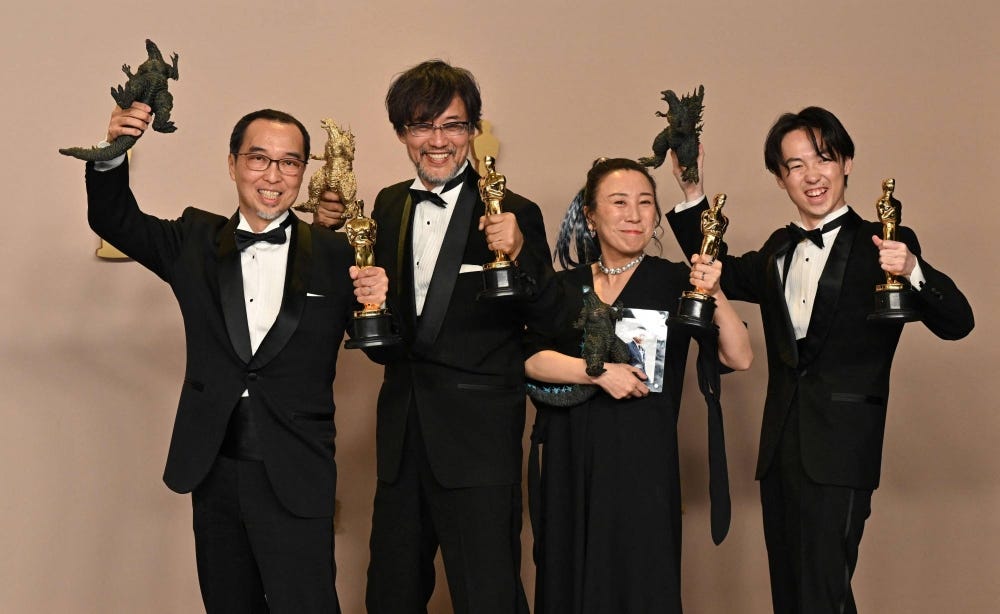
It became the first Japanese film to receive that award, and I think that’s a humongous moment in the history of Godzilla.
A franchise whose original filmmakers had helped develop an enormously influential approach to special-effects filmmaking was being recognised internationally for its visual effects nearly seventy years later.
And the filmmaker responsible had grown up watching the very films that had established that creative tradition.
GODZILLA MINUS COLOR
There is also a black-and-white version of Godzilla Minus One, known as Godzilla Minus One/Minus Color.
And if you haven’t seen it, I highly recommend it. It’s an incredible piece of Cinema!
What I particularly like about the existence of this version is the relationship it establishes with the original 1954 film.
It’s not simply a contemporary Godzilla film with the colour removed. It provides another visual interpretation of the story, drawing our attention to the textures, shadows and atmosphere of the environments.
Watching the original Godzilla and Godzilla Minus One/Minus Colour alongside one another is a particularly interesting experience.
You can appreciate how much the filmmaking technologies have developed, whilst also recognising how much of the original cinematic language remains present.
And I think Yamazaki’s relationship with Godzilla is an extraordinary example of what can happen when a passionate interest becomes a foundation for creative expression.
He didn’t simply recreate something he loved.
He used his understanding of it to create something that another generation of people could fall in love with, which, after this excavation, I believe I have!
CLOSING THE EXCAVATION
When I began researching Godzilla, I thought I was going to spend most of this excavation discussing monster movies, filmmaking techniques and the extraordinary knowledge demonstrated by Godzilla fans.
And I certainly found plenty of evidence of those things!
But the most significant discovery for me was the relationship between the original filmmakers and the historical circumstances in which they created Godzilla.
I found a director who had experienced the horrors of war and used his filmmaking to explore the consequences of nuclear destruction.
I found a team of special-effects artists who had developed innovative ways of making those ideas visible, and a composer who created a musical language that remains recognisable generations later.
And then I found an enormous community of people who have developed their own relationships with that creation.
They’ve documented its history, collected its artefacts, learned its language and created their own fictional worlds.
Some of those people have subsequently become the filmmakers responsible for continuing its legacy.
I think the relationship between the different Pillars of Autistic Culture is particularly interesting in this excavation. The Justice Seeking of the original film provides a creative motivation, whilst Game Changing Innovation and Boldly Creating provide the means of expressing it.
World Building creates opportunities for people to explore that creation in considerable detail. And Rhythmic Communicating and Passionate Superfanning help establish a shared culture around it.
What’s particularly lovely about all of this is that the seriousness of Godzilla’s original meaning can coexist with the joy that people experience through their passionate interests.
You can appreciate the original film as an extraordinary piece of cinema about the consequences of war, whilst also enjoying collecting little models of the monsters or learning to distinguish between their roars.
Those relationships with Godzilla are all part of its cultural history.
And more than seventy years after four Japanese filmmakers found a way to give physical form to the fear of nuclear destruction, people are still finding new things to communicate through their creation.
I think that’s extraordinary.
And it’s why I wanted to bring Godzilla into the Autistic Cultural Archive.
ACCOMPANYING EXCAVATOR’S NOTES
Dr Angela Kingdon
One of the things I found particularly interesting about Simon’s excavation of Godzilla was how familiar the character was to me, despite how little I knew about the history behind him.
When Simon played the original Godzilla roar, I was immediately transported back to my grandparents’ house, where I remember watching Godzilla on television as a child.
I think that’s a lovely example of the emotional significance that familiar sounds can develop throughout our lives.
But what I hadn’t appreciated was the relationship between the original film and the experiences of the Japanese people following the Second World War.
There’s something incredibly moving about the filmmakers’ decision to use a fictional creature to explore those experiences.
I also loved hearing Simon describe the specialist knowledge within the Godzilla fandom.
The different roars, the different costumes, the collections and the ability to identify all those little details are such recognisable examples of the cultural practices we’ve been exploring within the Archive.
And when you consider the relationships between the filmmaking, the fictional worlds and the culture that has developed around them, Godzilla makes an extraordinary amount of sense within the framework of Autistic Culture.
I think it helps explain why this character has occupied such a significant place in popular culture for more than seventy years.
He belongs in the Archive!

CLASSIFICATION
After examining the evidence, we’re filing Godzilla in the Autistic Cultural Archive. Not because we can establish that the original filmmakers were Autistic, or because every person who develops a passionate interest in Godzilla should be interpreted as neurodivergent, but because the creation, development and cultural legacy of Godzilla reveal substantial connections to the Ten Pillars of Autistic Culture.
Justice Seeking appears in the historical origins of the original film, Ishirō Honda’s exploration of the human consequences of war and nuclear destruction, and the continuing examination of grief, responsibility and the value of human life in Godzilla Minus One.
Game Changing Innovation appears in the special-effects filmmaking of Eiji Tsuburaya and his team, the development of an influential cinematic language and the Academy Award-winning visual effects of Takashi Yamazaki’s contemporary interpretation of Godzilla.
Rhythmic Communicating appears in Akira Ifukube’s music, Godzilla’s distinctive roars and physical movements, and the ways fans recognise, reproduce and share these sounds and gestures.
World Building appears in the extraordinary collection of creatures, locations, fictional histories and alternative continuities that have developed throughout the franchise.
Passionate Superfanning appears in the collections, specialist knowledge, fan communities and creative expressions associated with Godzilla, including Takashi Yamazaki’s development of his childhood fascination into his own filmmaking.
The Archive also contains several important supporting traces. Boldly Creating appears throughout the creative expression of the filmmakers and their fans. Bottom-Up Processing appears in the construction of the original special effects and the accumulation of specialist knowledge through individual details. Pattern Matching appears in the recognition and comparison of creature designs, roars, musical themes and fictional continuities.
Norm Challenging appears in the ethical questions posed by the original film and the examination of expectations surrounding sacrifice in Godzilla Minus One. And Predictably Comforting offers a further cultural connection through the familiarity of recurring characters, recognisable sounds and favourite fictional worlds.
Taken together, the evidence supports the classification.
ARTEFACT: GODZILLA (1954–PRESENT)
CLASSIFICATION: AUTISTIC CULTURE
PRIMARY PILLARS: Justice Seeking · Game Changing Innovation · Rhythmic Communicating · World Building · Passionate Superfanning
ADDITIONAL TRACES: Boldly Creating · Bottom-Up Processing · Pattern Matching · Norm Challenging · Predictably Comforting
ARCHIVE NO.: ACA-008-GODZILLA
LEAD EXCAVATOR: Simon Scott
ACCOMPANYING EXCAVATOR: Dr Angela Kingdon
STATUS: Excavation Complete
Godzilla is an Autistic Culture Artefact.
SUBMIT YOUR EVIDENCE
An archive is never finished. So now we’re handing the brushes to you.
What did we miss?
Is Godzilla one of your passionate interests?
Can you recognise the different versions of Godzilla from their appearance or the sound of their roars?
Perhaps you collect Godzilla figures, create your own monsters or have developed an extraordinary amount of knowledge about Japanese monster cinema.
And what about the original film?
Does its exploration of nuclear destruction and the human consequences of war resonate with your own experiences of Justice Seeking?
Are there other creatures, films, filmmakers or fan communities that deserve a place in our evidence locker?
Leave your field notes in the comments and tell us: What’s your favourite Godzilla?
The Archive is never finished.