


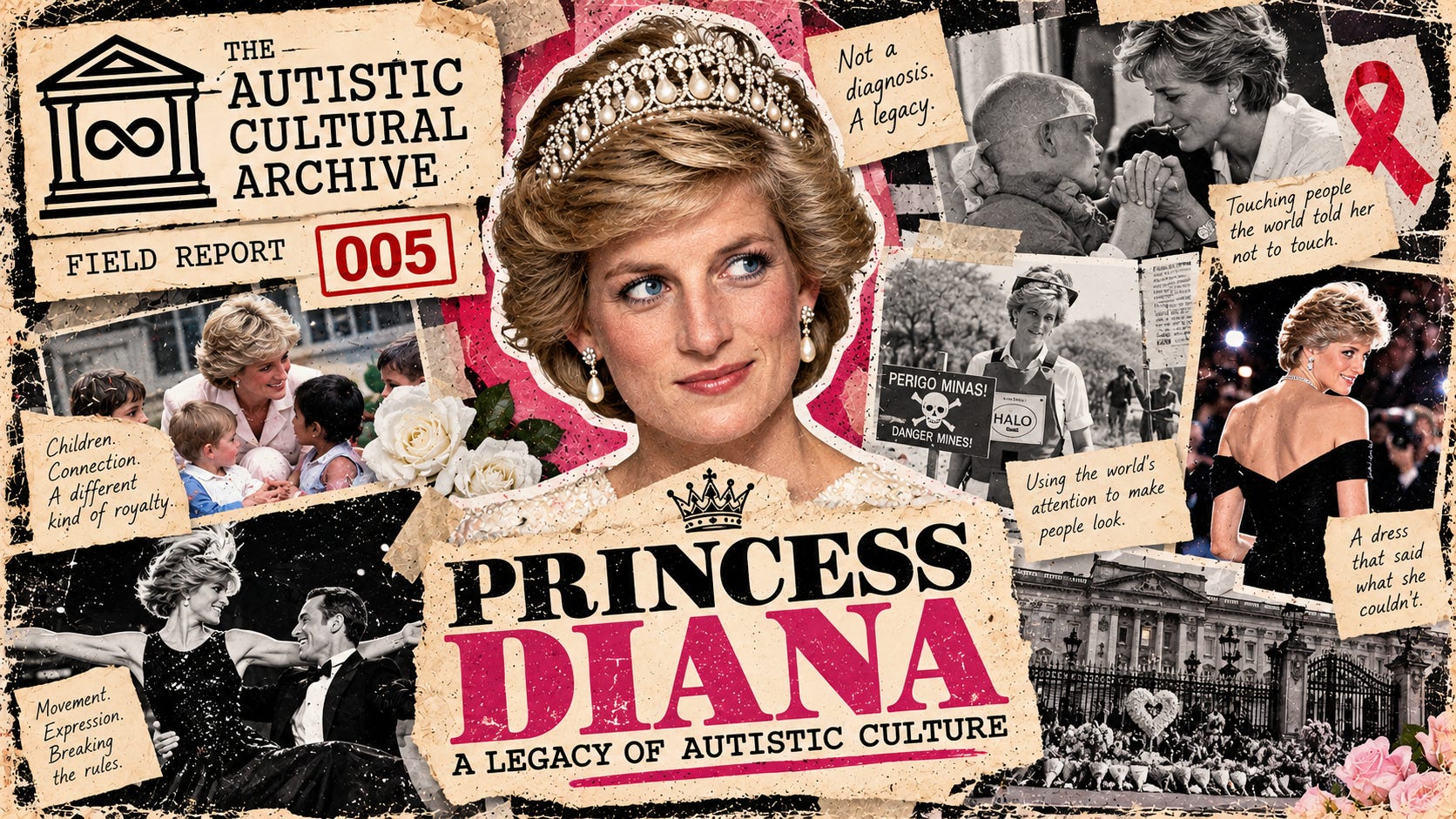
FIELD REPORT [005]
THE AUTISTIC CULTURAL ARCHIVE
ARTEFACT: The Cultural Legacy of Princess Diana
ARCHIVE NO.: ACA-005-PRINCESS-DIANA
PERIOD: 1961–1997 / Continuing Cultural Legacy
CLASSIFICATION: AUTISTIC CULTURE
PRIMARY PILLARS: Norm Challenging · Justice Seeking · Game Changing Innovation · Boldly Creating · Passionate Superfanning
ADDITIONAL TRACES: Predictably Comforting · Rhythmic Communicating
LEAD EXCAVATOR: Dr Angela Kingdon
ACCOMPANYING EXCAVATOR: Simon Scott
LISTEN TO THE EXCAVATION
This Field Report accompanies our excavation of The Legcacy of Princess Diana on This Week in Autistic Culture.
The Archive segment presents the case.
The Field Report contains the evidence locker.
Listen to the full excavation on the Autistic Culture Podcast Network.
Watch the excavation on our YouTube channel.
THE DISCOVERY
What happens when a woman enters one of the world's most rigidly structured institutions and refuses to behave the way that institution expects?
She touches people she isn’t supposed to touch.
She befriends people she isn’t supposed to befriend.
She speaks about subjects she isn’t supposed to discuss.
She dances when she is supposed to remain composed.
She cries when she is supposed to remain dignified.
She wears clothes that say things she cannot say aloud.
She tells the world she doesn’t follow the rulebook.
That woman was Diana, Princess of Wales.
For much of her public life, the institutions around her struggled to understand what to do with her.
Diana was supposed to represent tradition.
Instead, she became associated with challenging it.
She was supposed to embody royal distance.
Instead, she became famous for her closeness to people.
She was supposed to preserve an institution’s image.
Instead, she helped change what the public expected that institution to be.
That contradiction is at the heart of this excavation.
Because when we look at Diana through the Ten Pillars of Autistic Culture, something fascinating begins to emerge.
Not a diagnosis.
Not a checklist.
But a collection of cultural fingerprints.
Norm-challenging.
Justice-seeking.
Game-changing innovation.
Boldly Creating.
And a deep, sustained devotion to the people and interests that mattered to her.
When I brought Diana into the Autistic Cultural Archive, I wanted to examine those connections.
I also wanted to understand something more personal.
Why did so many people feel that Diana understood them when the institution she represented seemed so distant?
And why does her legacy continue to resonate with people who have spent their lives feeling different, misunderstood, or excluded?
Because whether or not Diana was Autistic, her legacy offers an extraordinary opportunity to examine the values we recognise in Autistic Culture.
The strongest evidence comes from the moments when she refused to behave like a princess.
THE ARTEFACT
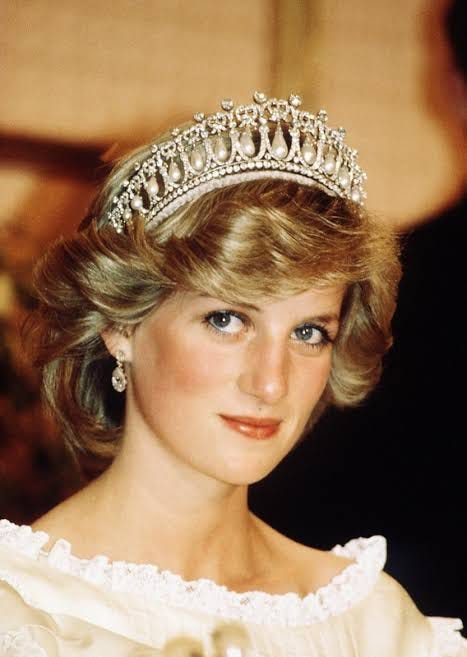
Diana Frances Spencer was born on 1 July 1961. She grew up in an aristocratic family with close connections to the British royal household.
Her childhood was marked by her parents’ separation, difficult family relationships, and an educational experience that did not always accommodate her strengths.
She struggled academically.
She did not achieve the conventional qualifications expected of a successful student.
But she had other interests.
Children.
Music.
Dance.
Relationships.
And the experience of connecting directly with people.
Before becoming a princess, Diana worked as a nanny and at the Young England Kindergarten in Pimlico.
She was comfortable around children, and she had a particular ability to make people feel that they had her attention.
In 1981, she married Charles, Prince of Wales.
She was twenty years old.
Almost overnight, she became one of the most recognisable women in the world.
Her wedding was watched by an enormous international audience, and the newspapers followed her every movement.
Her clothes were examined.
Her expressions were interpreted.
Her marriage became public property.
And she entered an institution with centuries of established rules about how a royal woman should behave.
The contrast between Diana’s public image and her private experiences became one of the defining stories of her life.
She experienced serious mental health difficulties, including bulimia, which she later discussed publicly.
Her marriage deteriorated, and she became the subject of relentless media attention.
Her relationship with the royal establishment became increasingly strained.
But alongside those difficulties, she developed a distinctive public identity.
She became known for visiting hospitals, supporting people affected by HIV and AIDS, spending time with children, and drawing attention to humanitarian causes.
She also transformed royal fashion into a form of communication.
And in the final years of her life, she used her extraordinary public visibility to bring attention to the international campaign against landmines.
Diana died on 31 August 1997, aged 36.
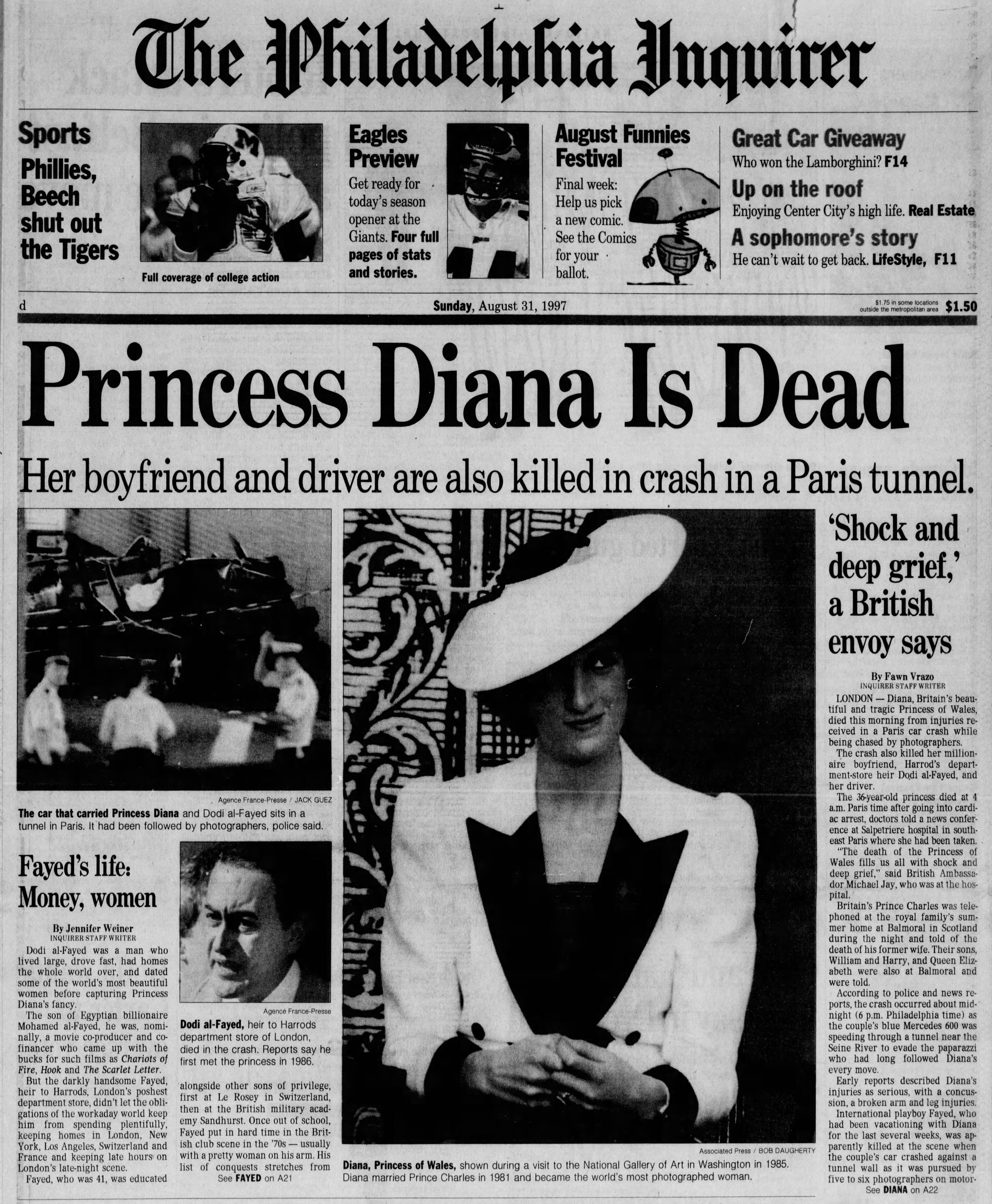
The public response to her death was extraordinary.
Millions mourned.
Flowers accumulated outside royal residences.
Her funeral became a defining cultural moment.
And nearly three decades later, people continue to discuss her life, her relationships, her fashion, her humanitarian work, and the changes she brought to the monarchy.
That enduring cultural presence is part of what makes Diana such an interesting artefact.
Because we are not simply excavating a historical figure.
We are excavating a legacy.
THE EXCAVATION
THE PRINCESS WHO DIDN’T FOLLOW THE RULE BOOK
NORM CHALLENGING · GAME-CHANGING INNOVATION
One of the strongest connections I found during my research came from Diana’s own words.
In her 1995 Panorama interview, she was asked why she believed the royal establishment did not want her to become queen.
Her answer was revealing.
“Because I do things differently, because I don’t go by a rule book, because I lead from the heart, not the head.”
That is an extraordinary statement from somebody whose public role was defined by following rules.
The monarchy operates through hierarchy.
Protocol.
Ceremony.
Tradition.
And a carefully managed distinction between the royal family and the people they represent.
Diana repeatedly challenged those distinctions.
Sometimes through deliberate public actions.
Sometimes through her relationships.
And sometimes simply by behaving in ways that were not expected of her.
Her former protection officer Ken Wharfe described her preference for addressing staff by their first names.
She was uncomfortable with some of the distance built into royal life.
And she increasingly developed relationships with people who existed outside the traditional social world of the monarchy.
What interests me here is not simply that Diana broke rules.
Plenty of famous people break rules.
The question is which rules she challenged, and why.
Diana repeatedly challenged conventions that created distance between people.
Rules about who deserved attention.
Rules about who could be touched.
Rules about who belonged.
Rules about how to express or repress emotions.
And rules about the relationship between status and human worth.
Those are much more substantial connections to Norm Challenging than simply describing somebody as rebellious.
A FIND FROM THE EXCAVATION
During our conversation, Simon recognised this tension between Diana and the institution surrounding her.
He described the ways she challenged royal expectations and the effect that had on the public’s relationship with the monarchy.
And that raised an interesting question.
What happens when somebody’s values conflict with the social rules of the environment they inhabit?
Many Autistic people describe experiences of questioning conventions that other people seem to accept automatically.
Why should somebody receive different treatment because of their position?
Why should a rule exist if it doesn’t serve a meaningful purpose?
Why should somebody’s social status determine whether they deserve kindness?
We cannot establish that Diana approached those questions through Autistic cognition.
But we can recognise that her public behaviour repeatedly challenged the same kinds of arbitrary distinctions.
And the consequences were enormous.
Because Diana wasn’t challenging the rules of an ordinary workplace.
She was challenging the conventions of the British monarchy.
THE WOMAN WHO TOUCHED THE UNTOUCHABLE
NORM CHALLENGING · JUSTICE SEEKING
If there is one image that captures Diana’s cultural impact, it may be a photograph of her holding somebody’s hand.
That might seem like an ordinary gesture.
But in 1987, it was ANYTHING but ordinary.
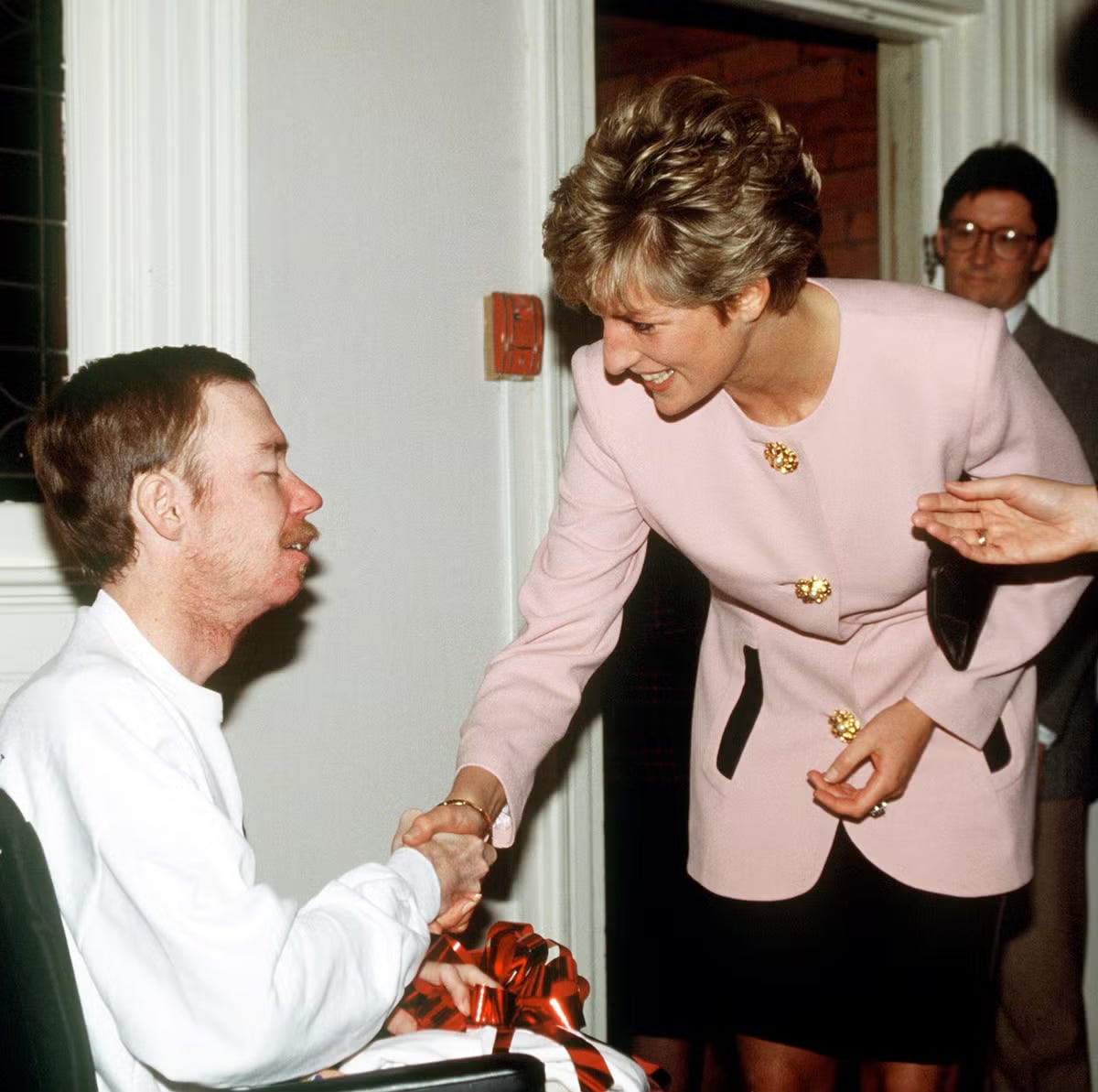
At the time, public understanding of HIV and AIDS was surrounded by misinformation.
People feared physical contact.
People living with HIV faced extraordinary stigma.
And many were treated as though ordinary human interaction presented a danger.
In April 1987, Diana opened the Broderip Ward at the Middlesex Hospital in London, a specialist ward for people living with HIV and AIDS.
She shook a patient’s hand without wearing gloves.
It was a simple action.
The cultural message was enormous.
A princess was publicly demonstrating that somebody living with HIV was not untouchable.
She was using one of the most recognisable images in the world to challenge a dangerous social assumption.
And she continued doing it.
In 1989, during a visit to Indonesia, Diana visited people affected by leprosy.
Again, she challenged public fears surrounding physical contact.
Again, she demonstrated her message through her behaviour.
And again, the photographs communicated something that words alone might not have achieved.
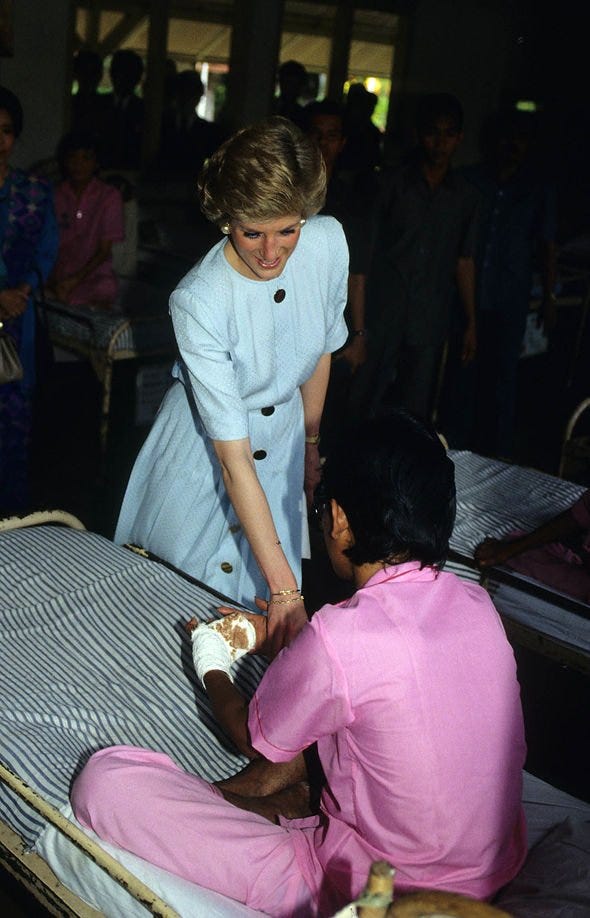
In a 1991 speech about children and AIDS, she explained the principle directly:
“HIV does not make people dangerous to know, so you can shake their hands and give them a hug.”
I think this is one of the strongest pieces of evidence in the entire excavation.
Because it connects two pillars.
Norm-Challenging and Justice-Seeking.
Diana was not simply behaving differently.
She was challenging conventions that harmed people.
THE CULTURAL IMPORTANCE OF TOUCH
During our excavation, Simon and I discussed Diana’s relationship with communities that were experiencing exclusion.
Her friendships with gay men.
Her visits to hospices.
Her relationships with people affected by HIV and AIDS.
And her willingness to enter spaces that the public often misunderstood.
Diana’s friendship with Elton John is particularly well documented.
They met in 1981.
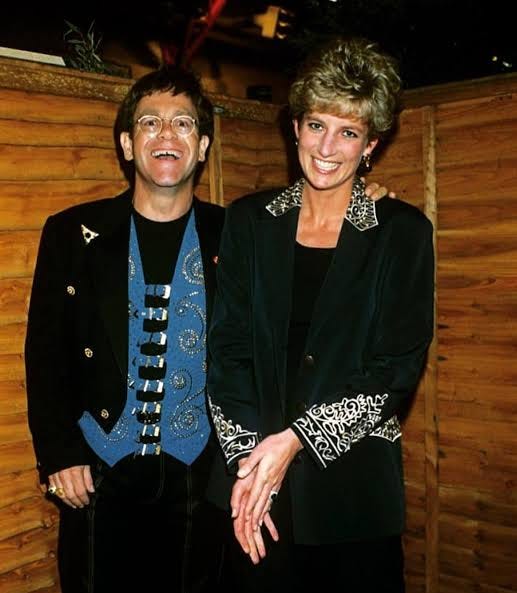
Their relationship continued through the following years, including periods of disagreement.
And one of the most recognisable photographs of Diana’s final summer shows her comforting Elton John at the funeral of fashion designer Gianni Versace in 1997.
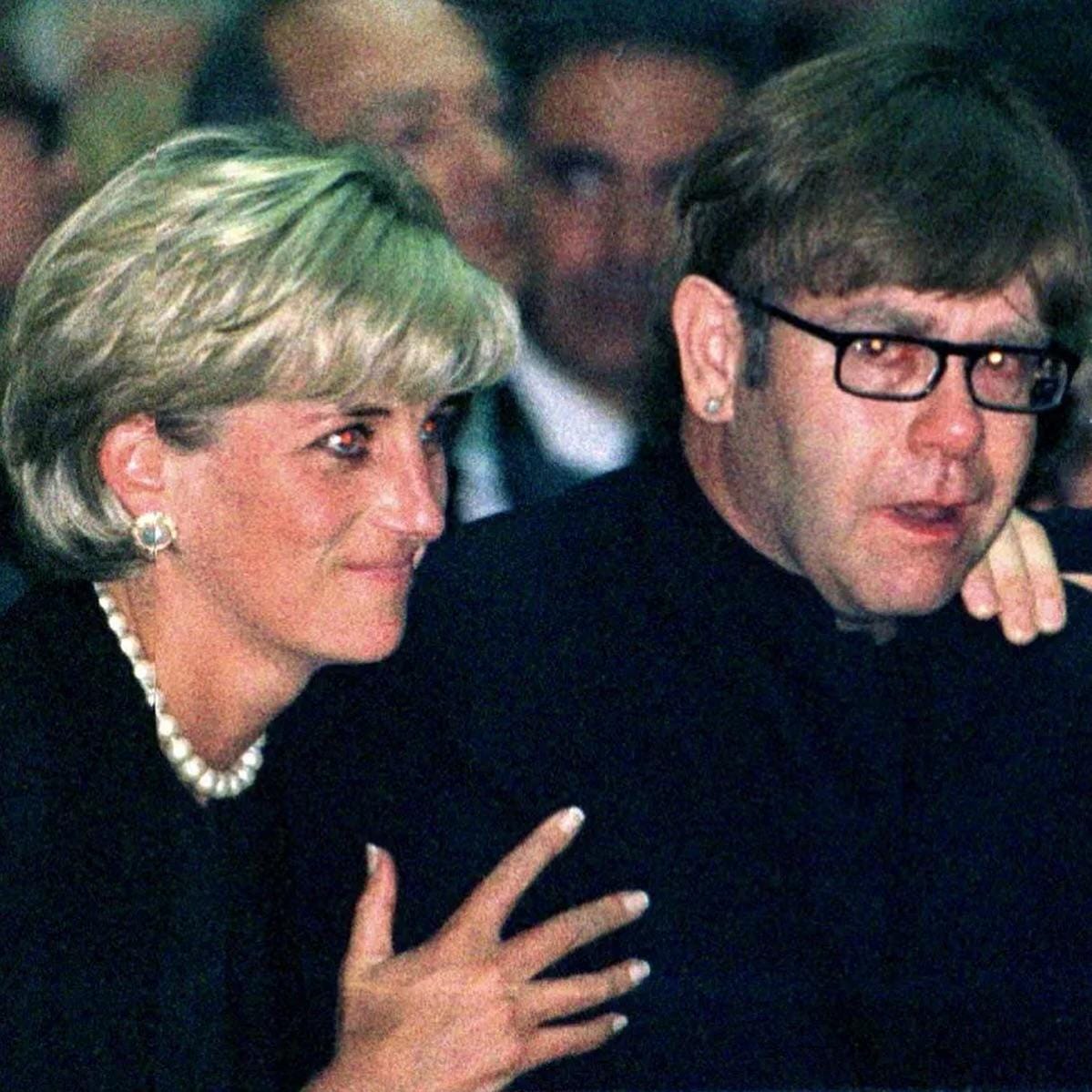
But Diana’s connection to people affected by AIDS extended far beyond celebrity friendships.
She visited the London Lighthouse hospice.
She spent time with residents.
And she helped make visible people whom society frequently preferred not to see.
We should be careful not to turn this into a claim that Diana led a formal gay-rights campaign.
The evidence for her AIDS work and friendships is much stronger than the evidence for any specific political campaigning on gay rights.
But the cultural significance of her actions remains substantial.
She demonstrated that people who were being rejected by society deserved dignity, friendship, physical affection, and public recognition.
And that brings us to one of her most revealing statements.
During the 1995 Panorama interview, Diana said:
“I found myself being more and more involved with people who were rejected by society … and I found an affinity there.”
Affinity. That word stayed with me.
Because Diana wasn’t simply describing charitable duty.
She was describing a connection.
She recognised something in people who had experienced rejection.
And she felt drawn towards them.
I cannot tell you precisely why she experienced that affinity. But I think we can recognise its cultural importance.
Diana made solidarity with outsiders part of her public identity.
And she did so from inside an institution that traditionally represented the centre of the establishment.
THE PRINCESS WHO CHANGED WHAT ROYALTY COULD DO
GAME CHANGING INNOVATION · JUSTICE SEEKING
One of the things I find most interesting about Diana is that she understood the extraordinary power of public attention.
The cameras followed her everywhere.
She could not escape them.
But she increasingly learned to direct them.
And that became one of the most important innovations of her public life.
Royal charitable work was already well established.
Diana did not invent the idea of a royal patron supporting a cause.
What she helped change was the relationship between the royal figure, the people receiving support, and the public watching.
Instead of maintaining distance, she moved closer.
Instead of allowing an institution to determine the entire message, she increasingly communicated through her own actions.
And instead of treating public attention as something that belonged exclusively to the monarchy, she brought that attention to people who had very little of it.
I think this is where Game-Changing Innovation becomes particularly interesting.
Because innovation does not always mean inventing a new technology.
Sometimes it means recognising that an existing system can be used differently.
Diana understood that a photograph of her visiting a hospital would travel around the world.
She understood that a gesture could challenge public attitudes.
And she understood that the public’s fascination with her could be redirected towards people and causes that needed attention.
THE MINEFIELD
In January 1997, Diana travelled to Angola with the British Red Cross.
She visited people affected by landmines.
And she walked along a cleared route through a former minefield in Huambo, wearing protective equipment.
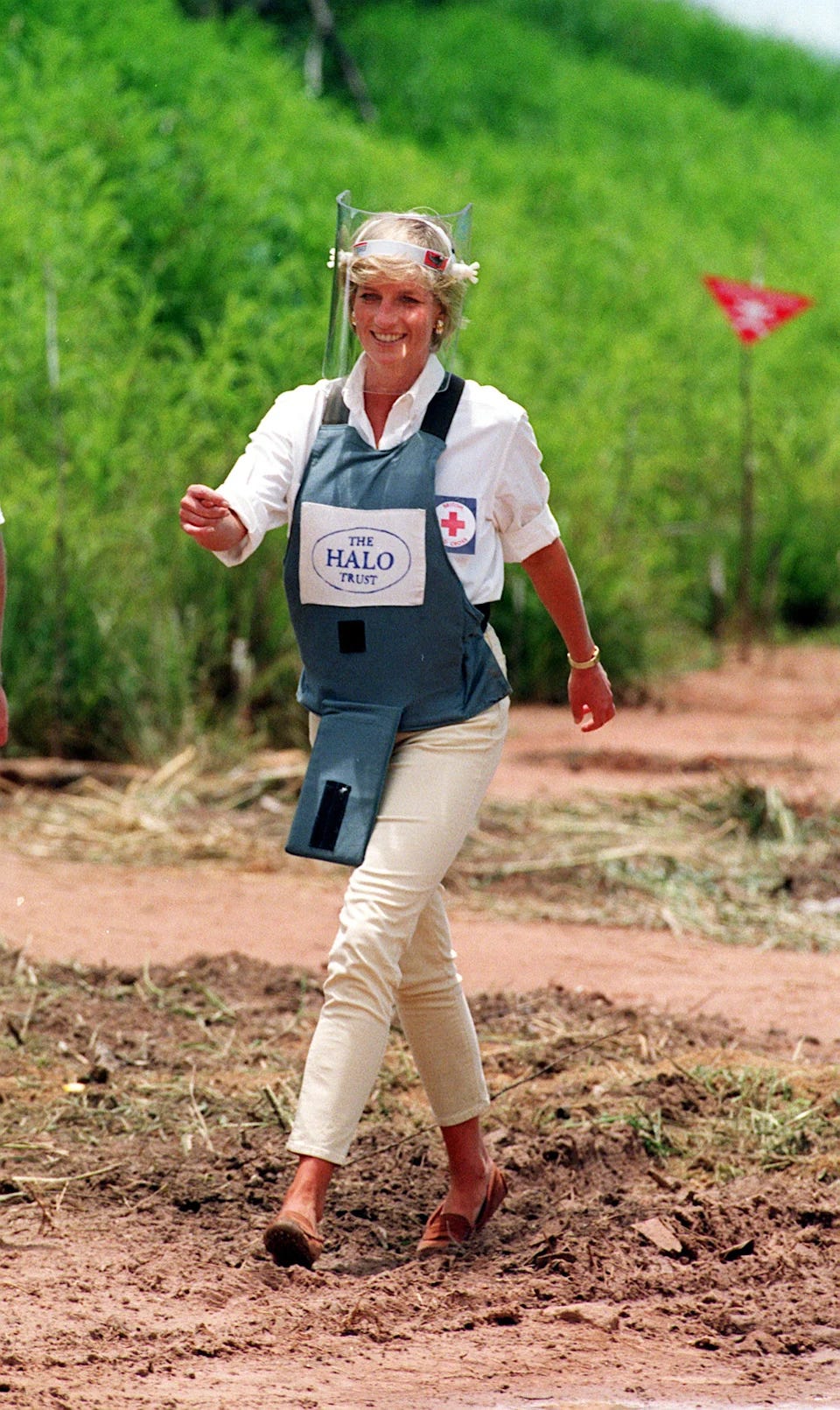
The photographs became some of the defining images of her final year.
A princess.
A protective visor.
A flak jacket.
And the devastating consequences of a weapon that continued harming civilians long after conflicts had ended.
In August 1997, Diana also visited Bosnia, where she met landmine survivors.
Three weeks later, she died.
The Mine Ban Treaty was opened for signature in December 1997.
Diana did not create the international movement against landmines.
Campaigners, humanitarian organisations, survivors, and governments had been working on the issue for years.
But her involvement brought extraordinary attention to their work.
Paul Heslop, the HALO Trust deminer who accompanied her in Angola, later reflected on her contribution:
“I’m not saying that Diana made it happen, but I am saying that I think her involvement made it a lot harder for it not to happen.”
I think that is a useful way to understand her impact.
She did not need to invent the campaign.
She needed to make people look.
And she understood how to do that.
A FIND FROM THE EXCAVATION
During our recording, Simon identified Diana’s humanitarian work as one of the strongest reasons to place her legacy in the Archive.
He connected her work with people affected by AIDS, her relationship with LGBTQ+ communities, and her campaigning against landmines.
But he also recognised something about the monarchy itself.
Diana helped change public expectations of what a royal figure could be.
And that is a much larger cultural shift.
Today, public figures are frequently expected to demonstrate personal engagement with charitable causes.
They are expected to visit communities.
Listen to people.
Show emotion.
Communicate directly.
Those expectations did not begin with Diana.
But she helped transform the public understanding of how royal humanitarian work could look.
She made closeness part of the performance of public service.
And she made distance look increasingly outdated.
THE PRINCESS WHO SPOKE WITHOUT WORDS
BOLDLY CREATING · NORM CHALLENGING
One of my favourite discoveries in this excavation concerns Diana’s relationship with creative expression.
Because some of the most memorable moments of her public life involved communicating without giving a speech.
Through movement.
Through performance.
And through the clothes she wore.
THE DANCE
Before she became a princess, dance was already an important part of Diana’s life.
She studied ballet, tap and ballroom dancing.
She played the piano.
And she maintained an enduring relationship with dance throughout her adult life.
She became a patron of the English National Ballet.
But perhaps the most memorable expression of that interest happened in December 1985.
Diana secretly rehearsed a routine with Royal Ballet dancer Wayne Sleep.
During a performance at the Royal Opera House, she surprised the audience by appearing onstage with him.
They danced to Billy Joel’s Uptown Girl.

Imagine the scene.
The Princess of Wales.
A professional ballet dancer.
A packed opera house.
And a performance that nobody was expecting.
Wayne Sleep later recalled the audience’s reaction:
“2000 people with one gasp of breath together.”
The performance reportedly received eight curtain calls.
There is something wonderful about that moment.
Because Diana was not behaving like a ceremonial royal figure.
She was doing something she loved.
Rehearsed.
Prepared.
Created.
And then stepped onto a stage to share it.
For a few minutes, she was communicating through movement rather than royal protocol.
That is where I see Boldly Creating.
THE REVENGE DRESS
During our conversation, Simon brought up one of the most famous dresses in British cultural history.
The Revenge Dress.
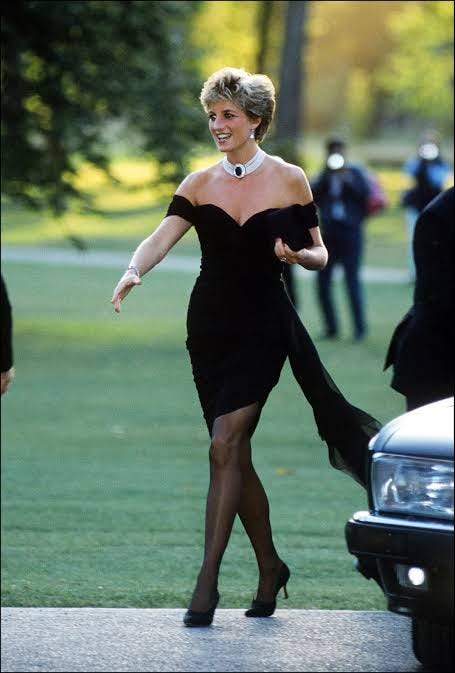
In June 1994, Diana attended a public event wearing a black, off-the-shoulder dress designed by Christina Stambolian.
It was a striking departure from the more restrained image traditionally associated with royal women.
The appearance coincided with a particularly difficult moment in the public breakdown of her marriage.
The dress became an international story.
And over time, it acquired a meaning far beyond fashion.
Independence.
Defiance.
Self-presentation.
Reclaiming control over a public identity.
What interests me is the way Diana communicated through the dress.
She did not need to deliver a statement explaining how she wanted the world to see her.
The clothes did the talking.
During our excavation, Simon recognised something important about this.
Fashion can become a form of authorship.
You choose the image.
You decide how to present yourself.
People interpret what you have created.
That does not mean every outfit is an expression of Autistic Culture.
But Diana’s use of fashion is particularly interesting because it challenged the expectations placed upon her.
THE BODY AS A LANGUAGE
There is a connection between the ‘Revenge Dress’ and the Royal Opera House performance.
Both involved the body.
Both involved public attention.
Both challenged expectations.
And both allowed Diana to communicate something without relying primarily on speech.
The dance said one thing.
The dress said another.
But both demonstrated that Diana could construct her own public image.
In an institution where so much of that image was controlled by others, that mattered.
And it helps explain why her fashion and performances remain cultural artefacts in their own right.
THE CHILDREN, THE DANCING AND THE THINGS SHE LOVED
PASSIONATE SUPERFANNING
One of the more interesting questions in this excavation is how we recognise a passionate interest.
When we talk about Autistic special interests, people often imagine particular subjects.
Trains.
Numbers.
Technology.
Collections.
But passionate interests can take many forms.
They can involve people.
Creative activities.
Communities.
Social causes.
Or subjects that become central to somebody’s sense of purpose.
With Diana, I was interested in three enduring areas of her life.
Children.
Dance.
And humanitarian work.
Before her marriage, Diana worked with children.
After becoming a mother, she developed a particularly hands-on relationship with William and Harry.
And throughout her public life, she repeatedly gravitated towards children in her charitable work.
During our conversation, Simon remembered seeing photographs and footage of Diana playing with her sons.
He recalled an image of her running around with them while dressed in formal clothing.
What Simon remembered was the contrast between the princess and the mother.
A woman expected to maintain a formal public image, and a mother who wanted to play.
A FIND FROM THE EXCAVATION
During the recording, I suggested that children might have been one of Diana’s deepest interests.
Not simply because she was a mother.
But because her enjoyment of children was visible before motherhood became part of her public identity.
Simon and I also discussed the way particular interests can be overlooked when they appear socially conventional.
A woman who loves children may simply be described as maternal.
A woman who loves dance may be described as graceful.
A woman who becomes absorbed in charitable causes may be described as compassionate.
Those descriptions are not necessarily wrong.
But they do not always tell us how important those interests are to the person experiencing them.
We should be careful here.
Loving children is not evidence of autism.
Neither is dancing.
Neither is charitable work.
What interests me is the continuity.
These were not interests Diana acquired simply because somebody handed her a royal job description.
They were visible across different periods of her life.
And they helped shape the way she engaged with the world.
That makes them relevant to Passionate Superfanning as a cultural lens.
THE GIRL WHO DIDN’T FIT THE CLASSROOM
THE QUESTION OF NEURODIVERGENCE
One of the reasons I wanted to explore Diana was a recent public discussion about her possible neurodivergence.
In October 2026, her brother Charles Spencer spoke about his belief that Diana had ADHD.
He also discussed the possibility of dyslexia.
Those observations invite us to reconsider aspects of Diana’s childhood and education.
Diana struggled in formal academic environments.
Her school experience did not produce the conventional achievements that might have been expected of somebody from her background.
And yet, as an adult, she demonstrated considerable ability in areas that mattered deeply to her.
She could establish connections with people.
She could communicate through images and gestures.
She could focus public attention on particular causes.
She could recognise opportunities to challenge established ways of doing things.
That contrast is worth exploring.
But it is important to distinguish different kinds of evidence.
An unsuccessful school experience does not establish ADHD.
Difficulty with examinations does not establish dyslexia.
And neither condition establishes autism.
We also need to remember that Diana’s childhood included significant emotional difficulties and family disruption.
Those experiences can affect learning, attention, confidence, and behaviour.
So this is not a section in which we can confidently identify a particular neurotype.
It is a section about the limits of what conventional education can tell us about somebody.
A DIFFERENT KIND OF INTELLIGENCE
Charles Spencer has also described Diana’s ability to become absorbed in the details of charitable causes.
In discussing her approach, he said:
“I think she cut through the conventional way of looking at causes to see the bits that really mattered.”
That observation interested me.
Because it suggests somebody who did not simply accept the established presentation of a problem.
She wanted to understand what mattered.
Who was affected.
What needed changing.
Where her attention could make a difference.
There are possible connections here to the ways we discuss attention, detail and Pattern Matching in Autistic Culture.
But I would not claim that this establishes Bottom-Up Processing.
We do not have the evidence to describe Diana’s underlying cognitive process with that degree of confidence.
What we do have is a description of somebody who could identify important details and approach problems differently.
And that is worth preserving in the evidence locker.
WHAT THE EVIDENCE DOESN’T TELL US
There is one part of Diana’s story that requires particular care.
Her mental health.
Diana experienced bulimia and spoke publicly about the distress associated with it.
During my research, I wondered whether aspects of her relationship with routine, physical activity or food might connect with Predictably Comforting.
But I want to distinguish a question from a finding.
We cannot establish whether Diana’s eating disorder involved the sensory experiences or needs for predictability that some Autistic people describe.
Eating disorders are complex.
They have multiple possible contributing factors.
And we should not retrospectively reinterpret Diana’s bulimia as an Autistic behaviour without evidence.
Speaking about her experiences, Diana said:
“I was crying out for help, but giving the wrong signals, and people were using my bulimia as a coat on a hanger.”
That image stayed with me.
A coat on a hanger.
Something visible that people could point to.
Something they could use to explain everything else.
And perhaps something that prevented them from looking more closely.
How often do we identify one visible difficulty and allow it to define an entire person?
How often do we mistake distress for character?
And how often do we overlook the environment in which somebody is struggling?
For Diana, that environment included extraordinary public scrutiny, family difficulties, an unhappy marriage and a rigid institution with powerful expectations.
Those circumstances matter.
We cannot separate somebody’s behaviour from the world in which it occurs.
And we should not confuse suffering with Autistic Culture.
THE PROBLEM WITH THE PERFECT PRINCESS
NORM-CHALLENGING · WORLD BUILDING — CULTURAL CONNECTION
There is another aspect of Diana’s story that I find particularly interesting.
The identity she was expected to inhabit.
When Diana became engaged to Prince Charles, she was nineteen.
And almost immediately, the world began constructing an identity for her.
The future queen.
The perfect bride.
The beautiful princess.
The mother of the next generation of royals.
A woman whose purpose was understood before she had fully established an adult identity of her own.
Psychologists sometimes use the term identity foreclosure to describe situations in which somebody commits to an identity before having the opportunity to explore alternatives.
I am not using that term to diagnose Diana.
But I think it offers a useful way to understand the expectations placed upon her.
Diana was given a role. The role came with rules.
How to dress.
How to speak.
How to behave.
How to express emotion.
How to respond to criticism.
How to represent an institution.
How much of herself she was permitted to reveal.
The public wanted the princess, but the woman inside that role was much more complicated.
A FIND FROM THE EXCAVATION
During our conversation, Simon and I explored the tension between a person’s public identity and their private experience.
It is a question we have encountered elsewhere in the Archive.
In our Robbie Williams excavation, we examined the distinction between the public entertainer and the private individual.
With Diana, the circumstances were different.
She was not constructing a stage persona in the same way.
But she was expected to inhabit an extraordinarily demanding public role.
And over time, the distance between that role and her own needs became increasingly visible.
That connection does not establish that Diana was masking in the clinical or Autistic sense.
But it raises a valuable cultural question.
What happens when the world becomes attached to a version of you that you cannot comfortably sustain?
And what happens when expressing your actual needs is treated as a failure to perform the role?
For many neurodivergent people, those questions will feel familiar.
CLOSING THE EXCAVATION
When I began researching Princess Diana, I thought I was going to be examining the life of a woman whose brother had recently suggested she might have been neurodivergent.
I expected to find some interesting connections.
What I found was considerably more complicated.
I found a young woman who entered one of the most traditional institutions in the world and struggled to become the person it expected her to be.
A woman who was supposed to follow the rules.
Maintain the hierarchy.
Preserve the distance.
And represent an institution that had spent centuries deciding how its members should behave.
Instead, I found somebody who repeatedly challenged those expectations.
I found a princess who held the hands of people living with HIV when much of society was afraid to touch them.
I found a woman who visited people affected by leprosy and challenged the stigma surrounding them.
I found a princess walking through a former minefield in Angola, using the world’s fascination with her to draw attention to people whose suffering might otherwise have been overlooked.
I found a dancer who secretly rehearsed a performance at the Royal Opera House.
A woman who stepped onto a stage and surprised an audience that thought it knew exactly how a princess was supposed to behave.
And I found a black dress that became one of the most recognisable statements of independence in British popular culture.
But perhaps the most important discovery came towards the end of my conversation with Simon.
Because we had spent much of the excavation discussing Diana herself.
Her childhood.
Her brother’s belief that she had ADHD.
And the extraordinary pressures she experienced within the royal family.
Simon recognised something important.
There were really two questions.
Was Princess Diana neurodivergent?
And did Princess Diana leave behind a cultural legacy that belongs in the Autistic Cultural Archive?
Those are not the same question.
We cannot know whether Diana was Autistic.
We can consider her brother’s observations.
We can recognise experiences that may feel familiar to neurodivergent people.
But we cannot ask Diana to explain her own experiences.
And we should not turn the difficulties she faced into evidence of a diagnosis we cannot establish.
What we can examine is what she left behind.
The conventions she challenged.
The people she stood beside.
The changes she helped bring about.
And the values that became associated with her public life.
There is also something important about the pain in Diana’s story.
Because so much of her life was shaped by trauma, public scrutiny and enormous expectations.
Those experiences matter.
But trauma is not a Pillar of Autistic Culture.
And I don’t want us to confuse somebody’s suffering with the cultural contributions they made.
I want us to recognise the creativity.
The compassion.
The willingness to challenge rules that didn’t make sense.
And the extraordinary ability to make people who had been excluded feel seen.
Diana once said that she felt an affinity with people who had been rejected by society.
I keep returning to that word.
Affinity.
Because perhaps that is one of the most important things she left behind.
The idea that somebody standing at the very centre of the establishment could choose to stand beside the people it had pushed to the margins.
And that doing so could change the way the rest of the world saw them.
We may never know whether Diana was neurodivergent.
But we can recognise the cultural legacy she created.
That is why I wanted to bring the Legacy of Princess Diana into the Autistic Cultural Archive.
Not to explain who she was.
But to explore what she changed.
ACCOMPANYING EXCAVATOR’S NOTES
Simon Scott
I grew up with Princess Diana as part of the background of British life.
The photographs.
The television coverage.
The newspaper headlines.
And, of course, the extraordinary public response to her death.
I knew who Diana was.
But I’m not sure I fully understood what she changed.
That’s what surprised me about this excavation.
Because when Angela began examining Diana through the Ten Pillars, I started seeing familiar moments differently.
The photographs of Diana holding hands with people living with HIV.
Her visits to communities experiencing exclusion.
Her walk through a former minefield.
These weren’t simply examples of a princess doing charitable work.
They were moments when somebody with enormous public influence challenged the way society treated other people.
And I think that’s where the strongest connections to Norm Challenging, Justice Seeking and Game Changing Innovation exist.
I was also fascinated by the revenge dress.
Because Diana could communicate an entire message without saying anything.
She understood the power of an image.
And she used it.
But the most important distinction for me was between Diana herself and her legacy.
We can discuss whether Diana had ADHD.
We can recognise experiences that might resonate with neurodivergent people.
But we cannot establish her neurotype.
What we can examine is the cultural impact she left behind.
And that impact is extraordinary.
I finished this excavation with considerably more respect for Diana than I had when we began.
Not because I now believe we can explain who she was.
But because I have a much better understanding of what she did.
She challenged hierarchy.
She made compassion visible.
And she helped change what people expected from the monarchy.
For me, that is why The Legacy of Princess Diana belongs in the Autistic Cultural Archive.
CLASSIFICATION
After examining the evidence, we’re filing The Legacy of Princess Diana in the Autistic Cultural Archive.
Not because we can establish that Diana was Autistic.
And not because every aspect of her personality, childhood or behaviour can be explained through neurodivergence.
But because her humanitarian work, creative expression, challenge to established conventions and extraordinary cultural influence reveal substantial connections to the Ten Pillars of Autistic Culture.
The strongest evidence isn’t a single behaviour.
It’s the way the connections interact.
Norm Challenging.
The royal conventions she questioned, the hierarchies she challenged and her refusal to maintain distance from people simply because society expected her to.
Justice Seeking.
Her work with people affected by HIV and AIDS, her relationships with marginalised communities and her campaigning against landmines.
Game Changing Innovation.
The way she transformed public expectations of royal humanitarian work, using her extraordinary visibility to direct attention towards people and causes that needed it.
Boldly Creating.
Her love of dance, her use of fashion as communication and her ability to express identity through movement, performance and public imagery.
Passionate Superfanning.
Her enduring interests in children, dance and humanitarian causes, and the way those interests helped shape her relationships and public life.
And through all of it, a woman who repeatedly challenged the expectations of an institution built around tradition, hierarchy and conformity.
The Archive also contains an important distinction.
Diana’s possible neurodivergence remains an open question.
Her brother has publicly discussed his belief that she had ADHD, and there are aspects of her life that may resonate with Autistic and neurodivergent experiences.
But we cannot establish her neurotype retrospectively.
And we do not need to.
Because the Autistic Cultural Archive is not a collection of people we believe were secretly Autistic.
It is an exploration of the cultural artefacts, contributions, traditions and values that connect with the Ten Pillars of Autistic Culture.
Diana’s life contained extraordinary difficulties.
But her trauma is not what earns her a place in the Archive.
It is the cultural legacy she left behind.
The conventions she challenged.
The people she helped make visible.
And the changes she helped bring about.
ARTEFACT: THE CULTURAL LEGACY OF PRINCESS DIANA
CLASSIFICATION: AUTISTIC CULTURE
PRIMARY PILLARS: Norm Challenging · Justice Seeking · Game Changing Innovation · Boldly Creating · Passionate Superfanning
ADDITIONAL TRACES: Predictably Comforting · Rhythmic Communicating
ARCHIVE NO.: ACA-005-PRINCESS-DIANA
LEAD EXCAVATOR: Dr Angela Kingdon
ACCOMPANYING EXCAVATOR: Simon Scott
STATUS: Excavation Complete
The Legacy of Princess Diana: An Autistic Culture Artefact.
SUBMIT YOUR EVIDENCE
An archive is never finished.
So now we’re handing the brushes to you.
What did we miss?
Do you remember Princess Diana?
Did her challenge to royal conventions change the way you thought about the monarchy?
Do you remember her work with people affected by HIV and AIDS, or her campaign against landmines?
And what about her creative expression?
Did her fashion, her love of dance or the famous revenge dress communicate something that words couldn’t?
Do you recognise connections between Diana’s legacy and your own experiences of Norm Challenging, Justice Seeking or Boldly Creating?
And perhaps the biggest question of all.
Can somebody leave behind a legacy of Autistic Culture without us knowing whether they were Autistic?
Which Pillar do you think appears most strongly?
And is there another moment from Diana’s life that belongs in our evidence locker?
Leave your field notes in the comments.
The Archive is never finished.