
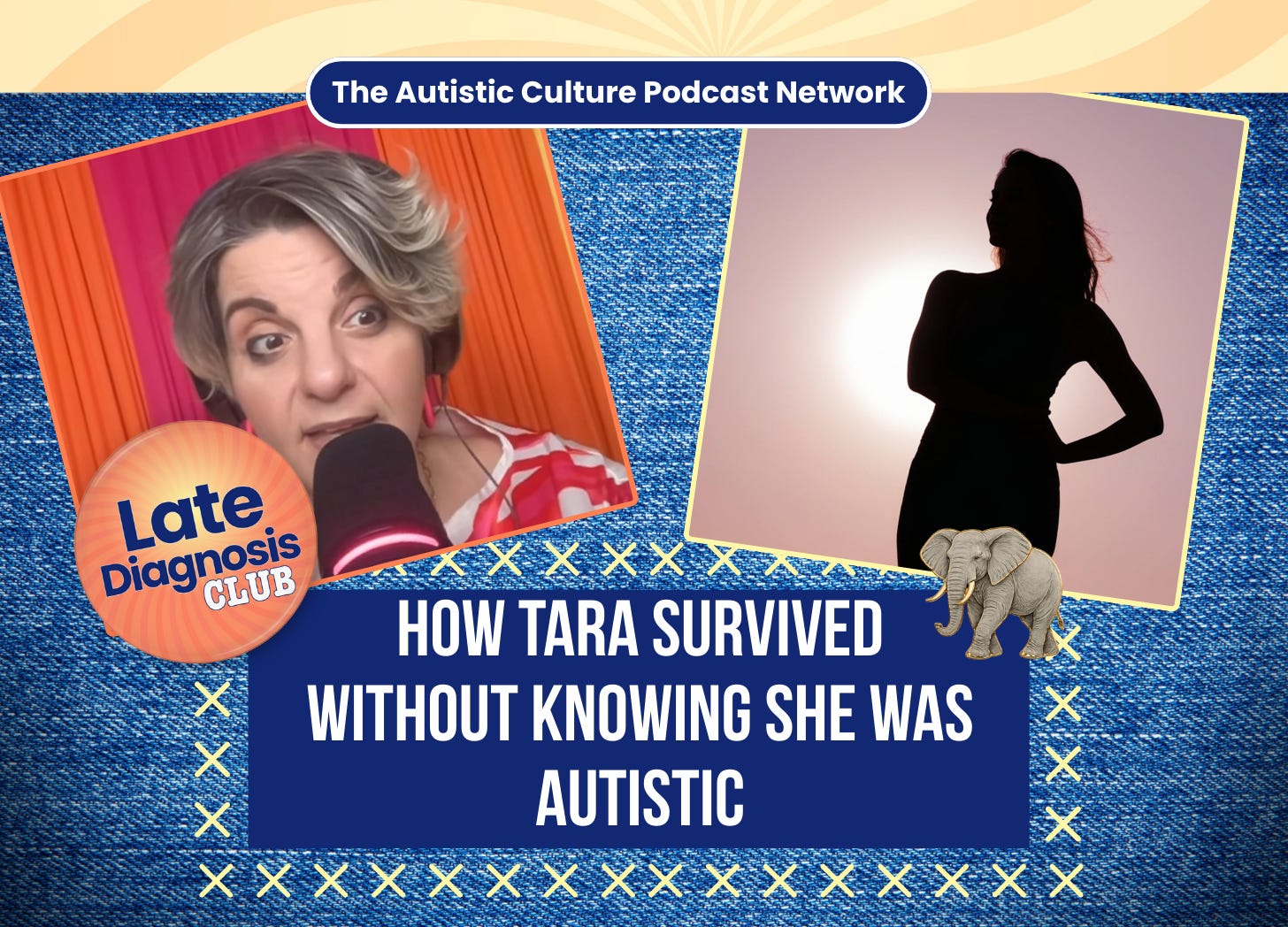
In this meeting of The Late Diagnosis Club, Dr Angela Kingdon welcomes Tara for one of the most difficult and important conversations the Club has held.
⚠️ Content notice: This episode includes discussion of violence, sexual abuse, child harm, and coercive control. Listener discretion is strongly advised. Please pause or skip as needed and take care of yourself.
Tara is a late-diagnosed Autistic woman, a mother, and a survivor of severe childhood abuse, abduction, and exploitation. She shares her story not for shock, but to illuminate how Autistic girls and women are uniquely vulnerable — especially when they grow up without protection, language, or recognition of their neurodivergence.
Together, Angela and Tara explore survival as an Autistic trait, truth-telling as both a strength and a liability, vulnerability to cults and exploitative systems, and the long road to healing through prolonged exposure therapy. Tara’s story is harrowing — but it is also a testament to resilience, instinct, and the life-saving power of being believed.
🎧 Listen to this episode:

🪑 Attendees
Chair: Dr Angela Kingdon — Author, community-builder, and Autistic advocate
Guest: Tara — late-diagnosed Autistic woman, mother, and survivor
You: The Listener!
🗒️ Meeting Agenda
Opening remarks from the Chair
Member introduction: Abuse, abduction, and survival
Discussion: Autistic vulnerability and coercive control, misdiagnosis, and being labelled a liar
Cults, self-help movements, and exploitation
Prolonged exposure therapy and Late autism self-recognition
Key learnings
Club announcements
🧾 Minutes from the Meeting
1️⃣ Opening Remarks
Angela opens the meeting with a clear trigger warning and an explanation of the safeguards taken to ensure this conversation was shared safely and consensually. This episode is framed as difficult — but necessary — for Autistic people, particularly women and girls, whose experiences of abuse are often misunderstood or erased.
2️⃣ Member Introduction: Tara’s Story
Tara describes knowing she was different from early childhood — hyperlexic, highly intelligent, sensory-sensitive, and deeply compliant. As a CODA, she was placed in adult responsibilities far too young, acting as her mother’s ears while navigating an unsafe home environment.
Family members responded to her Autistic traits with punishment and violence rather than protection. Tara was repeatedly locked away, beaten, and labelled with slurs — experiences that primed her for later exploitation.
At 14, Tara was abducted by adults known to her family. She was held, tortured, and left for dead. No search party was launched. No justice followed. Tara survived through instinct, dissociation, and an extraordinary will to live.
3️⃣ Discussion Highlights
Autistic vulnerability: How isolation, compliance, and literal trust increase risk
Survival instincts: Autism as a tool for endurance and escape
Misdiagnosis: Repeatedly labelled with personality disorders
Cults and self-help: Seeking safety and meaning in exploitative systems
Prolonged exposure therapy: Ten years of structured trauma processing
Late autism recognition: Finding language after decades of harm
Motherhood: Love, rupture, and intergenerational neurodivergence
Justice: Living without it — and learning how to go on
4️⃣ Key Learnings
Autistic girls are especially vulnerable when their differences go unprotected
Being articulate does not prevent exploitation
Truth-telling can be punished in unsafe systems
Misdiagnosis can cause as much harm as no diagnosis
Self-diagnosis can be life-saving
📣 Club Announcements
🎧 The Late Diagnosis Club is available on Spotify, Apple Podcasts, and all major platforms.
💬 Join our online meetups and community at latediagnosis.club.
📌 Check the LDC Notice Board for Member Contributions
💜 There is a small charge — but no one is turned away for lack of funds.
💌 Want To Be Our Next Guest?
If you’ve been nodding along and thinking, “That could be my story,” we want to hear from you.
We’re always looking for late-diagnosed or self-identified neurodivergent adults who are ready to share their story on The Late Diagnosis Club.
Tell us a little about yourself and your diagnosis journey here:
💜 Whether you’ve just realised you’re Autistic, ADHD, dyslexic, or you’re still figuring it out — your story belongs here. We’ve saved you a seat.
💫 Why Your Support Matters
When you join Autistic Culture Plus or pitch a show to the Autistic Culture Podcast Network, you’re doing more than subscribing to a podcast —
You’re investing in Autistic-led media.
Included with Autistic Culture Plus
• Ad-free listening (sensory-friendly)
• Early access to every episode
• Exclusive archive of ~100 classic episodes
Every pound, dollar, or share helps:
🎙️ Fund neurodivergent creators — paying Autistic hosts, editors, and producers for their work
🌍 Amplify Autistic voices and stories that mainstream media too often overlooks
💡 Build an ecosystem of culture, not pathology — where being Autistic is celebrated, not “treated”
🤝 Support accessible, sensory-friendly storytelling made with our community in mind
For less than the price of a coffee, you help sustain a growing network that’s 100% by and for neurodivergent people — ensuring that Autistic stories, creativity, and brilliance reach the audiences they deserve.
Joining isn’t just a subscription.
It’s solidarity. Visibility. Community in action.
💜 With Gratitude
A huge thank-you to our founding supporters of Autistic Culture Plus, who believed in this network before it even launched.
Our Executive Producers and Producers make this work possible — funding neurodivergent creators, amplifying Autistic voices, and helping build a media ecosystem rooted in pride, creativity, and community.
These members form the foundation of the Autistic Culture Podcast Network, and you’ll see their names credited at the end of our shows and on our website.
🎙️ Executive Producers
Amy Burns, Anamaria B Call, Andrew Banner, Anna Goodson, Ashley Apelzin, Audrea Volker, Ben Coulson, Brian Churcek, Cappy Hamper, Carley Biblin, Charlene Deva, Chloe Cross, Clay Duhigg, Clayton Oliver, Danny Dunn, Daria Brown, David Garrido, Emily Burgess, Eric Crane, Erik Stenerud, Fiona Baker, Grace Norman, Helen Shaddock, Jaimie Collins, Jason Killian, Jen Unruh, Jennifer Carpenter, Julia Tretter, Kathie Watson-Gray, Kenneth Knowles, Kira Cotter, Kristine Lang, Kyle Raney, Llew P Williams, Laura Alvarado, Laura De Vito, Laura Provonsha, Lily George, Nelly Darmi, Nigel Rogers, Rachel Miller, Tim Scott, Tyler Kunz, Victoria Steed, Yanina Wood.
🎧 Producers
AJ Knight, Bobby Simon, Da Kovac, Eleanor Collins, Emily Griffiths, Hannah Hughes, Jennifer Kemp, Jonas Fløde, Kate F, Katie N Benitez, Kendra Murphy, Lisa Dennys, Logan Wall, Louise Lomas, Melissa Nance, Nicola Owen, Rebecka Johansson, Sam Morris, Sarah Hannah Morris.
Really profound work here. The connection between autistic traits like truth-telling and literal trust being weaponized against vulnerable girls is something I've seen play out in my own family dynamics, where being 'too honest' was always framed as the problem rather than teh unsafe systems. What makes this even more crucial is how misdiagnosis creates a secondary layer of harm by stripping away the exact language needed to seek real support.
Yeah it was a wild experience to explain just a few snippets of how I came to realize my late in life diagnosis. If you know Elyse Myers from YouTube, she reminds me of how I came to my own realization. My life story has a lot of content and to only have a few minutes to highlight the one or two areas was hard for me. Thank you for listening.