


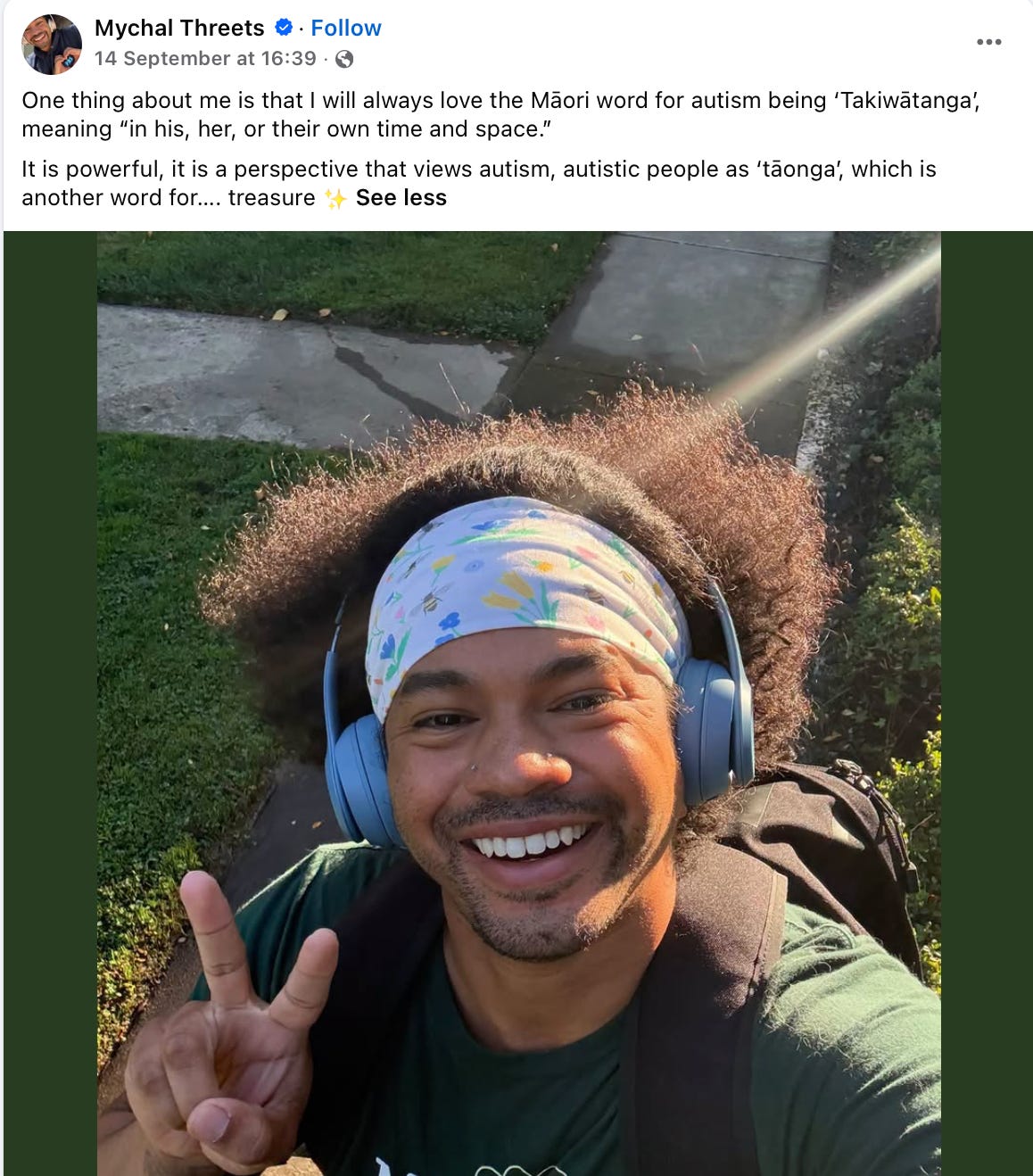
I’m a Library Kid and a Reading Rainbow Baby. If there were a Mychal Threets fan club presidential election, I would be in the running, but Mychal, like so many others, has glomed on to the idea Takiwātanga is the Māori word for autism. It’s a great word, with a great meaning, but it’s really not the Māori word for autism. It is A word for autism: one, in fact, invented recently by a non-autistic person.
In December of 2024, we made an episode of the Autistic Advocacy show on ACPN called Takiwātanga Tension which provided a break down of this term
Finally, a new study from Aotearoa New Zealand is challenging something that appears on government, health, education, and Autism websites: the idea that takiwātanga is simply the Māori word for Autism.
The study, published September 12 in the peer-reviewed journal Neurodiversity, looks at takiwātanga, a te reo Māori (Māori language) word meaning ‘in my/his/her/their own time and space’, as a way to think about autism without colonial ideas. The diagnosis of autism spectrum disorder can make autism seem like a problem, but takiwātanga comes from Māori ways of thinking that see difference as natural and important. Keri Opai coined the word takiwātanga in 2017 from older Māori words. Many people use the word, but there is not much written about what it means.
As we discussed on our episode, the term meaning “my/his/her/their own time and space” was coined by non-autistic Māori linguist and educator Keri Opai in 2017 while developing Te Reo Hāpai, a glossary for the mental health, addiction, and disability sectors.
The new paper develops that argument through what the researchers call a “polyvocal dialogic enquiry.” The four authors occupy different positions in the discussion. Newcombe is an Autistic Pākehā woman. Thomas is Māori and non-disabled. Tawa is Māori and takiwātanga. Amundsen is a non-Autistic Pākehā academic. “All authors agreed that takiwātanga is not a translation of autism,” they write.
Nicolina Newcombe, Tania Thomas, Maioha Tawa, and Diana Amundsen describe takiwātanga as a concept grounded in Māori understandings of difference, relationships, ancestry, and belonging. Autism, by contrast, entered Aotearoa through a Western medical system that classified particular characteristics as symptoms of a disorder.
They do not claim to speak for all Māori people or all people who identify as takiwātanga. They describe their work as a situated conversation in which Māori knowledge retains cultural authority.
“Takiwātanga has nothing to do with autism, and vice versa,” educator Dorothy Taare-Smith said in earlier research quoted by the authors.
While Opai is not Autistic, he consulted Autistic Pākehā, including his lifelong friend Peter Galvin and Autistic leader Matt Frost, as well as clinicians. According to the paper, he did not consult Māori people whom Western medicine would describe as Autistic.
From the perspective of Autistic self-advocacy, that can look uncomfortable. Autistic communities have spent decades arguing that language about Autistic people should not be created without us.
Newcombe raised exactly that problem during the researchers’ discussion.
Thomas offered a different cultural framework. In te ao Māori, she explained, creating a new Māori name is not necessarily a matter of asking the people being named to translate an existing Western category. Language specialists work from the values and meaning surrounding a concept and determine how it should be understood within Māori knowledge.
Opai put the question more directly in a May 2026 communication quoted in the study: “We, Māori people are the right ones to be making these decisions.”
Tawa, the Māori takiwātanga author, added another complication.
“The name is not for the disabled person; the name is for the one who is looking at them and saying they are different,” she said. “I am my normal.”
A medical diagnosis identifies characteristics located within an individual. The researchers describe takiwātanga as relational. The person exists within whakapapa, the network of genealogy and relationships connecting people to whānau, ancestors, and community.
The paper traces some of that difference to Māori understandings of disability before and after colonisation. Drawing on previous Māori scholarship, the authors describe Western disability categories as imported concepts that do not map neatly onto te ao Māori. Māori frameworks have historically understood wellbeing across physical, mental, spiritual, and relational dimensions rather than locating difference exclusively inside an individual body or brain.
Thomas describes Māori thought as allowing multiple truths rather than requiring every difference to fit opposing categories. Tawa illustrates this with Matariki, the star cluster whose number of recognised stars differs among regions and iwi. One account does not have to invalidate another.
“Takiwātanga is an acknowledgement of our differences,” she says.
The paper does not suggest that takiwātanga should simply replace Autistic everywhere.
Newcombe does not use the word for herself. Although she describes seeing its international appeal, including an American Autistic friend who has takiwātanga tattooed on her wrist, she continues to identify as Autistic because that is the community to which she feels connected.
The Māori authors nevertheless leave open the possibility that non-Māori people may use the term.
Thomas says she sees no reason to prevent people who connect with takiwātanga from embracing it. Tawa agrees, with a condition: people using it should learn where the word comes from and what it means.
That becomes more difficult as the word travels.
A Māori concept can be adopted internationally precisely because its English gloss, “in their own time and space,” is immediately attractive to Autistic people who have spent their lives being measured against someone else’s time, social expectations, developmental milestones, or ideas about normality.
Near the middle of the study, Tawa describes receiving her own assessment. She remembers its language as telling her that she was broken, and she did not want to tell people about it.
Takiwātanga gave her another way to name what the clinicians had named.
“If I were diagnosed as takiwātanga,” she said, “that would be something I would embrace instead of running away from.”
Reading Rainbow host, Mychal Threets was diagnosed as Autistic quite recently (in April 2026) and I am so happy he found a word explaining his diagnosis to fully embrace, but I still think understanding the background of this term is helpful context to have.