


Bella Mason and Kate M. Witt wanted to understan: How do you best teach an Autistic child music?
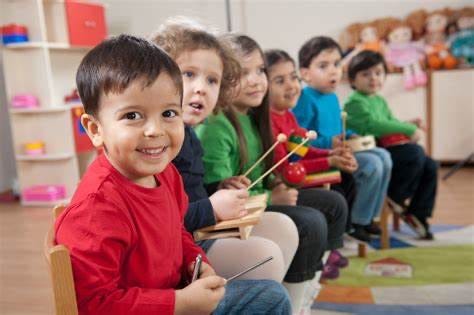
Mason, a music tutor who has adapted instruction for Autistic students, and Witt, an Autistic researcher, published their systematic review online September 8 in Update: Applications of Research in Music Education. Out of 1,011 studies on autism and music only 21 texts that met their criteria.
That number tells part of the story.
Music and Autism have been studied together for decades. The relationship has frequently been therapeutic. Researchers have asked whether music might improve communication, social interaction or other characteristics associated with Autism.
Mason and Witt wanted to know what happens when the purpose of music is just music.
They write that music education has been “frequently overlooked” in discussions about supporting Autistic students and that existing research commonly approaches music as therapy or intervention. Their review instead adopts a neurodiversity-affirming framework, one that locates at least some of the difficulty Autistic people encounter in unaccommodating environments.
The distinction changes the child’s role.
A child receiving music therapy is participating in an intervention with goals beyond the music itself. A child in band, choir or music class may be there because she wants to play the trumpet.
The researchers found eight broad areas in which music educators could make that possible, including predictable routines, visual supports, adapted instruction, thoughtful repertoire choices, peer interaction and sensory-aware environments. They recommend clear and literal language, additional processing time and reducing unnecessary noise, visual clutter and physical barriers.
Some recommendations are strikingly ordinary.
Give students a printed schedule. Tell them when performances and deadlines are coming. Use visual clocks or timers to make transitions easier to anticipate. Allow additional time to process an instruction. Make music vocabulary available on a student’s AAC system.
The paper also notes evidence that the music itself usually does not need to be segregated. One practitioner source concluded that repertoire commonly used with non-Autistic students was generally appropriate for Autistic students, with adaptation where necessary.
That places the burden of adaptation somewhere interesting.
The violin does not have to become an Autism intervention. The classroom has to become accessible enough for the Autistic violinist.
Music classrooms present a particularly complicated test of that idea because sound is both the point and a potential access barrier. Ensembles can involve overlapping instruments, sudden changes in volume, fluorescent rehearsal rooms, verbal directions delivered over background noise and the social coordination of performing with other people.
Mason and Witt found recommendations including reduced sound levels, less visual clutter, softer lighting and access to noise-cancelling headphones. They also stress individual variation. Autistic sensory profiles differ, and a modification useful to one student may be irrelevant or counterproductive for another.
The review becomes more interesting when the authors examine who has been producing the knowledge.
Of the 21 texts that survived their screening, only ten were empirical studies. The others were practitioner guides. Among the empirical work, several studies examined educators’ experiences. Only a few incorporated the perspectives of Autistic students themselves. Among the literature reviewed, only one author identified lived experience as an Autistic researcher and music educator.
Mason and Witt therefore end up identifying a problem inside the research they are synthesising.
Researchers have been developing recommendations for Autistic music students without much evidence about how those students experience the recommendations.
The authors call for future research to use participatory and co-design approaches that meaningfully involve Autistic students and Autistic researchers.
There are other reasons to be cautious about turning the review into a rulebook. The evidence base is small. Many recommendations come from practitioner literature rather than large empirical studies. The authors say the existing evidence does not allow them to compare the relative effectiveness of the different strategies, and they call for larger longitudinal and mixed-methods research.
For much of Autism research, creative activity has attracted scientific attention because of what it might reveal, teach or change about an Autistic person. Art becomes art therapy. Theatre becomes social-skills practice. Music becomes a tool for producing another outcome.
There is nothing inherently wrong with therapeutic uses of music for people who want them. The cultural question changes when therapy becomes the principal lens through which Autistic participation is imagined.
An Autistic child can also want to be in orchestra because orchestra is where the cellos are.
The review contains a small detail that captures the difference. Mason and Witt recommend putting music-related vocabulary into the AAC systems of students who use them: symbols and words for instruments, songs and classroom activities, so the student can communicate during music class.
The communication system is being adapted so the Autistic student can participate in the music.
The music does not have to fix the Autistic student.