


Psychologists have spent decades studying why Autistic people flap our hands, rock, pace, repeat movements, touch objects or make sounds.
A new study asked a different question: What if some of those movements are part of who we are?
Amy Pearson of Durham University, Helen Knight of the University of Aberdeen, Ray Winter of Durham, Autistic researcher Kieran Rose and Jon Rees of the University of Sunderland interviewed 103 people about self-concept: 51 Autistic people, 10 neurodivergent people who were not Autistic and 42 neurotypical people.
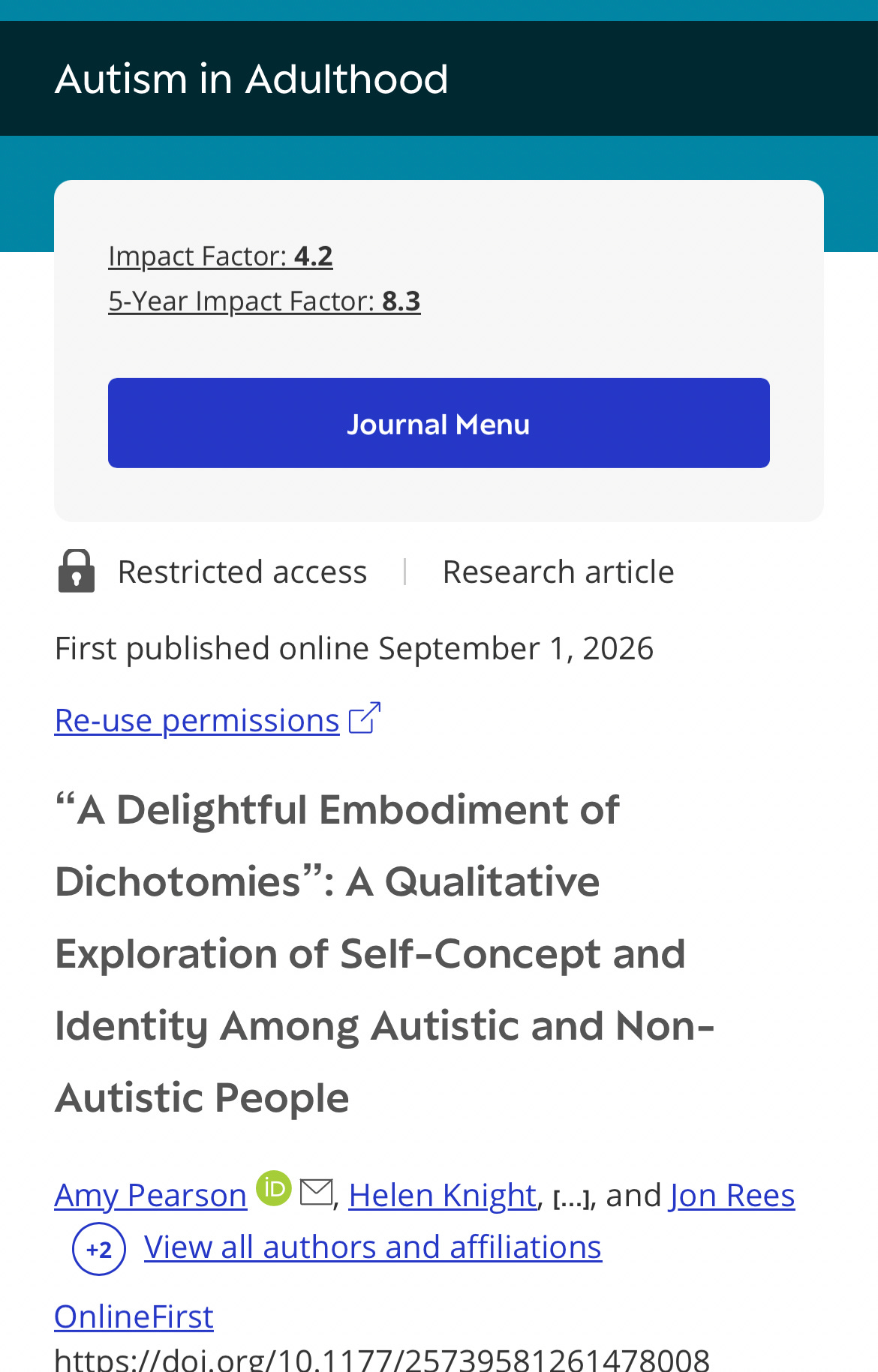
Their study, “A Delightful Embodiment of Dichotomies”: A Qualitative Exploration of Self-Concept and Identity Among Autistic and Non-Autistic People, was published online September 1 in Autism in Adulthood. Pearson and Rose are identified as Autistic researchers by the Autistic Autism Scholarship Project. (Sage Journals)
The researchers were interested in something broader than Autistic identity. They wanted to know how Autistic people understand the self.
Participants could answer interview questions in writing or speech. They were also invited to submit an artifact, such as a photograph or drawing, representing who they were.
The researchers identified three themes.
One came from a participant who wondered whether “the idea of the self might be one of those neurotypical things.”
It wasn’t.
The neurotypical participants also struggled to define themselves.
Across groups, people described selfhood as complicated, changing and dependent on context. Neurodivergent participants generally considered knowing they were neurodivergent important to understanding themselves, although it was not necessarily the most important thing about them.
That finding aligns with Pillar 2 of Autistic Culture which is “Rhythmically Communicating.” Listen to the full podcast episode here:
In the study’s third theme, “Unapologetically me,” Autistic participants described authentic expression as embodied. Being able to stim freely could be part of being themselves.
The researchers make the significance of this finding unusually explicit in their community brief. Stimming and interests, they write, can be “core to autistic self-concept.” They say the role of stimming can extend beyond validation or self-regulation because it can be part of who an Autistic person is. (Sage Journals)
That places a familiar Autistic behavior in unfamiliar territory.
Stimming has acquired several explanations over the history of Autism.
Within a deficit framework, repetitive movement became one of the behaviors by which Autism could be identified. The clinical language survives in diagnostic descriptions of restricted and repetitive behaviors.
Autistic accounts have added considerably more information. People stim because it feels good. We stim when excited. We stim when distressed. Movement can help regulate sensory input or emotion. Some stims help us concentrate. Others express joy.
The Pearson study adds another possibility.
Sometimes the movement is us.
That distinction becomes easier to see outside Autism.
Nobody requires a dancer to demonstrate that movement serves a regulatory function before accepting movement as self-expression. We understand that people have characteristic gestures, postures and ways of inhabiting their bodies. People communicate identity through clothing, hair, voice, facial expression and movement.
Autistic bodies have often been interpreted through a different vocabulary.
A hand movement can become a symptom. Pacing becomes repetitive behavior. A sound becomes a vocalization. An intense attachment to an interest becomes a restriction.
The researchers found that Autistic participants’ ability to express themselves was also shaped by what happened when other people saw those expressions.
Social power runs through the study.
Autistic and other neurodivergent participants described negative judgments that affected their ability to know and express themselves. The consequences they feared were sometimes severe. The researchers report that participants considered how being judged by other people could affect employment, relationships and, for some, even the possibility of having their children taken away. (Sage Journals)
Authenticity therefore existed within constraints.
An Autistic person may experience a movement as an expression of self while simultaneously calculating whether the person watching considers it inappropriate, unprofessional, childish or evidence of incapacity.
That calculation is familiar territory for research on masking. Pearson and Rose co-authored Autistic Masking: Understanding Identity Management and the Role of Stigma in 2023, and the new paper builds on a body of research examining the social consequences of appearing visibly Autistic. (Sage Journals)
Here the question shifts slightly.
Suppressing a stim may remove something from view. If stimming forms part of self-expression, suppression can also alter how much of the self is permitted into the room.
The study does not establish that every stim carries identity meaning for every Autistic person. It does not claim that regulation has ceased to matter. Its participants cannot represent the full Autistic population; the authors specifically note the limited representation of Autistic people with learning disabilities. Qualitative research of this kind describes how participants understand their experience rather than measuring how universally those experiences occur. (Sage Journals)
There is another useful complication in the findings.
Autism was important to many participants without consuming their identities.
The researchers found that people understood themselves through multiple parts of their lives and social worlds. An intervention intended to foster positive Autistic identity, they argue, should allow people to explore what being Autistic means to them and how it fits alongside everything else that makes them who they are. (Sage Journals)
That is a more expansive idea of Autistic identity than exchanging a negative clinical description for a positive one.
People learn culturally intelligible ways of greeting, looking, touching, sitting, dressing, celebrating and expressing emotion.
Autistic Culture is expressed through our bodies.