


Welcome to This Week in Autistic Culture
This week, Angela and Simon dive into new research about Autistic traits and romantic relationships — and find themselves questioning some of the assumptions behind it.
From attachment styles and relationship maintenance to masking, regulation and the need for connection, they explore what happens when Autistic experiences are measured against expectations that may not have been designed with Autistic people in mind.
It’s time to open the vaults for our brand-new segment: The Autistic Culture Archive!
Each week, Angela and Simon will become cultural archaeologists, excavating a film, book, musician, fandom, hobby or cultural figure and using the Ten Pillars of Autistic Culture to uncover the Autistic fingerprints hiding in plain sight.
First into the archive is The Rocky Horror Picture Show
And if our first excavation leaves you wanting to dig deeper, every entry in the Autistic Culture Archive will have its own Field Report, bringing together the research, evidence, rabbit holes and connections we couldn’t squeeze into the show — and inviting you to add your own field notes to an archive that is never truly finished
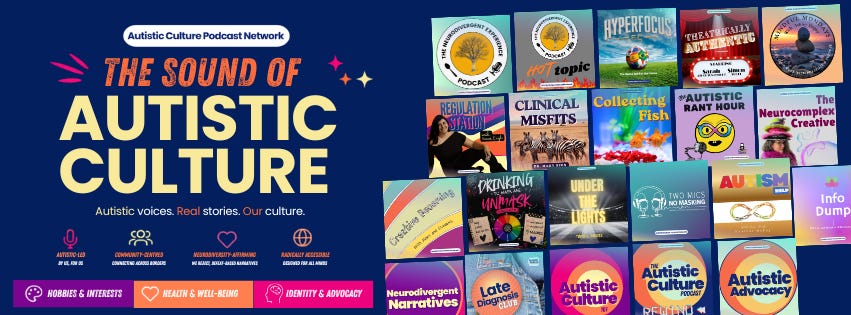
As always, we’ll take you through everything coming up across the Autistic Culture Podcast Network this week!
This Week’s Topics:
Strange Journey: The Story of Rocky Horror:
📻 On Air This Week:
Monday 5th October
Mindful Mondays with Ashley Dupuy
Ashley returns with another mindful reflection and guided meditation to help neurodivergent listeners begin the week with intention and regulation.
The Still Growing Up Film Club - Episode 6: How to Be You and Find Your People with Matilda
In the Season One finale of The Still Growing Up Film Club, Cece Fanning revisits the beloved 1996 film Matilda to explore belonging, justice, community and the families we find for ourselves.
Growing up in a family that neither understands nor appreciates her, Matilda learns to rely on herself from an extraordinarily young age. But through books, school, friendship and eventually Miss Honey, she begins to discover something different: there are people in the world who will value you precisely for the things that make you different.
Tuesday 6th October
Autistic Standpoint Theory - Episode 4: Autism, Identity & the Science of Being Seen
In the final episode of Autistic Standpoint Theory, Isha Snow is joined by psychometrician, mixed-methods researcher and autistic self-advocate Scott Frasard, PhD, to explore what happens when an autistic researcher turns the tools of measurement back towards the systems attempting to measure autistic people.
Scott discusses how being autistic shapes the way he approaches research, including his ability to recognise patterns, contradictions and assumptions that others may overlook. Together, he and Isha explore psychometrics, research methodology, autistic participation in research and why lived experience matters when deciding what questions get asked in the first place.
Wednesday 7th October
The Neurocomplex Creative - Season 2 Episode 5: Lucy Lane’s Story
In this episode of The Neurocomplex Creative, Vicki Peterson sits down with her daughter, Lucy Lane, a young actor, singer and musical theatre performer beginning her professional career in New York City.
Lucy reflects on growing up as a child actor in Hollywood, discovering acting techniques that helped her feel more grounded, and what she’s learning about building a creative life around a brain and body that don’t always work like everyone else’s. She and Vicki discuss EDS, dysautonomia, advocating for invisible needs and navigating the physical demands of professional performance without allowing a medical record to define what’s possible.
Clinical Misfits - Season 2 Episode 4: What If Your Neurological Symptoms Can’t Be Explained? | Functional Neurological Disorder
In this episode of Clinical Misfits, Dr Mary explores functional neurological disorder (FND), a term used to describe neurological symptoms that can include changes in sensation, speech and movement, paralysis and seizure-like episodes. She questions the language historically used to describe these experiences and what happens when unexplained symptoms are too readily dismissed as psychological or “all in your head.”
Dr Mary considers the relationship between these symptoms, the autonomic nervous system and trauma, particularly for neurodivergent people whose lives may include experiences of bullying, rejection, chronic illness, pain and other forms of trauma. She also discusses approaches used to manage symptoms, from medication and trauma therapies to sensory regulation, movement and other forms of self-care.
Thursday 8th October
The Neurodivergent Experience - Episode 131
Jordan James and Simon Scott return for a conversation about the Neurodivergent Experience!
📚 From the Archive - Friday 9th October
Autistic Culture Podcast Rewind – Cats is Autistic
In this episode of The Autistic Culture Podcast, hosts Dr Angela Kingdon and Matt Lowry, LPP, draw connections between the behaviours and traits exhibited by cats and the common experiences of autistic individuals.
Please rate, share and review our shows, as it helps them grow and reach more people! ⭐⭐⭐⭐⭐
🎧 Autistic Culture Radio
Looking for a different way to experience ACPN? Autistic Culture Radio is our curated Spotify listening experience, blending music with every programme released across the Autistic Culture Podcast Network.
Updated daily, each episode pairs carefully chosen songs inspired by its themes, creating a continuous soundtrack to Autistic culture. Save the playlist to your Spotify library and dip in whenever you want to discover new conversations, music and voices from across the network.
Want bonus content, early access, and ad-free listening across the entire network?
Join Autistic Culture Plus to support autistic creators and help us commission even more shows from our community.